Amazon’s AI Shopping Assistant Is Now Alexa for Shopping. Here’s What Enterprise Sellers Should Change
If all you heard was that Amazon swapped Rufus for Alexa, you missed the part that matters. The Amazon AI shopping assistant that took over on May 13, 2026 sits in the search bar every shopper already uses, and it changes what you pay for, what shows up in your reports, and what price a… The post Amazon’s AI Shopping Assistant Is Now Alexa for Shopping. Here’s What Enterprise Sellers Should Change appeared first on SellerApp Blog.
Source Lens
Industry Context
Useful background context, but lower-priority than direct platform, community, or operator intelligence.
Impact Level
medium
Use this briefing to decide whether your team needs an immediate workflow, policy, or reporting change.
Key Stat / Trigger
No single quantitative trigger surfaced in this report.
Focus on the operational implication, not just the headline.
Full Coverage
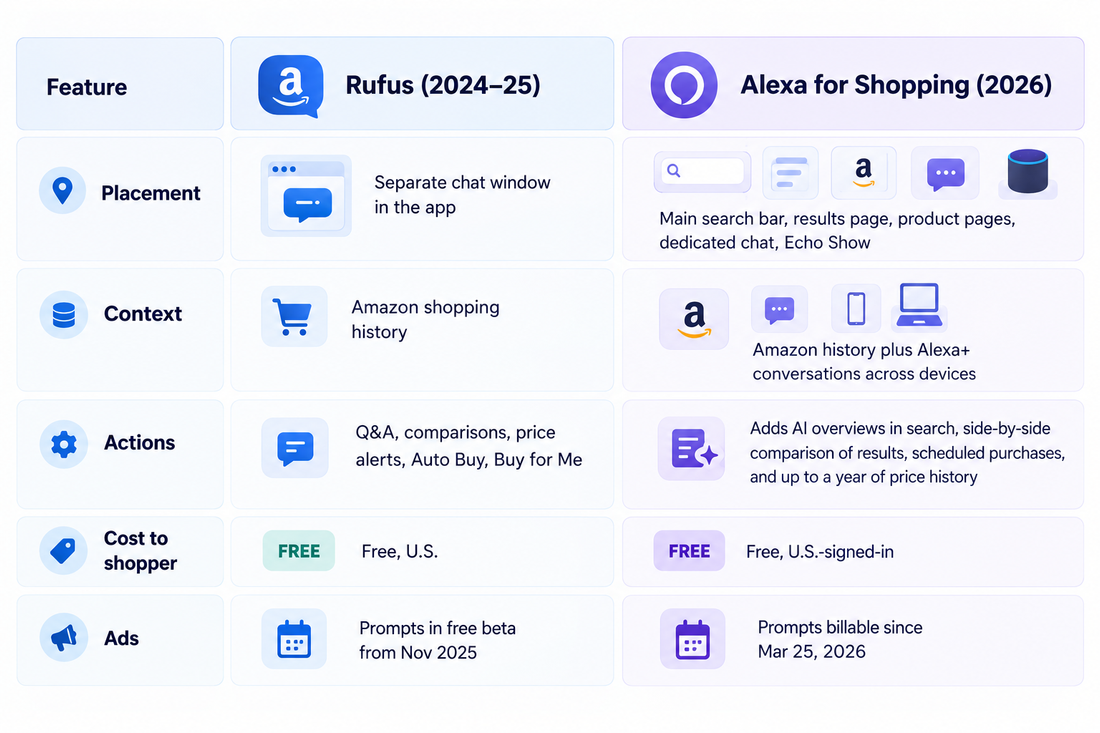
If all you heard was that Amazon swapped Rufus for Alexa, you missed the part that matters. The Amazon AI shopping assistant that took over on May 13, 2026 sits in the search bar every shopper already uses, and it changes what you pay for, what shows up in your reports, and what price a customer might buy at. Rufus lived in a side chat window.
Its successor lives in the search bar every shopper already uses. Alexa for Shopping, the Amazon AI shopping assistant that replaced it, sits in the main search bar, remembers what shoppers told Alexa in the kitchen, and will happily place an order the moment your price dips below a number you never got a vote on.
For a seller running hundreds of SKUs, three things landed at once. The assistant moved from a side chat into the results page, it can transact without a human at the decision point, and ads inside it became billable in March. The off-Amazon story changed too. Much of what was published about AI shopping agents in January no longer holds.
This article covers what the Amazon AI shopping assistant does, how it likely decides what to recommend, where your ad and pricing exposure sits, and which numbers in circulation deserve your trust. Quick GuideWhat the Amazon AI shopping assistant that replaced Rufus actually doesWhat agentic commerce can now do for shoppers?
Where Copilot, ChatGPT, and Google fit into this AI shopping assistants: who runs them and what each means for a sellerHow the Amazon AI shopping assistant decides what to recommendHow Ads work with AI shopping experienceYour price history is now an adFinal ThoughtsFAQs What the Amazon AI shopping assistant that replaced Rufus actually does Alexa for Shopping is Amazon’s agentic AI shopping assistant.
It merged Rufus and Alexa+ on May 13, 2026, appears in Amazon search results pages and product detail pages, and is free for any signed-in U. S. customer with no Prime membership or Echo device required. Amazon says Rufus reached more than 300 million customers in 2025.
On the Q2 2026 call, Andy Jassy, the president and CEO of Amazon, said more than 350 million shoppers had used Alexa for shopping over the trailing 12 months, with active users nearly doubling in the quarter. The placement change matters more than the rebrand. A feature that sat beside the shopping path now sits in the middle of it.
What agentic commerce can now do for shoppers? The shopper-side capabilities are mostly straightforward, and every competitor has covered them. Four of them touch your P&L, so they get the detail here: Price alerts and auto-buy A shopper sets a target price, and Amazon orders at or below it using the default payment method.
Amazon’s help page lists Auto Buy as available only for items Fulfilled by Amazon. Press coverage also reports that Auto Buy requires Prime and that coupons and promotional discounts don’t apply to it. The shopper can cancel within 24 hours of the order.
Price history Shoppers can see up to a year of price history, Amazon extended the tracker to 365 days on June 30. Recurring and scheduled purchases This is for repeat-buy categories, plus reordering from past purchases. Buy for Me For products Amazon doesn’t sell, Amazon’s agent completes the purchase on the brand’s own site.
It sits on top of Shop Direct, which Amazon says now indexes over 100 million products from more than 400,000 merchants, with tens of millions buyable through Buy for Me. That last item deserves a look from any brand with a DTC store. Shop Direct products appear in Amazon searches whether or not you set anything up.
Amazon states there’s no referral fee today, and brands that want out have to request removal by email. Search your top brand terms on Amazon and check what’s already there and at what the price is. If your DTC price and your Amazon price diverge, the assistant can see both.
Where Copilot, ChatGPT, and Google fit into this The off-Amazon picture split into three different bets, and one of them already failed. Microsoft Copilot Checkout launched in the U. S. on January 8, 2026. Shoppers buy inside the Copilot chat, the merchant stays the seller of record, and payments run through PayPal, Shopify, or Stripe.
Shopify merchants are enrolled automatically after an opt-out window. This is the Copilot Microsoft shopping route that matters for anyone on Shopify. ChatGPT is the cautionary tale. Instant Checkout launched in September 2025 and was pulled in March 2026. Forrester counted only about 30 Shopify merchants live by February.
Walmart said at Shoptalk that ChatGPT checkout converted at roughly a third of its own site. OpenAI’s stated pivot: merchants share product feeds and use their own checkout, while ChatGPT focuses on discovery.
Walmart’s response was to embed its own assistant, Sparky, inside ChatGPT and Gemini, with the purchase completed in Walmart’s system and not OpenAI’s. Google This is where in-chat checkout is still moving. The Universal Commerce Protocol (UCP), co-developed with Shopify, Walmart, Tar
Original Source
This briefing is based on reporting from SellerApp Blog. Use the original post for full primary-source context.
Style
Audience