FedEx moves closer to deploying robots that can load trailers
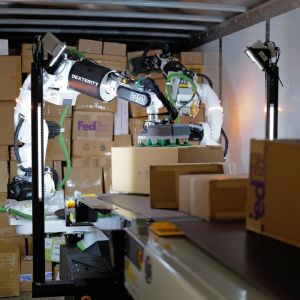
FedEx is ramping up a test program for robotic trailer loading at one of its large package distribution facilities. The post FedEx moves closer to deploying robots that can load trailers appeared first on FreightWaves.
Source Lens
Industry Context
Useful background context, but lower-priority than direct platform, community, or operator intelligence.
Impact Level
medium
Use this briefing to decide whether your team needs an immediate workflow, policy, or reporting change.
Key Stat / Trigger
No single quantitative trigger surfaced in this report.
Focus on the operational implication, not just the headline.
Full Coverage
Thursday was a busy day for companies developing automated truck loading and unloading technology. FedEx Corp. (NYSE: FDX) announced it is scaling up use of a specialized robot for loading truck trailers at its Hagerstown, Maryland, hub after validating the technology from startup Dexterity Inc. over several years.
And Pickle Robot Company said it will pair its trailer unloading robot with Ambi Robotics’s system to automate the movement of packages from the trailer through pallet stacking and warehouse receiving operations.
The expanded use case in Hagerstown will allow FedEx to continue evaluating Dexterity’s AI-enabled trailer-loading system at a larger operational scale in a high-volume logistics environment. window. googletag = window. googletag || {cmd: []}; googletag. cmd. push(function() {googletag.
defineSlot('/21776187881/FW-Responsive-Main_Content-Slot1', [[300, 100], [320, 50], [728, 90], [468, 60]], 'div-gpt-ad-1709668545404-0'). defineSizeMapping(gptSizeMaps. banner1). addService(googletag. pubads()); googletag. pubads(). enableSingleRequest(); googletag. pubads(). collapseEmptyDivs(); googletag. enableServices(); }); googletag. cmd.
push(function() {googletag. display('div-gpt-ad-1709668545404-0'); }); Technology assistance is being pursued to improve worker safety and network efficiency. Loading and unloading trailers is one of the most physically demanding and challenging tasks for warehouse workers in FedEx’s package operations, requiring real-time problem solving.
Automating that workflow has been difficult because of the variability of package sizes, weights, and loading conditions, as well as the need to implement it across thousands of trailers in the FedEx system.
The advent of physical AI — which lets autonomous systems like robots perceive, understand, reason and perform or orchestrate complex functions in the real world by executing movements through motors, robotic arms or wheels — has brought the technology closer to commercial reality.
“Truck unloading and truck loading are a very difficult problem for robotics to solve — packages come in every size, shape and weight,” said CEO Raj Subrmaniam, in an interview with the New York Times in January. “We’re not looking for humanoid robots. We’re looking for super humanoid robots because maybe they need to have a couple of elbows.
More degrees of freedom. It’s not ready for prime time yet.”
The ongoing tests with Dexterity allow FedEx to better analyze how AI-assisted robots perform in trailer-loading operations and how it can be integrated into broader hub operations, including destination planning, trailer assignment, maintenance and workforce processes, FedEx said in a news release.
Future deployment decisions will be informed by safety, operational performance, reliability, business needs, and lessons learned from evaluating the technology at a larger operational scale, said spokeswoman Christina Meek. The Dexterity loader is also being used at a facility in Tracy, California, she added.
Dexterity’s trailer loader is controlled by Foresight, an AI model that makes real-time decisions in dynamic environments. By combining vision, depth, and touch, Foresight predicts how physical AI actions impact the world.
In autonomous trailer loading, it reasons across three spatial dimensions and time to optimize how packages are placed for space, stability, and speed across a wide range of operating conditions.
Foresight powers Dexterity’s dual-armed “human-like” robot, Mech, which is designed for heavy industrial operations, while remaining compact enough to operate inside trailers. window. googletag = window. googletag || {cmd: []}; googletag. cmd. push(function() {googletag.
defineSlot('/21776187881/fw-responsive-main_content-slot3', [[728, 90], [468, 60], [320, 50], [300, 100]], 'div-gpt-ad-1665767553440-0'). defineSizeMapping(gptSizeMaps. banner1). addService(googletag. pubads()); googletag. pubads(). enableSingleRequest(); googletag. pubads(). collapseEmptyDivs(); googletag. enableServices(); }); googletag. cmd.
push(function() {googletag. display('div-gpt-ad-1665767553440-0'); }); FedEx hopefully can begin scaling up automated trailer unloading at more facilities within a couple of years, Subramaniam said last month on Fortune’s “Titans and Disruptors of Industry” podcast.
In February, FedEx announced a pilot implementation of the Scoop autonomous robotic package unloader from Berkshire Grey Inc. , a subsidiary of SoftBank pursuing AI-powered robotic solutions for supply chain processes, after a multiyear collaboration.
The Scoop has been engineered specifically for bulk automated trailer unloading, delivering a continuous flow and handling all package types. FedEx said at the time that the first Scoop will be operating in a live environment this year.
(Why It Matters: Automating the process of loading and unloading trailers could unlock huge savings for trucking companies and reduce heavy lifting for employees.) The Scoop trailer unloader. (Photo: FedEx) In 2021, FedE
Original Source
This briefing is based on reporting from Freightwaves. Use the original post for full primary-source context.
Style
Audience