How Triumph Financial’s CEO Beat the Longest Freight Recession
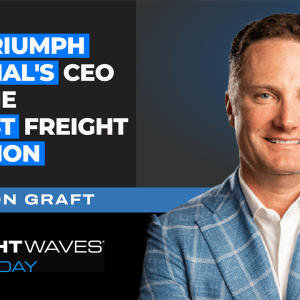
Triumph Financial posted 38% Q3 transportation revenue growth during freight's longest recorded recession, driven by organic customer adds and five simultaneous inflationary pressures pushing freight costs higher. Average invoice sizes are rising sharply — each $100 increase adds ~$12M in annual revenue — signaling carrier rates and shipping costs are climbing.
Carrier supply tightening due to litigation risk and multi-input inflation signals a shift from cheap capacity to defensible capacity, accelerating margin compression for marketplace sellers reliant on freight-heavy supply chains.
Rising driver wages (70+ cents/mile), diesel up 67% YoY, nuclear verdict litigation risk, and higher equipment costs will push carrier rates higher, compressing margins for sellers dependent on 3PL or freight-reliant replenishment. Check your inbound freight invoices and 3PL contracts now — rate increases are structural, not cyclical.
Operational Impact
This story may require teams to revisit workflows, monitoring, or platform assumptions.
Bottom Line
Freight inflation is structural — sellers' inbound costs are heading higher.
Source Lens
Industry Context
Useful background context, but lower-priority than direct platform, community, or operator intelligence.
Impact Level
medium
Freight inflation is structural — sellers' inbound costs are heading higher.
Key Stat / Trigger
Driver wages at 70+ cents per mile with diesel up 67% year-over-year
Focus on the operational implication, not just the headline.
Full Coverage
#fwtv_PVHOBmj4nYw. fwtv-panel{border:1px solid #d0d0d0;padding:18px;border-radius:6px;line-height:1. 6}#fwtv_PVHOBmj4nYw. fwtv-panel p{margin:0 0 12px}#fwtv_PVHOBmj4nYw.
fwtv-note{font-style:italic;color:#666;margin-top:16px;padding-top:12px;border-top:1px solid #e0e0e0}Triumph Financial CEO Aaron Graft joins FreightWaves to discuss how his company achieved a remarkable 38% transportation revenue growth during one of the longest freight recessions in history.
Discover the strategic investments in platform and product development that fueled organic growth, allowing Triumph to thrive despite challenging market dynamics.
Graft also shares critical insights on the shifting priorities from ‘available and cheap’ to ‘defensible and practicable’ capacity in the evolving freight landscape, especially in light of increasing litigation and inflationary pressures. Learn what to expect for the industry in the coming quarters.
Triumph Financial reported nearly 38% growth in third-quarter transportation revenue, with founder and CEO Aaron Graft crediting the simultaneous maturation of the company’s rebuilt product platform and an improving freight market cycle — a combination he said the company had not yet experienced in over four years of development spending.
“We spent 4 years investing in that,” Graft said of the expanded product suite, which now includes payments, intelligence, and load pay offerings. “Little did I know when we started off on that journey that we were going to be doing it at the same time we were going to go through the longest freight recession of my career and probably of history.”
Graft said roughly one-third of the revenue growth was organic, not simply a function of cyclical tailwinds. The company added more than 700 net new factoring customers for the year and now touches 65% to 70% of every transaction in brokered freight.
Average invoice sizes also rose materially year over year, driven by five simultaneous inflationary pressures: driver wages, which have climbed to 70 cents per mile and above; diesel, up 67% on a headline basis from a year ago; insurance costs inflated by nuclear verdicts; higher equipment prices; and more expensive equipment financing.
“We built a bigger sail while we were at it to catch that tailwind,” Graft said, describing the interplay between the market recovery and Triumph’s organic customer and product growth. The payments segment reached operating income for the first time this quarter — a milestone Graft framed carefully.
He noted that positive EBITDA margin in payments only arrived two years ago, and cautioned that the record EBITDA margin reported this quarter should not be viewed as a permanently sustainable run rate. “It’s that payments has matured from something we’re investing in to something we’re now harvesting from,” he said.
Graft quantified the company’s sensitivity to invoice size movements, estimating that each $100 rise in the average invoice adds approximately $12 million in annual revenue — but acknowledged the dynamic cuts both ways. Triumph’s factored receivables currently stand at $2 billion on its balance sheet, all of which must be funded by deposits.
He also argued that despite headline rate improvements, many carriers remain unable to earn their cost of capital given the full weight of inflationary inputs, noting that on an inflation-adjusted basis, current average invoice sizes are still well below the roughly $2,400 level seen in late 2021 and 2022, even as diesel is 40% to 50% higher than it was then.
On the supply side of the freight market, Graft expressed more conviction than on demand. He argued that the litigation environment — pointing specifically to a verdict against C. H.
Robinson approaching $700 million stemming from a load that earned the broker only a couple hundred dollars of gross margin — has permanently shifted how brokers must evaluate carrier selection. “This market used to focus on available and cheap,” he said. “Today it’s defensible and practicable.”
He does not expect gray-market capacity to return regardless of regulatory changes, which he believes will sustain upward pressure on rates and benefit Triumph’s longer-term earnings trajectory as it monetizes four years of platform investment.
Triumph Financial’s Q3 transportation revenue grew nearly 38%, with about one-third classified as organic growth driven by 700+ net new factoring customers and a 65–70% share of brokered freight transactions.
CEO Aaron Graft identified five simultaneous cost pressures — wages, diesel (up 67% year-over-year), insurance, equipment prices, and financing costs — as the primary drivers of higher invoice sizes, estimating every $100 invoice increase adds ~$12 million in annual revenue. Graft said broker liability rulings, including a verdict against C. H.
Robinson approaching $700 million, have permanently shifted carrier selection from ‘available and cheap’ to ‘defensible and practicable,’ limiting supply recovery regardless of regulatory cha
Audit your 3PL and freight contracts in the next 30 days — if rates are variable or tied to spot market, lock in fixed-rate agreements before inflationary pressures fully pass through to shippers.
Model a 10-15% inbound freight cost increase in your COGS to stress-test margin on your top 20 SKUs — if margin drops below 20%, reprice or renegotiate supplier terms now.
Original Source
This briefing is based on reporting from Freightwaves. Use the original post for full primary-source context.
Style
Audience