

Hazardous materials drivers can’t speak English
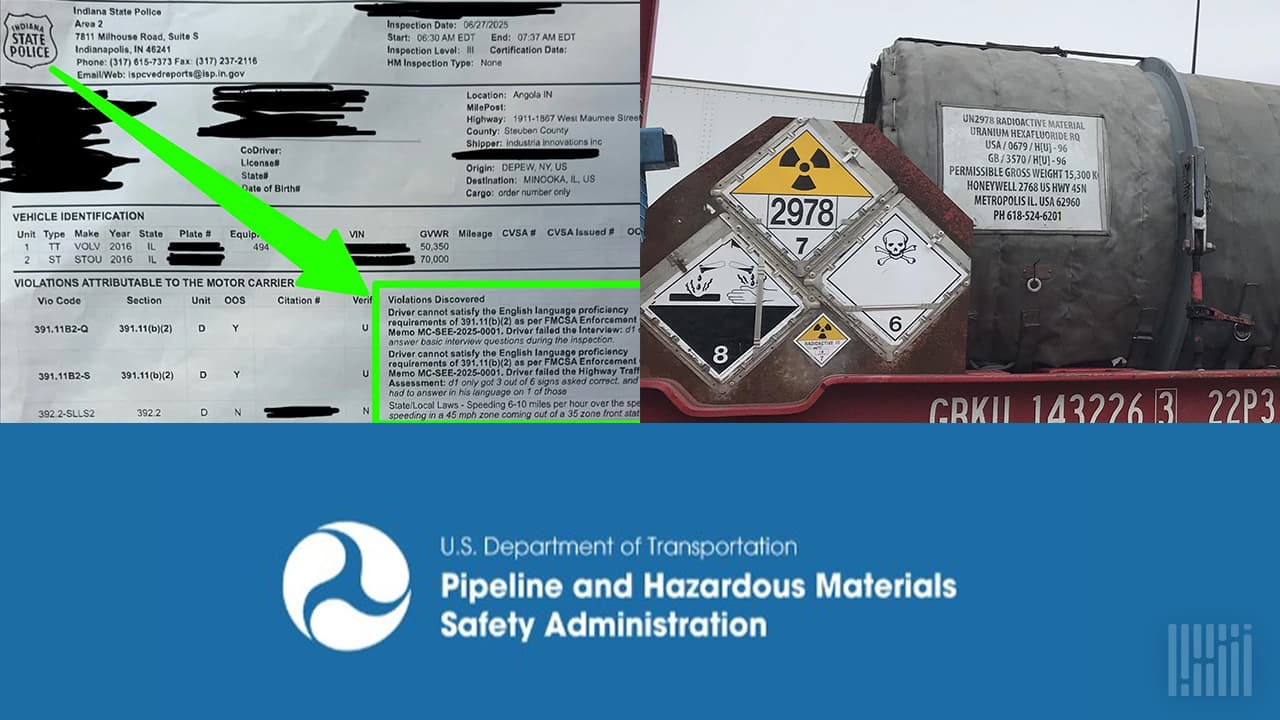
To hold a hazardous materials endorsement, a driver must pass a written knowledge exam on regulations, packaging, and emergency procedures, administered in English. So, how does a driver cited 98 times for being unable to read or speak English still hold that endorsement? The post Hazardous materials drivers can’t speak English appeared first on FreightWaves.
Source Lens
Industry Context
Useful background context, but lower-priority than direct platform, community, or operator intelligence.
Impact Level
medium
Use this briefing to decide whether your team needs an immediate workflow, policy, or reporting change.
Key Stat / Trigger
No single quantitative trigger surfaced in this report.
Focus on the operational implication, not just the headline.
Full Coverage
When a trailer full of fireworks burned on Interstate 75 near Chattanooga on June 6, the Tennessee Highway Patrol found that the driver had no hazardous materials endorsement, no placards, no shipping papers, and no emergency response information. The cargo was regulated explosives.
The paperwork that would have told a firefighter what was in the trailer did not exist. Pull the federal records on hazardous materials freight and you find the same structural failure repeating across thousands of stops, with one variable that turns a paperwork problem into a public safety problem.
A large and growing share of the drivers hauling placarded hazmat in this country have been cited repeatedly for being unable to read and speak English. I ran every carrier in the FMCSA inspection database that has been written up for both English-language proficiency and hazardous materials violations. Two hundred carriers came back.
Together, they carry more than 3,000 English proficiency citations and more than 600 hazmat out-of-service orders. An English proficiency violation under 49 CFR 391. 11 means an inspector determined the driver could not read highway signs, could not understand the officer’s instructions, or could not make the required entries in his record.
A hazmat violation means the load was explosives, gases, flammables, corrosives, or worse, and something about how it was being carried broke federal law. Put those together, and you have a company moving dangerous goods with drivers the government has already flagged as unable to function in the language in which the entire safety system is written.
A driver who cannot read DO NOT ENTER is hauling material that requires a placard he also cannot read. One carrier in that group stands out. Quality Tank, a Mexican tank truck operator, carries 98 English proficiency violations and 86 hazmat violations, with the most recent English citation logged in April of this year.
98 enforcement determined that this carrier’s driver could not communicate in English. The equipment is a tanker, which means the cargo is bulk hazmat. This is a years-long pattern of a company hauling the most dangerous category of freight on the road. You thought they’d be out of service because ELP is being enforced again, right?
Well, this is the commercial zone, so there are exemptions from ELP enforcement. How do you pass the test you can’t read? I’m on my 5th hazmat renewal, and to haul hazmat, a driver must hold a hazardous materials endorsement.
To get that endorsement, he must pass a written knowledge exam on federal regulations, packaging, quantity limits, and emergency procedures, and he must clear a fingerprint-based background check through the Transportation Security Administration. The exam is administered in English. The regulations are written in English.
The shipping papers that ride in the cab are in English. The emergency response guidebook is in English. So how does a driver who has been cited 98 times for not being able to read or speak English hold a hazmat endorsement at all? Either he doesn’t, and he is hauling placarded freight illegally, exactly like the driver on I-75.
Or he does, and we should ask how the endorsement was issued and whether the exam meant anything. The papers exist for the worst day People outside trucking assume placards and shipping papers are bureaucratic nonsense. They’re not.
They’re the only information a first responder has in the first minutes of a hazmat emergency, and those first minutes are when people die. When a truck is burning on the shoulder, the firefighter does not know what is in it. He reads the placard to get the hazard class.
He pulls the shipping papers to get the exact material and the United Nations identification number. He cross-references that number against the emergency response guide to decide whether to put water on it, foam it, or pull everyone back a half mile and let it burn.
That chain depends on a placard being posted, papers being present, and a driver who can hand them over and tell the responder what he is carrying. The emergency information is only as good as the driver’s ability to communicate it. Run that scene with a driver who cannot speak English. The placard might be missing, as it was on I-75.
The papers might be missing. Even if both are present, the one human being on scene who knows the load cannot answer the most basic question a firefighter will ask: what is in the truck. The emergency response system assumes a driver who can communicate. The data show that the assumption fails thousands of times a year, particularly for hazmat loads.
The federal standard never required fluency. It doesn’t require a driver to write an essay or debate policy. It requires functional English sufficient to read a sign that says BRIDGE ICES, understand an officer who says, “step out of the vehicle,” and tell a paramedic what chemical just spilled on the road.
That is the floor, and it is a safety floor, not a cultural one. The cas
Original Source
This briefing is based on reporting from Freightwaves. Use the original post for full primary-source context.
Style
Audience