

McLane and Aurora launch autonomous hauls in Texas as Volvo route reaches Oklahoma City
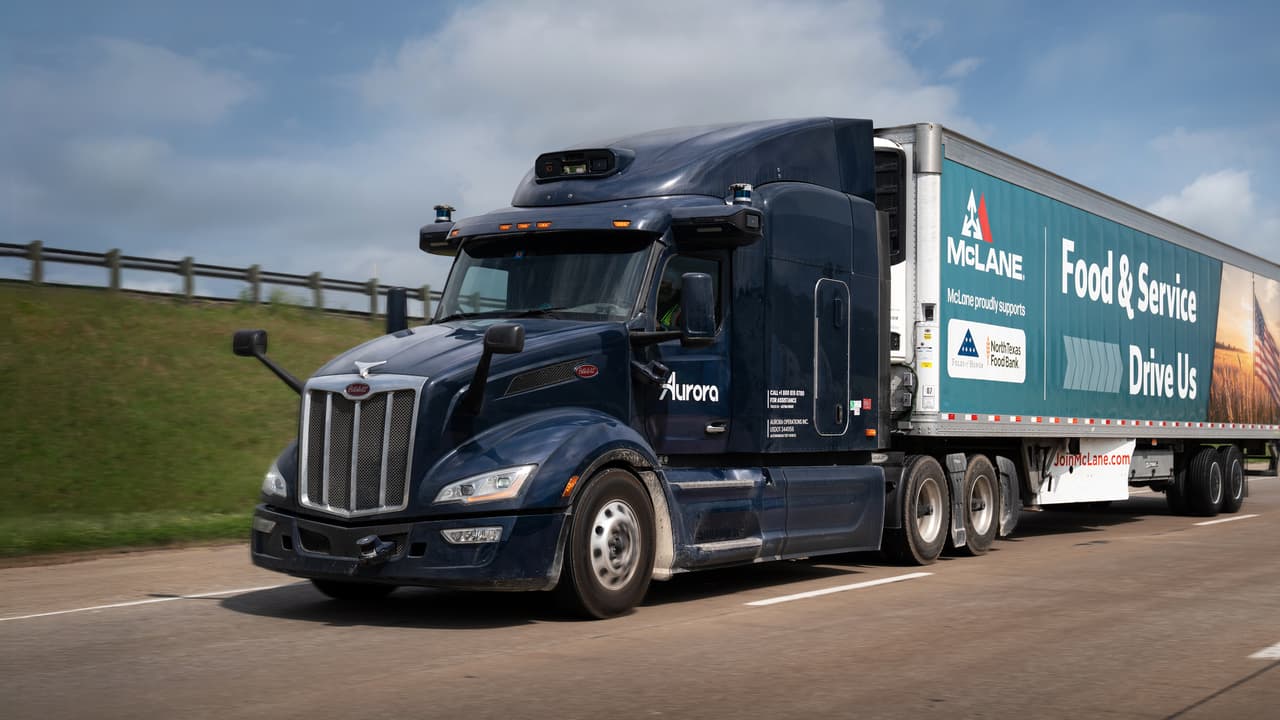
Aurora and McLane launched fully autonomous truck hauls between Dallas and Houston after a 3-year pilot with 100% on-time delivery. Aurora also expanded autonomous routes to Oklahoma City with Volvo, operating 5 days weekly.
Autonomous freight between major distribution hubs could reduce shipping costs and improve delivery predictability for sellers using ground transportation. Monitor your shipping analytics for cost reductions on Texas routes as this technology scales to more corridors.
This represents the early stages of logistics cost deflation that could improve seller margins as autonomous freight expands beyond pilot programs to major shipping corridors.
Check shipping cost reports in Seller Central or Walmart Connect -- if you ship between Texas distribution centers, track for potential cost reductions as autonomous freight scales.
Review your ground shipping mix for routes between major distribution hubs that could benefit from 24/7 autonomous capacity in the next 12 months.
Bottom Line
Autonomous trucks in Texas mean lower shipping costs for ground freight.
Source Lens
Industry Context
Useful background context, but lower-priority than direct platform, community, or operator intelligence.
Impact Level
low
Autonomous trucks in Texas mean lower shipping costs for ground freight.
Key Stat / Trigger
280,000 autonomous miles with 100% on-time performance
Focus on the operational implication, not just the headline.
Full Coverage
Aurora Innovation and McLane Company announced Wednesday that they have moved from supervised pilot runs to fully driverless commercial hauls on Texas highways. The move follows a three-year pilot that logged over 280,000 autonomous miles and delivered 1,400 loads with 100 percent on-time performance.
It also positions one of the nation’s largest private fleets to reshape how perishable food reaches America’s chain restaurants. “The business of moving food is essential to our economy and our way of life. With a 134-year legacy, McLane is deeply woven into the American distribution industry,” said Ossa Fisher, president of Aurora.
“We’re excited to enter the next chapter with McLane and transform the American food supply chain with autonomous trucks. Our collective momentum in logistics is palpable.”
The agreement enables McLane, a Berkshire Hathaway subsidiary serving convenience stores, mass merchants, and chain restaurants, to begin driverless hauls between Dallas and Houston using the Aurora Driver. Pilot Performance Proves the Model The companies launched their supervised autonomy pilot in 2023.
Since then, the Aurora Driver consistently met McLane’s rigorous scheduling demands. The pilot then expanded operations to two round-trips daily between Dallas and Houston, seven days a week.
That track record opened the door for driverless approval on the Dallas-Houston corridor, with Aurora planning to expand to new routes between McLane distribution centers across the U. S. Sun Belt by the end of 2026.
“We’ve been thoroughly impressed with Aurora’s technology, exceptional safety performance and commitment to operational excellence,” said Susan Adzick, president of McLane Restaurant.
“Autonomous technology helps us drive greater efficiency across the supply chain, while our drivers remain focused on the critical last mile—and continuing to serve as the face of our company to customers.” Hybrid Model Keeps Human Drivers on the Front Line The operational workflow divides labor between the virtual and human driver.
Aurora’s self-driving system handles the long-haul “middle mile” between distribution centers. McLane’s human drivers manage local deliveries directly to customer locations. That hybrid structure will remain in place as the partnership scales.
This addresses multiple pain points: autonomous trucks moving refrigerated hauls 24/7 offer scalable, reliable capacity that flexes with demand. The consistent and predictable middle-mile routes keep freight flowing smoothly without pulling drivers away from customer-facing work.
Network Expansion Reaches Oklahoma City Separately, Aurora and Volvo Autonomous Solutions (V. A. S.) announced earlier this week the launch of a new 200-mile autonomous route between Dallas and Oklahoma City. The expansion marks the first time V. A. S. is hauling freight directly to customer facilities in Oklahoma City.
The route uses the Volvo VNL Autonomous integrated with the Aurora Driver. The program currently runs five days a week in supervised autonomy. By operating directly to endpoints, V. A. S. reduces the need for drayage moves and handoffs that add complexity to logistics flows.
“Expanding our operations into Oklahoma City and adding customer endpoints is an important step for scaling autonomous transport,” said Sasko Cuklev, head of on-road solutions at Volvo Autonomous Solutions.
“Running end-to-end requires a higher level of operational precision and integration, and it further demonstrates how autonomous trucks can operate reliably in real logistics environments. Together with Aurora we are focused on expanding our network and accelerating the adoption of this new and exciting technology.”
Aurora mapped the Dallas-to-Oklahoma City interstate route and began autonomous hauls within weeks. The speed highlights the system’s ability to scale into new markets quickly. “Leveraging our technology to open new routes quickly and efficiently is a core part of our strategy,” Fisher said.
“Aurora and Volvo are firing on all cylinders and our ability to execute together at scale is clear. As Volvo’s most advanced autonomy partner, we are proud to be the first to deploy the Volvo VNL Autonomous across multiple states.”
The post McLane and Aurora launch autonomous hauls in Texas as Volvo route reaches Oklahoma City appeared first on FreightWaves.
Original Source
This briefing is based on reporting from Freightwaves. Use the original post for full primary-source context.
Style
Audience