

The fraudsters are collaborating. It’s time the good guys did too.
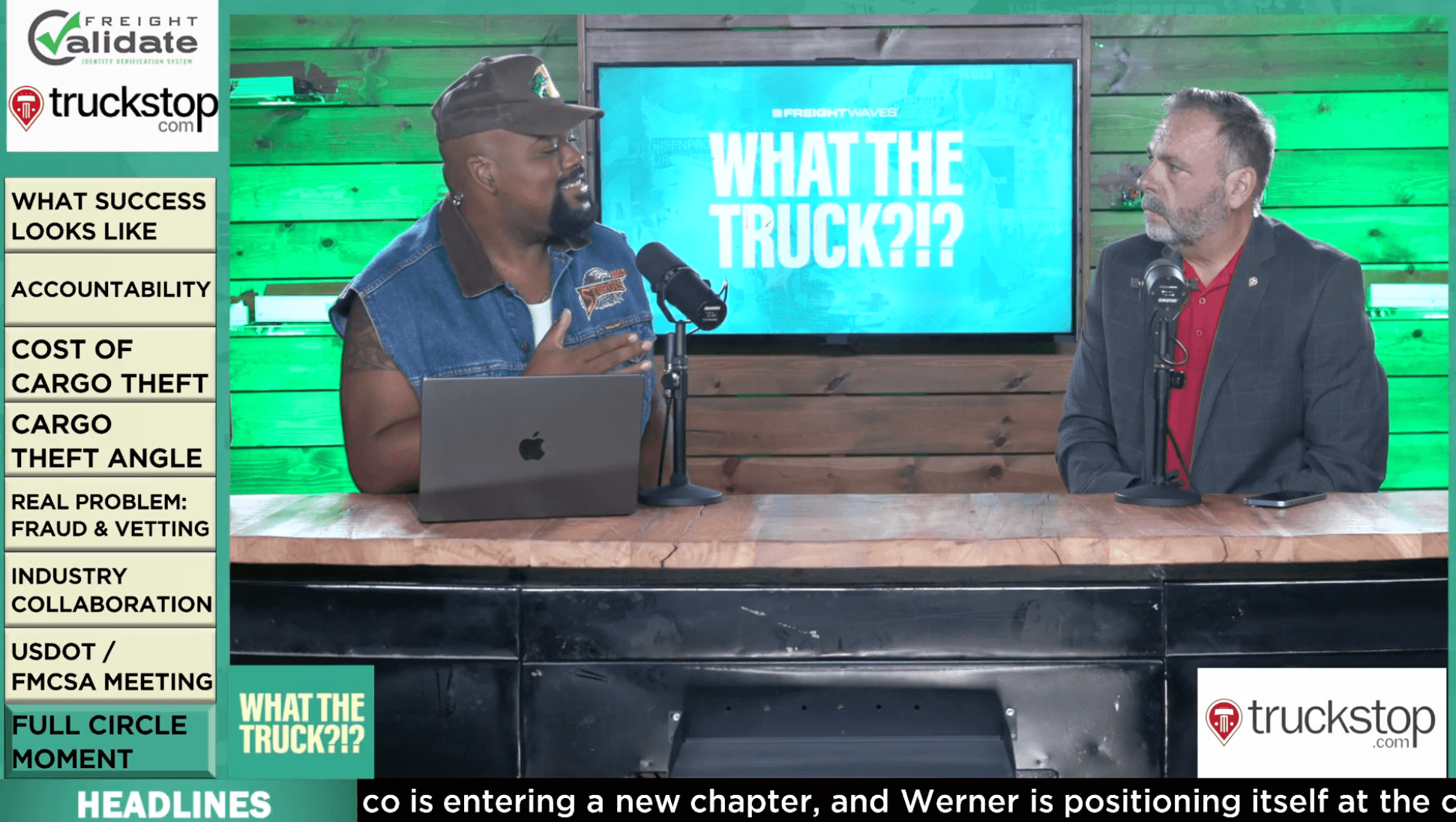
Dale Prax makes the case for cross-platform collaboration on freight fraud — and explains why the industry can’t afford to keep working in silos. The post The fraudsters are collaborating. It’s time the good guys did too. appeared first on FreightWaves.
Source Lens
Industry Context
Useful background context, but lower-priority than direct platform, community, or operator intelligence.
Impact Level
medium
Use this briefing to decide whether your team needs an immediate workflow, policy, or reporting change.
Key Stat / Trigger
No single quantitative trigger surfaced in this report.
Focus on the operational implication, not just the headline.
Full Coverage
Fraudsters are sharing warehouses, swapping drivers, and coordinating across networks. The people trying to stop them are still working alone. That’s the gap Dale Prax has spent years trying to close. Prax is the founder, president, and CEO of Collaborative Rating Systems (more widely known as FreightValidate.
com) and a strategic fraud advisor and advocate at Truckstop. com. Prax joined Malcolm Harris on What the Truck?!?
to lay out a vision for cross-platform collaboration between vetting companies, a closer working relationship with federal regulators, and a shared sense of accountability that extends to every party in a freight transaction, from the driver at the dock to the broker booking the load.
The conversation picks up where Prax left off during a December appearance on the show, where he first floated the idea of bringing competing vetting platforms together. Five months later, the idea is becoming a meeting on the calendar, with the FMCSA at the table.
The bad guys are already collaborating Prax has been making the argument for collaboration among vetting and onboarding platforms since at least 2022, when a wave of new fraud-prevention companies began entering the market in response to surging cargo theft and identity fraud schemes.
The problem, as he sees it, is that even with more tools in the ecosystem, the bad actors are still finding ways through. “We all know that the bad guys are collaborating with each other,” Prax said. “They own warehouses, they share truck drivers, so they’re collaborating very closely.” Coordination on the criminal side has created a gap problem.
A carrier flagged in one vetting platform might sail through another with no issues. “I get calls all the time from people who don’t understand why they’re not validated in our platform,” Prax said. “Some people can fall through the crack, which is why we have to bring the systems together.”
Why sharing intelligence beats sharing algorithms His proposed fix doesn’t involve simply sharing proprietary algorithms or trade secrets between competing platforms. The key, he says, is sharing intelligence, such as verified, time-consuming findings that individual companies are already producing in isolation.
“It takes several months to a year sometimes to get information from the Freedom of Information Act office to prove a guy is a bad guy,” Prax explained.
“So if I’m doing it, I should be able to share that with the other vetting platforms and let them know we’ve proven if someone owns 15 MC numbers and has not disclosed that affiliation, or if he lives outside The United States, but he lied in his application.”
If one platform has already done the investigative legwork to uncover a fraudulent operator, every other platform in the ecosystem should benefit from that finding rather than duplicating the effort (or worse, never catching it at all). What was once a theoretical pitch is now materializing in practice.
Prax described a pivotal conversation with Derek Barrs at the Transportation Club of Jacksonville that turned into a formal invitation to Washington, D. C. When Prax sent the invite out to vetting platforms across the industry, the response was immediate.
“When I sent out the list to all the vetting platforms that I know, the immediate response was a resounding yes,” Prax said. “It’s really refreshing to see that happen.”
What the FMCSA can and can’t do The meeting, scheduled for May 14, will bring together not just vetting companies but also representatives from the Federal Motor Carrier Safety Administration (FMCSA). Prax considers that pairing essential.
For too long, he argues, the private-sector fraud prevention community and federal regulators have operated without a clear understanding of what the other side can and can’t do. “A lot of us vetting companies may not know the limitations of the FMCSA,” Prax said. “We don’t know where their hands are tied.”
He pointed to a specific legal constraint that most of the industry may not be aware of: a case called FMCSA v. Darlene Riojas, 7 Star Transport, and Four Star Trucking, in which Administrative Law Judge J. E. Sullivan ruled in 2019 that the agency lacks the authority to impose civil penalties.
That kind of limitation changes the calculus for how fraud gets addressed at the federal level. “Vetting platforms and onboarding platforms need to know what their limitations are,” Prax said. “They also need to know what our capabilities are so we can help each other. Maybe the agency can’t do something, but we certainly can.”
That means the private sector may need to serve as a de facto enforcement layer in cases where the regulatory process is slow or legally hamstrung, recommending against the use of carriers that shouldn’t have been granted operating authority in the first place, even while the formal legal process plays out at the FMCSA.
The real cost of cargo theft The actual dollar cost of cargo theft is still an ongoing discussion between industry voices who have offered w
Original Source
This briefing is based on reporting from Freightwaves. Use the original post for full primary-source context.
Style
Audience