

Amazon GWD vs AWD: Fees, Eligibility, and Trade-offs Sellers Need to Know in 2026
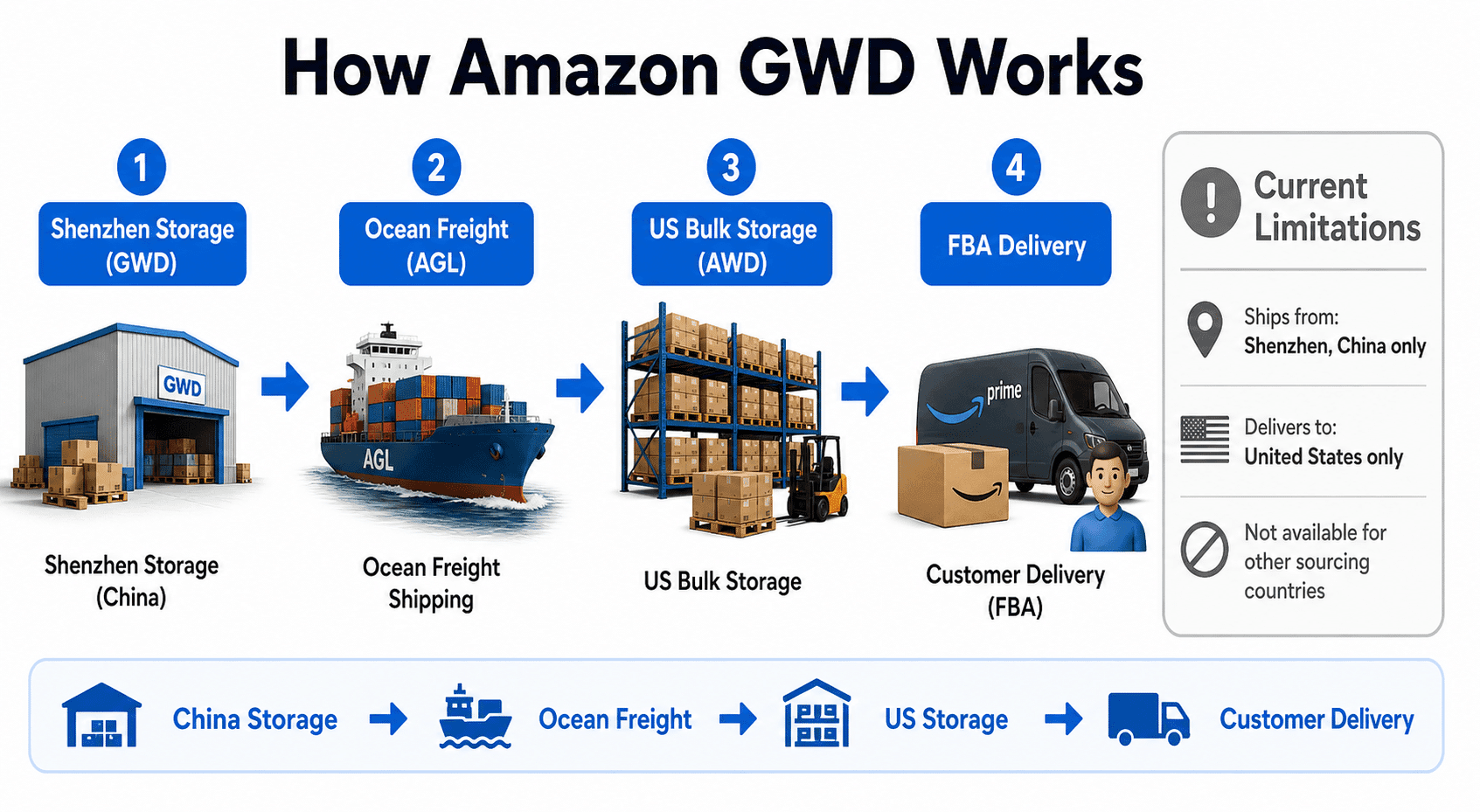
Amazon launched Global Warehousing and Distribution (GWD) on April 9, 2026, offering China-based storage with claimed 45% lower costs than US AWD and 7-day faster delivery. The service operates from one Shenzhen warehouse shipping only to US markets via ocean freight taking 35-65 days total transit time.
Amazon's 45% savings claim only covers storage fees, not total landed costs including ocean freight, processing, and customs fees. Sellers should calculate their full door-to-door costs including AGL freight rates before switching from existing 3PL arrangements.
Amazon continues vertical integration of its logistics stack, potentially pressuring traditional freight forwarders and 3PLs serving China-based sellers. This consolidation gives Amazon more control over seller supply chains while creating dependency on their ecosystem.
Compare your current China-to-US logistics costs against GWD storage + AGL ocean freight + AWD processing + FBA fees in Seller Central's FBA Revenue Calculator.
Review your inventory velocity in Business Reports -- GWD works best for products with predictable demand and 60+ day lead time tolerance.
Bottom Line
GWD offers China storage but total savings depend on your freight costs.
Source Lens
Operator Tactics
Tactical content that tends to be strongest when tied to workflow, process, or execution.
Impact Level
medium
GWD offers China storage but total savings depend on your freight costs.
Key Stat / Trigger
45% lower storage costs claimed vs US-based AWD
Focus on the operational implication, not just the headline.
Full Coverage
On April 9, 2026, Amazon launched Global Warehousing and Distribution, or GWD for short. The pitch is simple: store your FBA inventory at one warehouse in Shenzhen, China, and let Amazon handle the cross-border shipping to US fulfilment centers through Amazon Global Logistics.
Amazon says storage costs run up to 45% lower than US-based Amazon Warehousing and Distribution, and delivery runs up to seven days faster when you pair GWD with AGL. But here's the thing: both numbers come from Amazon, no one else has verified them, and that “up to” language is doing a lot of heavy lifting.
So take the marketing with a grain of salt, and let's actually look at what you're signing up for. What follows is the practical breakdown of what GWD is, what you pay, what you give up in exchange, and which sellers should consider signing up. Everything here pulls from Amazon's own Seller Central documentation and fee schedules current as of January 2026.
How GWD Works GWD links four parts of Amazon's logistics system into one sequential process. Your products start at the GWD warehouse in Shenzhen, where they sit in storage until your US inventory needs a top-up.
When stock in the US drops below a certain level, Amazon uses Amazon Global Logistics (AGL) to ship your products by ocean freight from Shenzhen to the United States. Once the shipment clears customs and arrives in the US, it moves into AWD, Amazon's bulk storage network, where it waits until individual fulfillment centers need stock.
From there, FBA takes over, picking, packing, and delivering orders directly to your customers. In short, the chain runs like this: Shenzhen storage, then ocean freight, then US bulk storage, then customer delivery.
You manage every stage of that chain through a single workflow inside Seller Central, instead of coordinating separate vendors for freight, customs, storage, and fulfillment. What “Global” Actually Means Right Now The name overstates the program's current reach.
As of today, GWD operates with one warehouse location in Shenzhen and ships to one destination market, the United States. Amazon has mentioned plans to expand, but has not named specific countries or set public timelines. So if your products come from other regions (like Shanghai or Shandong), GWD might not be the best option for you right now.
(Moreso if you're shipping from other countries like Vietnam, Bangladesh, India, or anywhere other than mainland China. Can You Really Save 45% on Storage with Amazon GWD? Amazon's headline number compares GWD's storage rate against AWD's storage rate, and the math checks out at that one line.
The catch is that storage is one piece of your total cost, not the whole picture.
Other costs that factor into your total landed cost include: Inbound and outbound processing fees Export declaration fees AGL ocean freight charges FBA fulfillment fees once inventory reaches the US Whether your total drops by 45%, by 10%, or by nothing at all depends on your specific products, your shipment volumes, and how often your inventory replenishes.
The seven-day speed claim deserves the same skepticism.
Amazon's own AGL transit time tables tell a clearer story than the marketing does: Shipping modeOrigin to US destinationTransit timeFast Ocean FCLChina to West Coast35-45 daysFast Ocean LCLChina to West Coast38-48 daysStandard FCLChina to West Coast45-55 daysStandard FCLChina to East Coast55-65 daysStandard LCLChina to West Coast54-64 days Pure ocean transit from a Chinese port to a US port runs 12 to 22 days depending on the route.
Shanghai to Los Angeles, for example, is usually 14 to 18 days on the water under normal conditions. That's the number you'll see quoted in shipping circles, but it only covers the boat ride. Your inventory doesn't become sellable the moment the boat docks.
The full door-to-door timeline includes: Cargo drop-off or pickup at origin in China Origin handling, consolidation, and loading at the Chinese port Ocean transit (the 12 to 22 day part) US port arrival, customs clearance, and unloading Inland transportation to the cross-dock or fulfillment center Final delivery and check-in at Amazon Amazon's published AGL transit times put the full chain at 35 to 65 days depending on your shipping mode and US destination.
That's the number to plan your inventory cycles around, not the ocean-only figure. None of those windows changes whether you're using GWD, AWD, or shipping straight to FBA. The water is the water. Whatever speed gains exist come from faster customs clearance and better consolidation, not from ships moving any quicker.
Amazon's documentation also includes a quiet caveat: transit time reliability is “subject to volume and external market conditions.” So the published numbers are best-case estimates. Port congestion, customs delays, and peak season volume all push the actual time higher than the table suggests. What does hold up is the simplification benefit.
Replacing three or four vendor relationships with one Seller
Original Source
This briefing is based on reporting from EcomCrew. Use the original post for full primary-source context.
Style
Audience