

Carrier vetting 101. Spoiler: It’s not about safety.
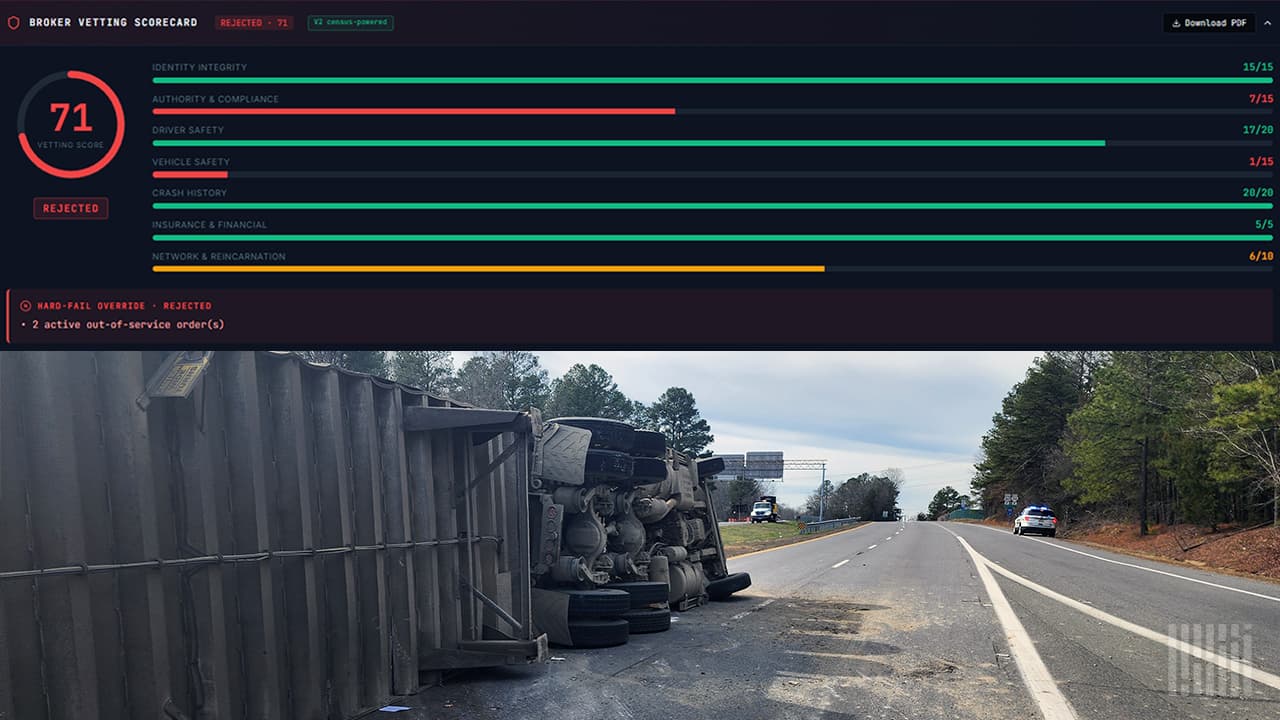
Safe isn’t always exposure-free or risk-free. Compliant isn’t always safe. What “safety” means doesn’t matter. A carrier can be all three of those things on paper and still bury everyone who touched the load in exposure. This is a working primer on how risk professionals actually vet, qualify and screen a carrier. The post Carrier vetting 101. Spoiler: It’s not about safety. appeared first on FreightWaves.
Source Lens
Industry Context
Useful background context, but lower-priority than direct platform, community, or operator intelligence.
Impact Level
medium
Use this briefing to decide whether your team needs an immediate workflow, policy, or reporting change.
Key Stat / Trigger
No single quantitative trigger surfaced in this report.
Focus on the operational implication, not just the headline.
Full Coverage
Since the Supreme Court handed down Montgomery v. Caribe Transport on May 14, I have not been able to get through a phone call, a deposition prep, or a LinkedIn thread without somebody asking me the same question. What makes a carrier safe? If we cannot just lean on FMCSA’s SAFER snapshot anymore, what is the objective standard?
I understand why everybody is asking it. It’s the wrong question. Here is the quick refresher, because the rest of this depends on it. The justices ruled 9 to 0. Justice Amy Coney Barrett wrote the opinion, and Justice Brett Kavanaugh filed a concurrence joined by Justice Samuel Alito.
The plaintiff, Shawn Montgomery, lost part of his leg in 2017 when a Caribe Transport truck struck his parked tractor-trailer on an Illinois shoulder. C. H. Robinson brokered the load. Caribe carried a conditional safety rating at the time.
The Court held that the Federal Aviation Administration Authorization Act does not preempt a negligent selection claim against the broker, because the statute’s safety exception saves it. For roughly a decade, brokers leaned on FAAAA preemption to get these cases dismissed before discovery ever started. That shield is gone.
And the reasoning does not stop at licensed brokers. The principle the Court announced is that exercising ordinary care when you select a carrier concerns motor vehicle safety. That logic reaches shippers who pick carriers directly, third-party logistics providers, and digital freight platforms.
Anybody in the chain who selects a carrier and who has access to the public safety data is now exposed. Three words that are not synonyms Almost every conversation I have about this runs aground on the same problem. Safe, compliant, and risky are three different words, yet the industry uses them as if they mean the same thing. They do not.
Compliant means a carrier meets the minimum standard the federal government will accept before it lets that carrier keep its operating authority. Compliance is a floor. It is pass-or-fail, and the bar is set low on purpose because the Federal Motor Carrier Safety Regulations are a national minimum, not a best practice.
When a carrier is compliant, what you actually know is that, on the day someone checked, it was not so far out of line that the government would withdraw its authority. That is the whole guarantee. Safe describes an operational outcome. Did the truck get from point A to point B without hurting anyone or damaging the freight?
Safe is a backward-looking track record, mostly a function of things hard to see from the outside. Risk is the one almost nobody defines, and it is the one that matters. Risk is exposure. It is the amount of financial and human damage a carrier is capable of causing, the likelihood it will cause it, and the question of who pays when it does.
Risk is forward-looking, probabilistic, and encompasses an entire category of factors unrelated to safety or compliance. Here is the part people miss. A carrier can be compliant and unsafe. A carrier can be safe and out of compliance on paper. A carrier can be both safe and compliant and still be a genuinely bad risk.
After Montgomery, when that carrier causes a catastrophic crash, safe-and-compliant is not the shield people think it is, because the plaintiff’s lawyer is not going to argue compliance. He is going to argue risk, and that you could have seen it coming.
Risk 101: frequency and severity If you have ever sat across the table from an underwriter, you already know how they think. Risk has two axes. Frequency and severity. How often something bad happens, and how bad it is when it does. Multiply them and you get expected loss, the actuarial spine of every commercial auto premium ever written.
Now notice what is not in that equation. There is no line item for safety rating. There is no field for compliant, yes or no. Those things might correlate loosely with frequency. They tell you almost nothing about severity, and severity is where companies die. When an insurer retains me to assess a fleet, I am not grading the fleet’s character.
I am estimating frequency, estimating severity, and pricing exposure. Carrier vetting, done correctly, is the exact same lens applied to a hiring decision rather than a policy. The FMCSA data trap So let us talk about the data the industry actually leans on. FMCSA assigns exactly three safety ratings, and only after an on-site compliance review.
Satisfactory, Conditional, Unsatisfactory. That is the entire scale. Here is the number that should reframe the conversation. Roughly 92 percent of carriers have no rating at all. They are Unrated. Out of something like 780,000 motor carriers, the overwhelming majority have never had an auditor walk through the door.
So when a broker or a shipper pulls up a carrier and the rating field says Unrated, that does not mean safe. It means nobody from the federal government has looked. The absence of a bad rating gets read as a good rating. It is not one. Unrated is not a cle
Original Source
This briefing is based on reporting from Freightwaves. Use the original post for full primary-source context.
Style
Audience