

Robots drive $10B Amazon investment for European fulfillment centers
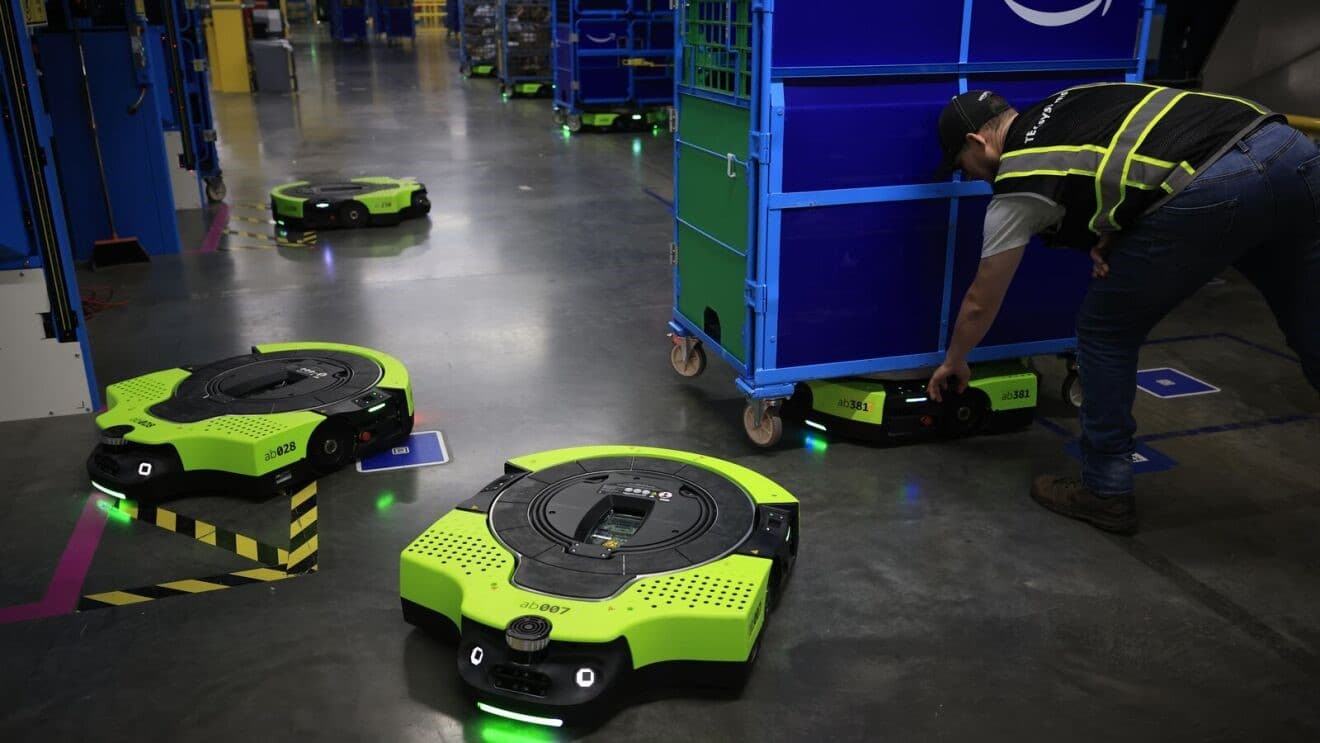
Amazon has deployed 1 million robots, mostly in the United States. Now it is investing heavily to expand robot use across fulfillment centers in Europe. The post Robots drive $10B Amazon investment for European fulfillment centers appeared first on FreightWaves.
Source Lens
Industry Context
Useful background context, but lower-priority than direct platform, community, or operator intelligence.
Impact Level
medium
Use this briefing to decide whether your team needs an immediate workflow, policy, or reporting change.
Key Stat / Trigger
No single quantitative trigger surfaced in this report.
Focus on the operational implication, not just the headline.
Full Coverage
Amazon plans to deploy three types of new robots as part of a plan to invest more than $10 billion to expand and modernize fulfillment centers in Europe and grow its workforce by 25,000 by the end of the decade. Amazon (NASDAQ: AMZN) relies on robots to make the work environment safer and easier for employees, while improving package processing speed.
Amazon Robotics was founded in 2012 when Amazon acquired Massachusetts-based Kiva Systems. The original Kiva robots moved stacks of shelves within a warehouse. Now robots conduct a variety of tasks. Some zip around like motorized saucers, while others have mechanical arms for lifting.
Amazon recently surpassed 1 million robots developed, produced and deployed across its operations network. At an event in London Thursday, the retail logistics behemoth introduced the next-generation Proteus autonomous robot.
It is designed to do physically demanding tasks such as moving heavy carts with packages over long distances to the outbound loading dock so employees can reduce their risk of injury and focus on managing inventory flow, quality control and other high-skill work.
Proteus, introduced in Nashville, Tennessee, in 2022, is Amazon’s first fully autonomous mobile robot, meaning it can navigate freely throughout a warehouse using sensors to detect and avoid objects in front of it.
The original version of the self-guided transporter works in conjunction with Cardinal, a robotic arm that tightly loads packages up to 50 pounds into carts in a Tetris-like manner.
Cardinal uses advanced AI and computer vision to quickly select one package from a pile of packages delivered via a chute, lift it with air suction, read the label and precisely place it in the appropriate cart assigned to a specific truck.
One of the major changes, made possible by advances in artificial intelligence, involves how employees interact with the robot. Proteus, about the size of a 50-inch flat-screen TV, is capable of understanding instructions in plain, conversational language with no technical commands and no programming interface.
That means warehouse workers can assign tasks to the robot the way they would communicate with a colleague. The next-generation Proteus is also designed to travel much further than the original. Rather than operating only in dock areas, the new system can work anywhere items need to be moved.
Amazon said this includes transporting containers as they arrive at a site, transferring them between workstations, and assisting employees across Amazon’s fulfillment centers and delivery sites. “You tell it what needs to be done.
It figures out the priority, the route, the timing,” said Scott Dresser, vice president of Amazon Robotics, in an article on the company’s website. “It becomes your assistant for material movement.” Proteus 2. 0 is currently being tested in Amazon labs, with deployment in Europe expected in the first half of 2027.
Broader robotics roadmap The scaling of these systems reached a new peak with the 2024 launch of Amazon’s next-generation fulfillment center in Shreveport, Louisiana. The site uses eight different robotics systems that work in harmony to support package fulfillment and delivery, according to another blog post.
Alongside advancements in mobile robots, Amazon is also developing new collaborative technology and robotic manipulation — the ability to handle individual objects with precision. This includes STARK, a new collaborative robotic tote-handling system.
The brainchild of an operations employee, STARK picks full totes from conveyors and places them on carts — work that otherwise requires repetitive heavy lifting. First piloted in Barcelona, Spain, STARK is planned to expand to 15 sites across Europe by 2027, Amazon said.
STARK is Amazon’s collaborative robotic tote-handling system, designed to handle individual objects with precision. (Image: Amazon) Amazon said it will also expand the use of Vulcan, the company’s first robot with a sense of touch. Vulcan uses sensors to pick and stow at the top-and-bottom rows of inventory pods at fulfillment centers.
The grab tooling can see and feel objects simultaneously to navigate densely packed environments and understand how much force to apply. Originally developed for a facility in Spokane, Washington, Vulcan expanded last year to handle more complex picking tasks at Amazon’s Hamburg facility in Germany and will be installed at more sites.
“Europe is at the center of how we’re building our operations for the future,” Dresser said. Legacy robots Amazon actually has two Vulcan robots. The pick version can grab items up to five pounds and 14 inches in length. Each robot reaches nine feet tall. In total, a system uses 10 robot arms in a 350-square foot area.
The stow version can grab items up to eight pounds, but nothing that can roll. This system links three robot stations together in a 500-square foot area and weighs nearly 10,000 pounds. Vulcan Stow uses an arm that carries a camera and a suction c
Original Source
This briefing is based on reporting from Freightwaves. Use the original post for full primary-source context.
Style
Audience