

Why the Moment for RNG in Heavy-Duty Trucking Has Finally Arrived
The convergence of a proven 15-liter engine, Clean Energy’s nationwide fueling network, and fuel savings averaging $3 or more per gallon is reshaping how fleets evaluate their next fuel strategy. The post Why the Moment for RNG in Heavy-Duty Trucking Has Finally Arrived appeared first on FreightWaves.
Source Lens
Industry Context
Useful background context, but lower-priority than direct platform, community, or operator intelligence.
Impact Level
medium
Use this briefing to decide whether your team needs an immediate workflow, policy, or reporting change.
Key Stat / Trigger
No single quantitative trigger surfaced in this report.
Focus on the operational implication, not just the headline.
Full Coverage
For more than three decades, renewable natural gas (RNG) has occupied a particular lane in the alternative fuel conversation. It’s been respected but never quite mainstream in Class 8 trucking. The engine technology wasn’t there, the fueling network had gaps, and diesel, for all its volatility, was the devil fleet operators knew.
Chad Lindholm, Clean Energy’s Senior Vice President, thinks that calculus has fundamentally changed.
In a recent interview with FreightWaves, Lindholm laid out a case built not on projections or pilot programs, but on real-world fleet data, a maturing infrastructure footprint, and an engine platform he says has closed the gap that kept RNG on the sidelines of long-haul trucking.
The conversation started where most fleet procurement discussions do: cost per mile. There’s a sharp contrast between diesel’s exposure to global disruption and the domestic production profile of RNG. “With diesel, there is always volatility,” Lindholm said.
“It seems like at least every three to five years, there is some event that affects the market, and truck operators pay the price. Conversely, when it comes to natural gas, we use a domestically produced product. There is zero fluctuation due to conflict abroad.” That stability shows up in the numbers.
While diesel pricing swings often move roughly two dollars per gallon in either direction, RNG prices tend to fluctuate by about a dime. The savings are substantial across every region of the country. “RNG can be found at an average savings of two dollars per gallon, and a bigger delta in some parts of the country,” Lindholm said.
Clean Energy’s own regional pricing data backs that up. And with the current conflict overseas leading to continued diesel fuel pricing volatility at home, fleet customers operating X15N trucks today are seeing savings as high as $5. 00 per gallon in certain parts of the country. There are still areas where RNG asks fleets to make tradeoffs.
The upfront premium for a Cummins X15N-equipped tractor runs $80,000 to $100,000 over a comparable diesel unit, though that figure has come down since the engine entered production a year ago. A fleet with high purchasing power can push it lower. Fuel economy, meanwhile, runs about 15% behind diesel in like-for-like lane comparisons.
“Cummins has done a tremendous job closing the gap, but we do want to be up front about that 15%,” Lindholm said. The previous 12-liter RNG engine carried a significantly higher fuel economy penalty, making the X15N’s improvement a meaningful step forward.
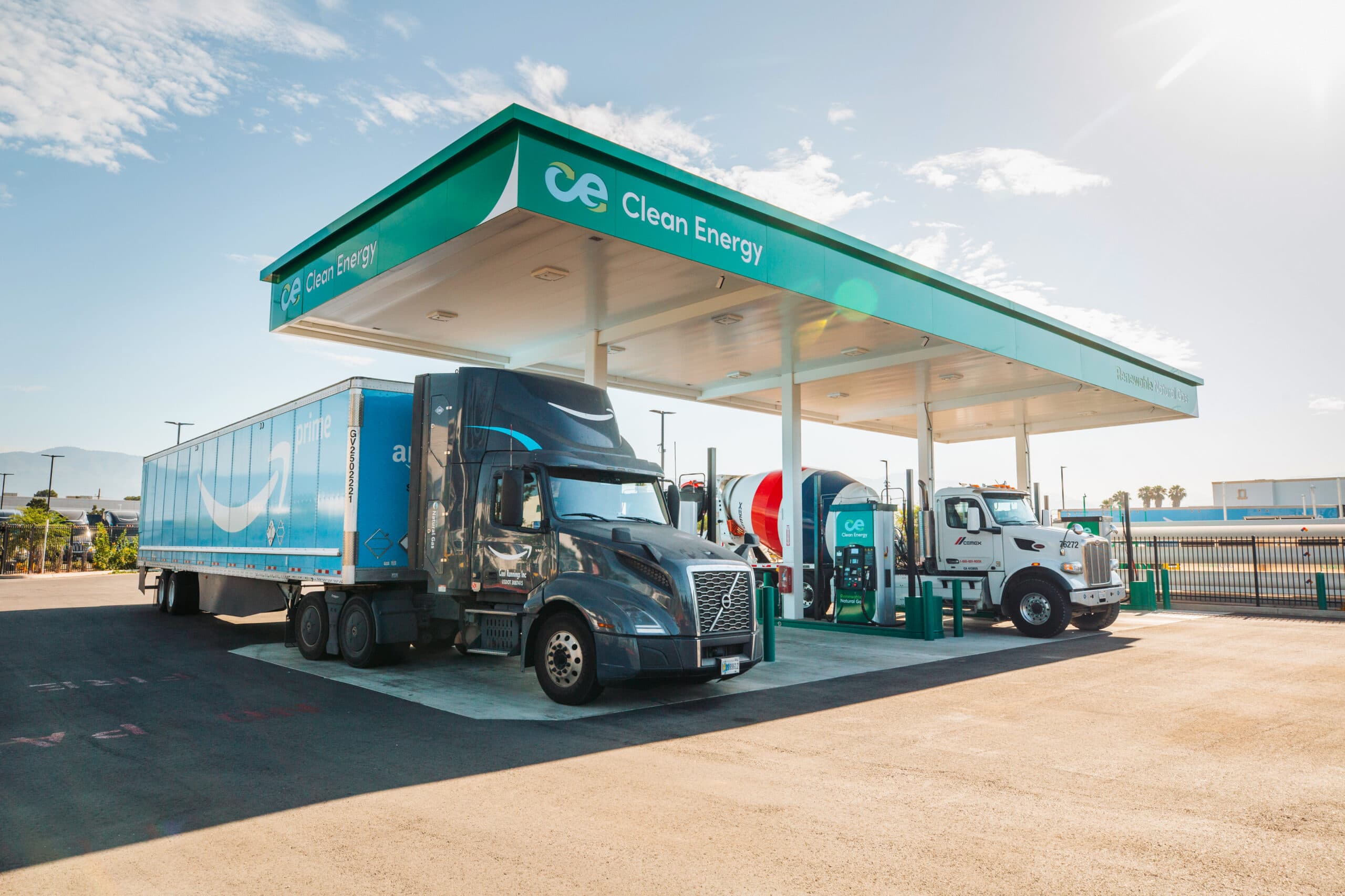
Those fleet managers who haven’t examined the data in the past year or so may be unaware just how much of an improvement there has been with the current generation of RNG technology and infrastructure. Amazon and CEMEX RNG-powered trucks fueling at Clean Energy station in San Bernadino, CA.
[Credit: Scott Sporleder, courtesy Clean Energy] Where the math turns in RNG’s favor, Lindholm said, is in the TCO conversation over time. “Fleets will see return from the Cummins X15N engine in about two years. That resonates for fleets who hold assets for a minimum of five years.”
Clean Energy’s fleet overview materials identify the highest-value deployment scenarios as fleets with high annual mileage, long-term asset holds of five years or more, regional or fixed-route operations with predictable fueling patterns, and proximity to the RNG station network.
Clean Energy deliberately builds its business case without factoring in government incentives. “All discussions of cost are without the assumption of subsidies,” Lindholm said. “To scale throughout the industry and keep from being a niche market product, we’re serious about providing viable trucks, engines, and fuel without government subsidy programs.”
Grants and incentive programs exist and Clean Energy helps fleets navigate them, but they don’t form the foundation of a pitch for using natural gas. While fuel pricing has been a rational argument for RNG for some time, the Cummins X15N has also made the transition to a different fuel source positive for drivers behind the wheel.
The most common feedback Clean Energy gets from drivers is that the truck operates like the diesel rig they’re used to. “We want drivers to know they can expect diesel-like performance,” Lindholm said.
“Fleets tell us that the X15N comes with the familiarity that a truck driver is looking for so that they can safely get from point A to point B, meet their routes on time, and return home each night.” Beyond performance parity, there are ancillary benefits that matter to driver quality of life, including a quieter engine and the absence of diesel fumes.
[Credit: Scott Sporleder, courtesy Clean Energy] The X15N is the culmination of years of iteration. The industry previously tried to make a 9-liter engine work in Class 8 applications, then spent years learning from the limitations of the 12-liter platform. The current 15-liter engine offers specs up to 500 horsepower and 1,850 foot-pounds of torqu
Original Source
This briefing is based on reporting from Freightwaves. Use the original post for full primary-source context.
Style
Audience