US manufacturing expands for seventh month in a row: ISM
Prices are “still too high but going in the right direction,” said Susan Spence, chair of the Institute for Supply Management.
Source Lens
Industry Context
Useful background context, but lower-priority than direct platform, community, or operator intelligence.
Impact Level
medium
Use this briefing to decide whether your team needs an immediate workflow, policy, or reporting change.
Key Stat / Trigger
No single quantitative trigger surfaced in this report.
Focus on the operational implication, not just the headline.
Full Coverage
An article from US manufacturing expands for seventh month in a row: ISM Prices are “still too high but going in the right direction,” said Susan Spence, chair of the Institute for Supply Management. Published Aug.
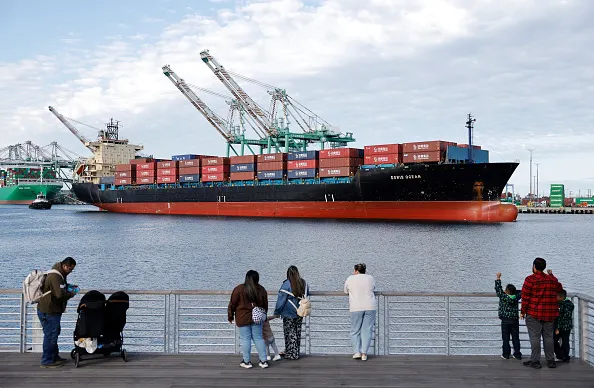
3, 2026 Jeff Kinney Editor Share Copy link Email / Print License Add us on Google People watch as the Doris Ocean container ship departs from the Port of Los Angeles on May 28, 2026, in Los Angeles. Mario Tama via Getty Images First published on Listen to the article 6 min This audio is auto-generated. Please let us know if you have feedback.
Economic activity in the U. S. manufacturing sector expanded in July for the seventh consecutive month to 55. 6%, or 2. 3 percentage points higher than June, according to the Institute for Supply Management’s latest Purchasing Managers’ Index. The overall economy grew for the 21st month in a row, ISM reported.
A figure below 50% indicates an industry in contraction. The S&P Global U. S. Manufacturing PMI showed a slightly higher rate of expansion, registering 53. 9, unchanged from June. “We have a really strong report this month,” Susan Spence, chair of ISM’s Manufacturing Business Survey Committee, said during a media call on Monday.
In July, 38% of respondents’ comments were positive while 62% were negative, with a 1:1. 6 ratio of positive to negative sentiment, she said in a news release. Spence added that pricing volatility was mentioned in 57% of negative comments, while the Iran war was mentioned in 43%, increasing lead times in 22% and tariffs in 18%.
Four of the six largest manufacturing industries — transportation equipment, machinery, computer and electronic products, and food, beverage and tobacco products — expanded in July. The New Orders Index expanded for the seventh consecutive month after four straight readings in contraction, registering 56. 7%, up 0.
7 percentage point compared to June’s figure of 56%. The July reading of the Production Index at 58. 5% was 6. 3 percentage points higher than June’s reading of 52. 2%. It was also the highest reading since November 2021 at 60. 5%. The Prices Index remained in expansion, registering 71. 1%, a 1. 9 percentage point decrease from June’s reading of 73%.
The Backlog of Orders Index registered 55%, up 4. 5 percentage points compared to the 50. 5% recorded in June. The Employment Index reading of 52. 8% was up 3. 1 percentage points from June’s figure of 49. 7%. The manufacturing industry added 3,000 jobs in June, a small improvement from May. The Supplier Deliveries Index reading of 58. 9% was up 1.
5 percentage points from its June reading of 57. 4%. Supplier Deliveries is the only ISM PMI Report index in which a reading of above 50% indicates slower deliveries. The Inventories Index registered 51. 2%, down 0. 2 percentage point compared to June’s reading of 51. 4%. The Customers’ Inventories Index reading of 40. 7% was 1.
6 percentage points lower compared to 42. 3% in June. The New Export Orders Index returned to expansion territory with a reading of 53%, 4. 5 percentage points higher than the 48. 5% registered in June. The Imports Index registered 55. 7%, 2. 8 percentage points higher than June’s reading of 52. 9%.
Three of ISM’s four demand indicators — New Orders, Backlog of Orders and New Export Orders — were in expansion, and the Customers’ Inventories Index remained in ‘too low’ territory, contracting at a faster rate. A “too low” status for the Customers’ Inventories Index is usually considered positive for future production.
Prices, employment bright spots Spence acknowledged during the call that “the continued Iran war and remaining price volatility” are still risk factors for manufacturing. However, s he also noted that the employment index was “finally into expansion” for the first time in 33 months. “ Demand is up, and prices are up as a result,” she said.
Spence added that although the list of shortages “is pretty significant” and “certainly could get worse” depending on geopolitical factors, currently “orders are flowing”. “Overall, we’re definitely optimistic,” she said. Prices, market volatility and shortages were top of mind for many respondents in July.
“We are seeing a very opportunistic and reactive marketplace,” said one respondent in the chemical products industry. “If shortage items become available, we opportunistically buy. Some customers are reducing inventory, others are pulling forward demand. As many customers that are slowing down, an equal number are growing.
It looks like a lot of shuffling and shifting market share.” Respondents said geopolitical uncertainty is also complicating the economic picture for many of their businesses.
“Continued tariffs on products utilized in our product lines are being monitored by the business, which is working to mitigate or limit tariff risk,” said a commenter in the transportation equipment industry. “Geopolitical risk, especially in the Middle East, pertaining to commodity and energy markets remains a concern. There has been som
Original Source
This briefing is based on reporting from Supply Chain Dive. Use the original post for full primary-source context.
Style
Audience