

How meat sticks players are trying to find white space in the red-hot category
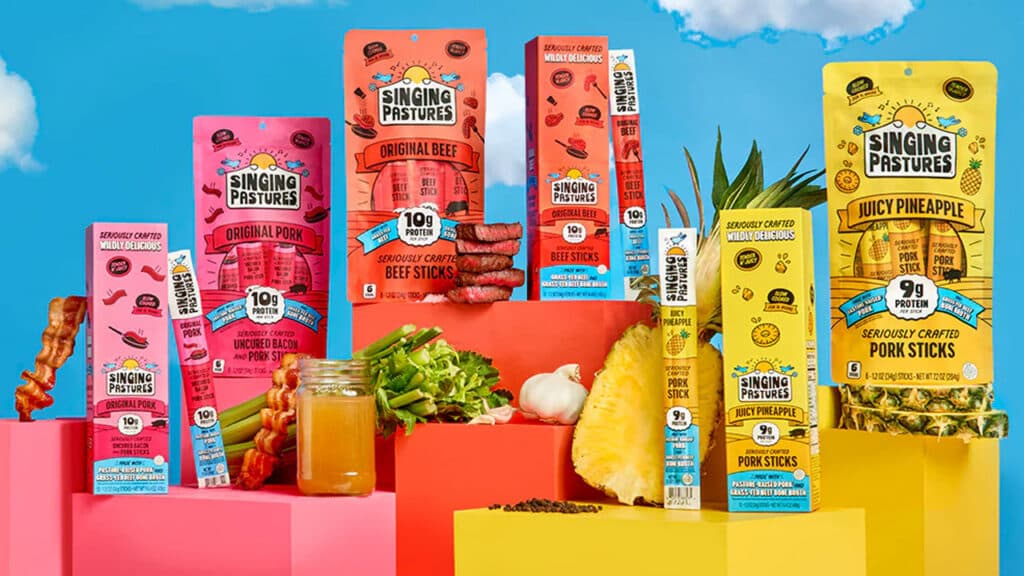
The growing meat snacks market is attracting new brands like Singing Pastures to jump in to challenge incumbents, even as major startups like Chomps and Archer continue to dominate the better-for-you subcategory.
Source Lens
Industry Context
Useful background context, but lower-priority than direct platform, community, or operator intelligence.
Impact Level
medium
Use this briefing to decide whether your team needs an immediate workflow, policy, or reporting change.
Key Stat / Trigger
No single quantitative trigger surfaced in this report.
Focus on the operational implication, not just the headline.
Full Coverage
CPG Playbook // June 11, 2026 How meat sticks players are trying to find white space in the red-hot category By Gabriela Barkho Singing Pastures The meat snacks market, which includes both sticks and jerky, is growing at a fast rate thanks to America’s obsession with high-protein everything.
According to Bank of America Global Research, the meat snacks category is valued at $5. 5 billion, accounting for 7% of the overall savory snack category, which hit $74. 9 billion in 2025. Meat snacks sales also grew 6. 6% in 2025, outpacing previous projections.
In recent years, brands like Chomps and Archer have helped reinvigorate the category’s stagnant look and recipe. Now, both larger and emerging companies want a bigger slice of the category. That includes PepsiCo, which launched its Good Warrior line of meat sticks this spring as part of its strategy to offer more nutritious snacks.
In turn, brands are on the hunt for white space in the category. Players like Signing Pastures and Chomps are trying to innovate in the space with new flavors, the addition of trending ingredients like collagen and bone broth, and by innovating with new proteins.
Shifting consumer behavior has also prompted brands to rethink their approach in the space Holly Arbuckle, co-founder and CEO of Singing Pastures, said when the category was exploding a few years ago, one thing she kept hearing from retailers was that women were eating more meat sticks.
That inspired her to overhaul the brand’s look and positioning to relaunch it in January. Singing Pastures first launched in 2016 and was largely sold through digital grocery stores like Misfits Market and Thrive Market. The company is owned by the Arbuckle family, which also operates its own farm in Maine.
“The brand is still inspired by the farm, even though we no longer source the meat sticks from our home farm,” said Arbuckles. The company rebranded from its old farm-to-table aesthetic, replacing it with packaging geared toward female shoppers.
The old packaging was mostly black and white with graphic pops of color, whereas the new SKUs each have a saturated corresponding color: red for original beef, pink for original pork and yellow for the juicy pineapple flavor. “Now it’s bright and bold and fun, and partly inspired by Fishwife’s look,” Arbuckle said.
The brand also revamped the recipe by adding grass-fed beef bone broth and collagen for added protein. The pineapple flavor also now features chunks of pineapple blended into the meat. “Our sticks are also fermented and slow-cooked with real hickory wood instead of liquid smoke, which takes twice as long to produce,” Arbuckles said.
With that, Singing Pastures also comes at a premium retail price of $3. 49 per stick. Arbuckle said that hasn’t deterred retailers so far. It’s an increase the company had to make due to the higher manufacturing costs. It previously charged about $2. 49 per stick.
Arbuckle said Singing Pastures plans to promote multi-packs and other in-store deals that make the cost per unit cheaper for customers. The brand is currently sold at Costco in the Northeast, at Sprouts and will roll out at select Whole Foods Market locations on the East Coast this fall.
“Our velocities at Costco were so good that we got a reorder,” she said. The brand’s overall year-to-date growth is 346%, with DTC sales up 67% year over year. Singing Pastures’ growth has also helped it secure new funding. In April, the brand raised a $2 million round led by investment firm Bullish.
Mike Duda, a managing partner at Bullish, said the firm was drawn to the brand’s distinct positioning in the meat stick category. “When you look at what’s been getting investor money, it’s protein, whether it’s sticks or bars,” Duda said.
“The underlying growing factor is GLP-1 use,” Duda said, with more people moving away from sugary bars to more natural and complete sources of protein. This shift is also what’s fueling dairy products with a high protein serving, like cottage cheese and yogurt.
“With Singing Pastures, you can get nine or 10 grams of protein in a very natural way, and it’s only 70 to 80 calories,” he continued. That caters to health-conscious female shoppers while still offering the convenience of a portable snack to take on the go. For the longest time, Duda said, brands like Slim Jim and Old Trapper were the main options.
That led to the perception that the category was built around a very male audience. “In our belief, the mom or the female that’s been buying it for others in the household is going to become more of the actual consumer in this category,” Duda said. “Players like Chomps are still a very viable business, and they deserve success,” Duda said.
“But there is a ton more room for high-protein options.” As for Chomps, there is still more growth to be had thanks to product innovation. The company’s latest venture into chicken-based sticks is paying off. &nbs
Original Source
This briefing is based on reporting from Modern Retail. Use the original post for full primary-source context.
Style
Audience