

Same Repair. Same Truck. Higher Invoice. Here Is the Number Behind What You Are Paying at the Parts Counter Right Now.
On October 17, 2025, President Trump signed a proclamation under Section 232 of the Trade Expansion Act of 1962, imposing a 25% tariff on imported medium and heavy-duty trucks and truck parts — Class 3 through Class 8 vehicles, engines, transmissions, tires, chassis components. It took effect November 1. For USMCA-compliant parts out of Mexico […] The post Same Repair. Same Truck. Higher Invoice. Here Is the Number Behind What You Are Paying at the Parts Counter Right Now. appeared first on Frei
Source Lens
Industry Context
Useful background context, but lower-priority than direct platform, community, or operator intelligence.
Impact Level
medium
Use this briefing to decide whether your team needs an immediate workflow, policy, or reporting change.
Key Stat / Trigger
No single quantitative trigger surfaced in this report.
Focus on the operational implication, not just the headline.
Full Coverage
On October 17, 2025, President Trump signed a proclamation under Section 232 of the Trade Expansion Act of 1962, imposing a 25% tariff on imported medium and heavy-duty trucks and truck parts — Class 3 through Class 8 vehicles, engines, transmissions, tires, chassis components. It took effect November 1.
For USMCA-compliant parts out of Mexico and Canada, the tariff applies only to the non-U. S. content of the component. Parts classified as knock-down kits or equivalent compilations? Fully dutiable, no exceptions. Clark Hill’s trade law analysis lays out the stacking rules and USMCA treatment in full if you need the legal detail.
Some carriers read the headline about new truck prices and figured it didn’t apply to them because they weren’t buying a new truck. That’s where the misread happened.
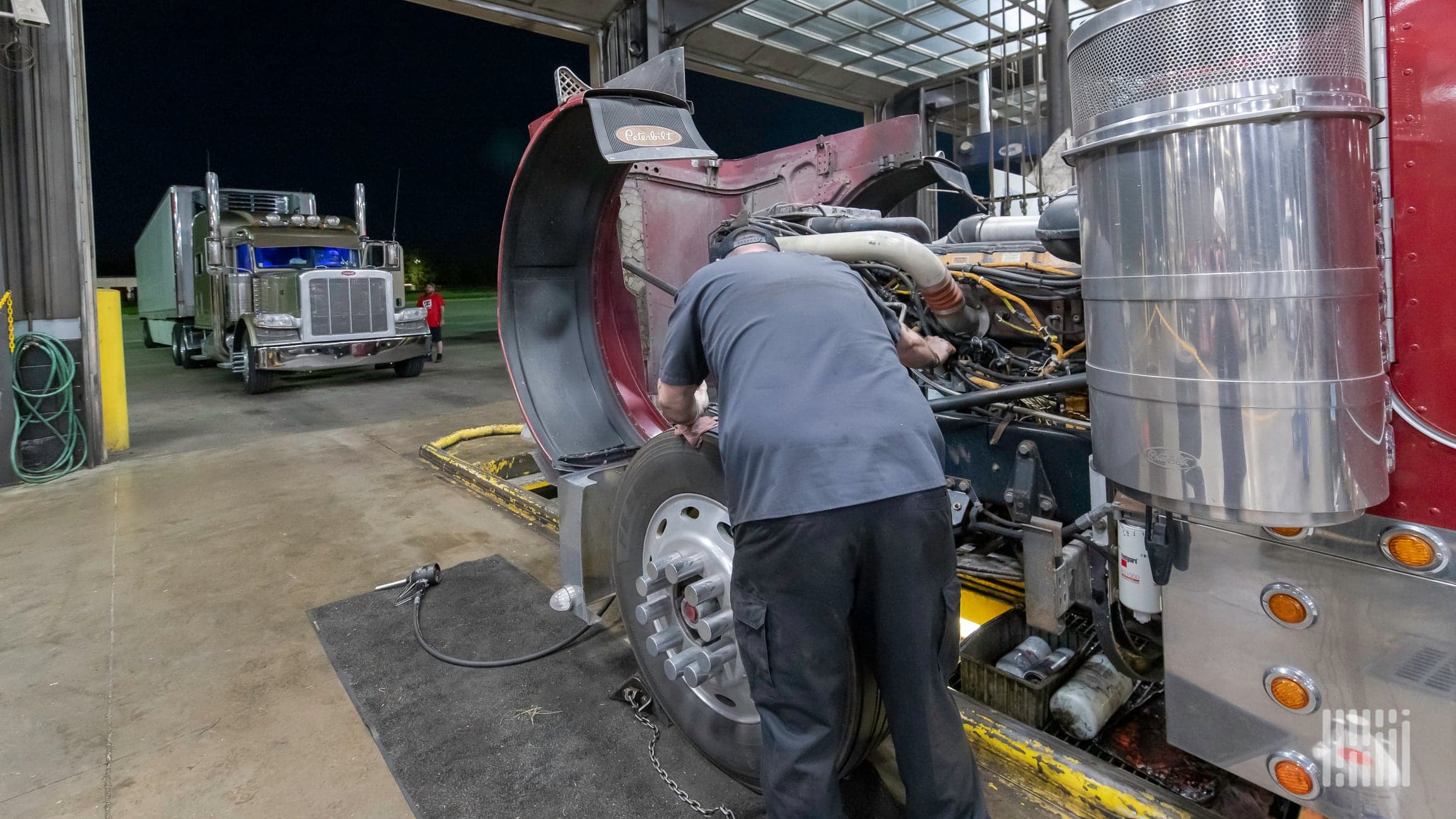
The components that fail most often on high-mileage trucks — injectors, turbochargers, EGR systems, DPF assemblies, transmissions — are now 20% to 30% more expensive to replace than they were before the tariff environment tightened. That’s according to Decisiv/TMC Parts and Labor Service Benchmark Report data cited by Decisiv CEO Tim Hardin.
And the increase isn’t only from the tariff itself. Hardin has been clear on this: supply chain anxiety pricing is its own mechanism. Distributors and parts manufacturers reprice preemptively, before any physical shortage materializes.
Truck News captured Hardin’s framing directly at the TMC annual meeting in Nashville: “Typically what I’ve seen is it gets priced into the supply chain regardless of whether there’s a physical impact or not.”
The Richmond Fed’s CFO Survey put a number on it: firms attribute close to 40% of total unit cost growth in 2025 and 2026 to tariffs and tariff-related uncertainty. Parts that aren’t directly subject to the tariff are catching price increases from the surrounding environment anyway. Then there’s steel and aluminum.
Section 232 duties on imported steel and aluminum now sit at 50%. Those input cost increases move through the manufacturing chain and land on the shelf at your local dealer. Brake components, chassis parts, frames, structural hardware — all of it is exposed.
The Invoice Isn’t Going to Tell You Why Before you can make a smart call at the parts counter, you need to understand what’s actually driving the price. Not every line item is tariffed the same way, and the invoice won’t tell you which is which. A part built entirely from U. S. -origin materials by a U. S. manufacturer carries no direct Section 232 exposure.
A part assembled in the U. S. from USMCA-compliant Mexican or Canadian components carries partial exposure — only on the non-U. S. content. A fully imported part from outside USMCA coverage carries the full 25%.
The Federal Register proclamation and CBP’s entry-filing guidance spell out the classifications, but distributors aren’t required to break any of that out on your invoice, and most don’t. What you see is one price that reflects wherever the component sits on that spectrum, plus whatever margin the distributor layered on top to cover their own uncertainty.
This matters because it determines which alternatives are actually worth pursuing — and which ones are just being marketed as cost-effective without the numbers to back it up. The Remanufactured Parts Case Is Stronger Now Than It’s Ever Been Remanufactured parts aren’t new to trucking.
Cummins, for instance have run large-scale remanufacturing operations for years. What’s changed is their competitive position relative to new imported components — and the shift is significant. Here’s why remaining parts are gaining ground right now: they’re rebuilt from cores sourced domestically. The remanufacturing process happens in the U. S.
, using a domestic workforce, starting from a domestic core. No Section 232 tariff exposure on the finished part. The global automotive parts remanufacturing market is projected at $74 billion in 2026, with North America holding roughly 45% of global market share, according to Persistence Market Research.
That market is growing because cost pressure on new imported components is pushing buyers toward alternatives. Remanufactured heavy-duty components — engines, transmissions, axles, brake systems, turbochargers, injectors, DPF assemblies — typically run 30% to 70% less than new parts while carrying equivalent performance specifications.
The American Trucking Associations’ total cost of ownership analysis supports that range. That cost gap existed before the tariff. It’s wider now because the baseline price of the new imported alternative went up, not because reman quality changed.
Multiple aftermarket distributors reported in Trucks, Parts, Service’s 2026 State of Industry Report that remanufactured and rebuilt components are outperforming the broader parts market as fleets hunt for cost relief without trading away reliability. Know What You’re Actually Buying The term gets misused, so it’s worth being specific.
A remanufactured part is not a used par
Original Source
This briefing is based on reporting from Freightwaves. Use the original post for full primary-source context.
Style
Audience