A Conversation With EAIGLE’s Leadership on Cargo Theft, Data Ownership and What a Smart Gate Actually Knows
The pitch for automated gate technology is almost always throughput, and the numbers are genuinely impressive, but a gate that clears a truck in three seconds is also a gate that has removed a human being from the one moment where somebody might have looked at a document and thought something about it felt wrong, […] The post A Conversation With EAIGLE’s Leadership on Cargo Theft, Data Ownership and What a Smart Gate Actually Knows appeared first on FreightWaves.
Source Lens
Industry Context
Useful background context, but lower-priority than direct platform, community, or operator intelligence.
Impact Level
medium
Use this briefing to decide whether your team needs an immediate workflow, policy, or reporting change.
Key Stat / Trigger
No single quantitative trigger surfaced in this report.
Focus on the operational implication, not just the headline.
Full Coverage
The pitch for automated gate technology is almost always throughput, and the numbers are genuinely impressive, but a gate that clears a truck in three seconds is also a gate that has removed a human being from the one moment where somebody might have looked at a document and thought something about it felt wrong, which is exactly the moment strategic cargo theft is designed to exploit.
So that is where I started. Does automation make a facility harder or easier to steal from? Amir Hoss, EAIGLE’s chief executive, did not hedge. Harder, he said, provided the gate is well integrated, and the qualifier is carrying weight in that sentence. His reasoning was specific. Fictitious pickups run on fake or expired documentation.
A gate that validates only a purchase order is not doing much. A gate that validates the bill of lading, handles shipments with multiple bills, and maps them against each other can catch documents that a person scanning paperwork in a queue would wave through. He described the pattern the system sees most often.
A fraudster uses an expired bill of lading to pick up a different load from the same carrier, paired with a trailer number where four of the five or six digits match the legitimate one and a single digit does not. That is an invisible discrepancy to a human under time pressure.
Hoss said the system flags cases like that roughly two to three times a month per site at their higher-volume facilities. EAIGLE’s team offered a second data point.
At a deployment with what they described as a top-five consumer packaged goods customer, the system detected three theft events in the first month, and that result is what drove the expansion to additional sites. All three involved either fake documentation or attempts to take empty trailers. The framing that stuck with me was about velocity.
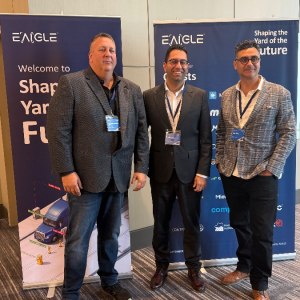
A gate is a high-throughput environment, and the errors that matter are single-digit ones. Humans miss those but machines do not. (Photo: Adam L. Wingfield, FreightWaves. EAIGLE uses existing camera integrations to deploy their solutions through, making a cost effective implementation strategy feasible with its customers.)
The Carrier Is Also an Identity Problem Directly on site I noticed Loblaw does not capture vehicle identification numbers, and I asked whether that becomes necessary at scale. Hoss said yes, but pointed at something more available. The Department of Transportation number is always visible and always present, which makes it the low-hanging fruit.
EAIGLE reads it from camera in real time, and then does the part I had not expected: it pulls the carrier’s history tied to that number, including theft history and claims, and evaluates it against a risk profile the customer has defined in advance.
Cross a threshold the customer set, and the transaction becomes an exception regardless of whether the paperwork is clean. That is a meaningful shift. The gate is no longer validating a transaction, it is scoring a counterparty. I pushed on the obvious hole.
Carrier identity fraud in the United States frequently involves a compromised DOT number, sometimes as crudely as a placard on a truck door. Hoss’s answer was that a digital identity is not one identifier, it is the collection of everything visible at once.
License plate, DOT number, truck number, color, even existing damage, cross-referenced against prior sightings of that equipment across the network. The practical version, he said, is that you can get most of the way there by matching two, the plate and the DOT, and confirming they belong together.
Who Owns the Failure The question I most wanted answered was contractual. When the system approves a truck that should never have been admitted, who is responsible? The answer turned on the standard operating procedure, which the customer defines and EAIGLE maps.
If the system followed the SOP and everything matched, the company’s position is that it did the job it was contracted to do. If the system checked, nothing matched, and the gate opened anyway, that lands on EAIGLE. Hoss said he could not recall a case where the SOP was followed correctly and the system failed.
A related point came up that I think matters more than it first appears. Risk scoring does not have to be binary. Rather than sending a low-scoring carrier straight to exception, a customer can tier the response. A clean grade proceeds normally. A middling grade triggers a license verification.
No information at all can trigger a deeper check where the driver photographs their license, takes a selfie, and the system confirms the two match. That is identity verification at the gate, and it is the sort of capability that exists quietly until an industry needs it. The Moat Question There is nothing proprietary about EAIGLE’s cameras.
The company says so plainly, and at Loblaw it taps infrastructure the site already had. So I asked the uncomfortable version: what stops a telematics provider or a yard management vendor from building this nativel
Original Source
This briefing is based on reporting from Freightwaves. Use the original post for full primary-source context.
Style
Audience