

FMCSA warns trucking companies about 4 fake Motus registration sites
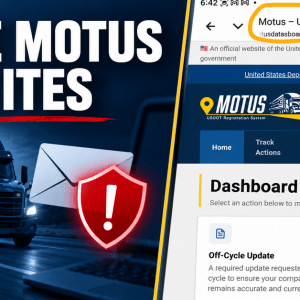
Scammers claim carrier profiles require immediate updates, then steer recipients toward.com domains. FMCSA identifies motus.dot.gov as the only legitimate portal. The post FMCSA warns trucking companies about 4 fake Motus registration sites appeared first on FreightWaves.
Source Lens
Industry Context
Useful background context, but lower-priority than direct platform, community, or operator intelligence.
Impact Level
medium
Use this briefing to decide whether your team needs an immediate workflow, policy, or reporting change.
Key Stat / Trigger
No single quantitative trigger surfaced in this report.
Focus on the operational implication, not just the headline.
Full Coverage
Scammers are targeting trucking companies with emails impersonating FMCSA’s new Motus registration system. The notices direct recipients toward four bogus websites resembling the federal portal. Each message claims an off-cycle profile update requires immediate attention. Regulators now urge customers to avoid every listed destination.
“Latest reports indicate that bad actors have started to impersonate the Motus website application,” FMCSA wrote. The legitimate service operates at motus. dot. gov. Fraudulent correspondence calls its destination the “New MOTUS Portal.” All-capital lettering provides another warning sign because officials write the name as Motus.
One real site and four fakes Only one URL belongs to the federal government. It ends in dot. gov. Regulators connected every imitation below with the scheme. None carries an official domain. window. googletag = window. googletag || {cmd: []}; googletag. cmd. push(function() {var gptSlot = googletag.
defineSlot('/21776187881/FW-Responsive-Main_Content-Slot1', [[300, 100], [320, 50], [728, 90], [468, 60]], 'div-gpt-ad-1709668545404-0'). defineSizeMapping(gptSizeMaps. banner1). addService(googletag. pubads()); googletag. pubads(). enableSingleRequest(); googletag. pubads(). collapseEmptyDivs(); googletag. enableServices(); setInterval(function() {if (!
document. hidden) {googletag. pubads(). refresh([gptSlot]); } }, 30000); }); googletag. cmd. push(function() {googletag. display('div-gpt-ad-1709668545404-0'); }); REAL: motus. dot. gov FAKE: dot. motusdatasboard. com dot. motusdatadesk. com dot. motuswebdeck. com dot. motusfunction.
com The campaign uses the subject line “Notice of Required Off-Cycle Update- Motus email.” Its content urges recipients to click a “New MOTUS Portal” button. That link routes targets toward an outside destination. Federal officials recommend checking every address before taking action. FMCSA’s screenshot dates the example to August 2026.
The rolling alert page records a September 11 update. That timestamp covers the entire webpage, not each item. Scam follows system transition FMCSA launched Motus May 19 as its new USDOT registration system. Carriers, brokers and other regulated entities use it for applications or company updates.
The platform replaced several legacy processes during a wider modernization effort. Customers access the service through Login. gov. On September 10, regulators temporarily suspended biennial-update enforcement to reduce transition disruptions. That decision also paused USDOT-number inactivation for missed filings due after June 1.
Officials plan to release additional guidance while recovery work continues. Unsolicited correspondence does not override those instructions. Potential targets should avoid clicking questionable links. Complaints can go through the Federal Trade Commission or FBI Internet Crime Complaint Center. Local police and state attorneys general also accept reports.
FMCSA handles registration questions at 1-800-832-5660. window. googletag = window. googletag || {cmd: []}; googletag. cmd. push(function() {var gptSlot = googletag. defineSlot('/21776187881/fw-responsive-main_content-slot3', [[728, 90], [468, 60], [320, 50], [300, 100]], 'div-gpt-ad-1665767553440-0'). defineSizeMapping(gptSizeMaps. banner1).
addService(googletag. pubads()); googletag. pubads(). enableSingleRequest(); googletag. pubads(). collapseEmptyDivs(); googletag. enableServices(); setInterval(function() {if (! document. hidden) {googletag. pubads(). refresh([gptSlot]); } }, 30000); }); googletag. cmd. push(function() {googletag.
display('div-gpt-ad-1665767553440-0'); }); Questions remain The agency has not disclosed when the campaign began or how many recipients encountered it. The warning provides no victim count, financial losses or confirmed account takeovers. Authorities have yet to connect these pages with unauthorized registration changes or cargo theft.
FreightWaves requested additional information from FMCSA and will update this article if officials respond. Why it matters Carrier registration records help brokers and shippers confirm who controls a trucking company. A successful account takeover could weaken safeguards that depend on federal identity data.
CFCO In my opinion, CFCO training gives freight teams practical habits for recognizing impersonation attempts before criminals capture valuable credentials. The program strengthens identity checks, access controls, domain review and escalation procedures across daily operations.
Those skills help employees pause when urgent messages demand profile changes through unfamiliar websites. Better preparation can turn one suspicious link into a reported threat instead of causing costly damage. window. googletag = window. googletag || {cmd: []}; googletag. cmd. push(function() {var gptSlot = googletag.
defineSlot('/21776187881/fw-responsive-main_content-slot4', [[300, 100], [320, 50], [728, 90], [468, 60]], 'div-gpt-ad-1709668086344-0'). defineSizeMapping(gptSizeMaps. banner1). addService(googletag. pubads()); goo
Original Source
This briefing is based on reporting from Freightwaves. Use the original post for full primary-source context.
Style
Audience