

Manufacturers balance costs, inventory amid uncertain rate environment
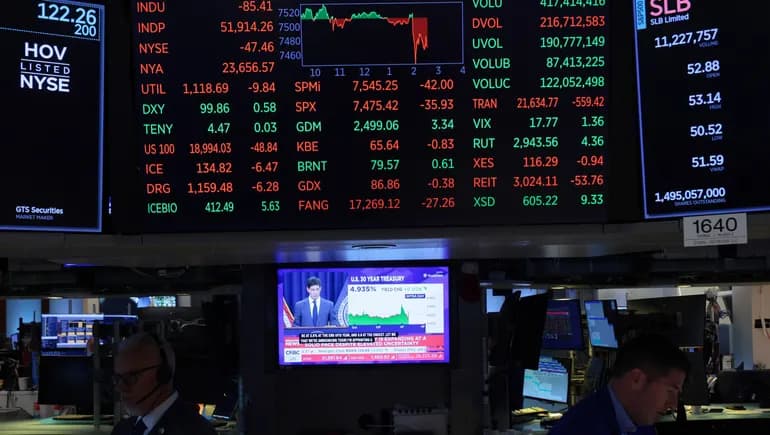
As companies watch to see if the Federal Reserve may change its posture on interest rates later in the year, and ripple effects from the Middle East continue, they’re getting more comfortable navigating the complexity.
Source Lens
Industry Context
Useful background context, but lower-priority than direct platform, community, or operator intelligence.
Impact Level
medium
Use this briefing to decide whether your team needs an immediate workflow, policy, or reporting change.
Key Stat / Trigger
No single quantitative trigger surfaced in this report.
Focus on the operational implication, not just the headline.
Full Coverage
An article from Manufacturers balance costs, inventory amid uncertain rate environment As companies watch to see if the Federal Reserve may change its posture on interest rates later in the year, they’re getting more comfortable navigating the complexity.
Published June 23, 2026 By Keesa Schreane Share Copy link Email / Print License Add us on Google A television displays a Kevin Warsh, chairman of the Federal Reserve, press conference as traders work on the floor of the New York Stock Exchange during afternoon trading on June 17, 2026 in New York City. Michael M.
Santiago via Getty Images First published on As manufacturers move into the second half of 2026, they continue to navigate a complex mix of interest rates, inventory decisions, energy volatility and geopolitical uncertainty. While inflation accelerated to 4.
2% year over year in May, according to the latest Consumer Price Index report, executives and advisors say companies are still planning investments to help them compete beyond 2026. One piece of good news for manufacturers is that the Federal Reserve kept interest rates unchanged at the last Wednesday’s Federal Open Market Committee meeting.
Experts say this steadiness in an otherwise uncertain environment can be especially helpful, given the difficulty large manufacturers may have shifting course after their factories are built and their machinery is purchased.
Preparing for 2027 through targeted investments Alex Krutz, managing director at Patriot Industrial Partners, said issues such as oil price volatility stemming from the war in Iran may prove to be minor disruptions compared to the economic shocks triggered by COVID-19 in 2020.
"I don't think that companies in manufacturing, which is usually years in investment and planning, will make drastic decisions based upon a short-term shock," he said.
Krutz, who served as deputy assistant secretary for manufacturing at the Commerce Department in 2025, believes companies will take a more measured, strategic approach to navigating uncertainty.
“I think that company leaders need to be cognizant of laying out a plan that shows the roadmap for their investors, where they're going to go for their investors, and what it's going to take to get there,” he said.
Krutz sees five trends that manufacturers are investing in as they prepare for the second half of the year: A shift from global sourcing toward more localized supply chains, ensuring suppliers are located closer to production facilities and end customers.
Efforts to develop an energy strategy by evaluating energy costs, grid reliability and emerging technologies. Increasing localized production of high-value and strategically important components, such as semiconductors, pharmaceuticals and other specialized products, to reduce supply chain vulnerabilities.
A growing connection between industrial strategy, economic security and national security. Manufacturers are paying closer attention to how sourcing decisions, production capabilities and supply chain resilience align with broader economic priorities.
Plans to pursue targeted, shorter-term artificial intelligence projects that can generate measurable operational improvements and productivity gains. Initiatives like these support competitive positioning and may not always be out of reach financially, according to experts.
Scott Spyker, a supply chain technology expert who works closely with manufacturers, said uncertainty, not necessarily costs themselves, is often what causes companies to hesitate. “Companies really don't care what the game is. As long as they know what it is, they can play it,” said Spyker, a partner at Neos by Argon & Co.
The challenge, he said, is that ongoing geopolitical events and economic volatility make it difficult for organizations to confidently plan investments months or years into the future. When companies are unsure what conditions will look like six months from now, they often become more cautious with spending and capital deployment.
“Cost inflation is likely the biggest earnings risk for U. S. industrials beyond the next two quarters as input costs rise,” said Mustafa Okur, a senior research analyst for Bloomberg Intelligence, in a May 29 report.
The report noted that while many manufacturers benefit from short-term protection through hedging contracts, recovering margins through pricing actions can take considerably longer. It also noted that many industrial companies report being better prepared for inflationary pressures today than they were during the last major inflation cycle.
While inflation remains a concern, historical performance suggests many manufacturers have become more effective at protecting profitability once pricing actions and operational adjustments take hold. Permission granted by Bloomberg Finance L. P.
Prioritizing inventory and supply chain flexibility One area where manufacturers may have a higher degree of control is inventory management. During the pandemi
Original Source
This briefing is based on reporting from Supply Chain Dive. Use the original post for full primary-source context.
Style
Audience