

New York to lose $73 million playing licensing games with the Duffy
FMCSA withheld $73.5 million from New York after finding 53% of commercial driver's licenses were issued illegally, with drivers holding CDLs years beyond their work authorization expiration dates.
Freight theft and delivery reliability issues will likely increase as unvetted drivers remain on roads with invalid licenses. Sellers should audit their 3PL partners' carrier vetting processes and consider requiring additional insurance coverage for New York-based trucking companies.
This reflects broader supply chain reliability issues as regulatory enforcement tightens, potentially driving up logistics costs and insurance requirements for ecommerce fulfillment.
Review your 3PL and freight broker contracts - add clauses requiring carrier license verification and additional liability coverage for regulatory violations
Increase cargo insurance limits for shipments handled by New York-domiciled carriers given higher theft risk from improperly licensed drivers
Bottom Line
NY CDL violations mean higher freight theft risk for sellers.
Source Lens
Industry Context
Useful background context, but lower-priority than direct platform, community, or operator intelligence.
Impact Level
medium
NY CDL violations mean higher freight theft risk for sellers.
Key Stat / Trigger
$73.5 million withheld from New York over 53% CDL violation rate
Focus on the operational implication, not just the headline.
Full Coverage
Transportation Secretary Sean Duffy announced today that FMCSA is formally withholding $73,502,543 from the state of New York after the state failed to complete required corrective actions following a federal audit that found a 53 percent failure rate in the state’s non-domiciled commercial driver’s license program.
Of the 200 sampled records, 107 were issued in violation of federal law. On March 13, FMCSA issued a formal response refuting New York’s claims of compliance and reiterating that the state had not completed the required rescission of noncompliant licenses.
After continued refusal, FMCSA issued a final determination of substantial noncompliance and moved to withhold the funds. This represents 4 percent of New York’s National Highway Performance Program and Surface Transportation Block Grant allocations.
FMCSA Administrator Derek Barrs called it a systematic, grossly unacceptable deviation from federal safety regulations that have been on the books for a long time. This is not a misunderstanding of a new rule. This is a state that had clear, longstanding federal requirements and programmed its own DMV system to ignore them.
When a foreign national applied for a CDL in New York, the DMV’s computer system automatically defaulted to issuing an 8-year license with non-REAL ID credentials, regardless of when that driver’s actual work authorization expired. A driver who walked in with a 60-day work authorization walked out with a credential valid until 2032.
A driver with a work permit expiring in May 2025 and a CDL expiring in May 2032, nearly seven years beyond their legal presence in the country. Auditors also found cases in which New York relied on expired lawful presence documents to issue licenses in the first place, meaning some drivers whose status had already lapsed were still being issued CDLs.
New York has 32,606 active non-domiciled CDLs in circulation, potentially making it the largest non-domiciled issuer in the country outside California. The state’s response was to call Duffy a liar.
New York DMV spokesman Walter McClure issued a statement saying Duffy was “lying about New York State once again in a desperate attempt to distract from the failing, chaotic administration he represents” and that every CDL New York issues is subject to lawful status verification.
That statement does not square with the admissions New York officials made to federal auditors, which included confirming that their system was, in fact, programmed to default to 8-year expirations regardless of legal presence documentation. I personally am inclined to believe the audit findings, Secretary Duffy and Administrator Barrs.
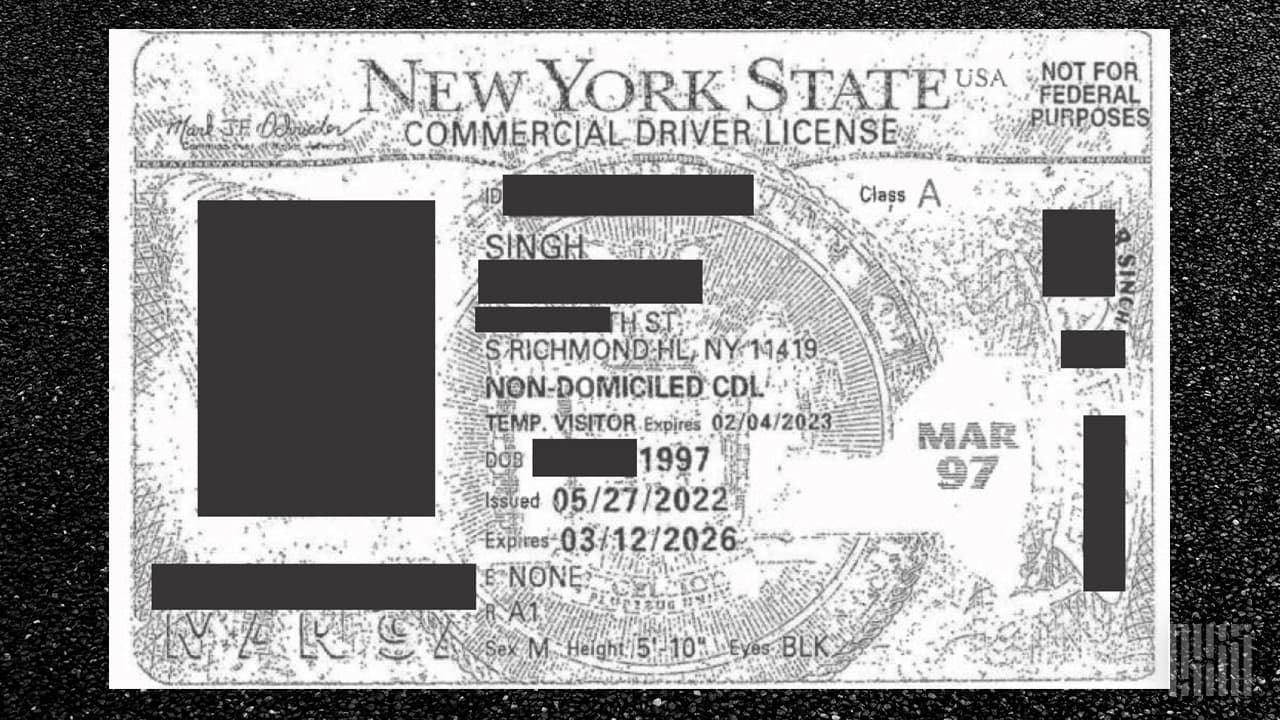
In a litigation case of my own, we have a theft case where a load was picked up by one of these drivers. Neither the load nor the driver was ever seen again. In the photo above, you see the “Temporary Visitor” expiration date expires 2/4/2023, while the Non-Domiciled CDL remained valid until 3/12/2026.
That means this driver held a CDL without a valid work authorization issued by NY for at least 3 years. Here’s the other issue here, a Temporary Visitor is a B-1/B-2 Visa, which typically means they’re not allowed to work at all.
So the validity of this license is in complete question, but at the end of the day, the CDL holder picked up a load, and neither he nor the load was ever seen again. These licensing standard issues have consequences for the public, for shippers, and for insurance companies.
I have covered California, North Carolina, Pennsylvania, Minnesota, Washington, South Dakota, Colorado, and now New York in this column. The state denials all sound the same. The audit findings all tell the same story. At some point, denial stops being a legal strategy and starts being a liability multiplier.
What does this actually mean for the people in this industry who have to operate in the real world while state and federal officials fight this out?
If you are a fleet based in New York or operating significant mileage in the Northeast corridor and you have non-domiciled drivers on your payroll holding New York-issued credentials, the time to audit your driver qualification files was yesterday.
Under federal regulations, a carrier that dispatches a driver operating on a license issued in violation of federal requirements assumes significant exposure. That exposure exists regardless of whether the carrier knew the license was noncompliant.
The burden is on you to verify that your drivers are legally qualified to operate the equipment they are driving.
If FMCSA’s audit findings are applied to the broader population of New York’s 32,606 non-domiciled CDL holders, and the 53 percent sample noncompliance rate holds, you may be looking at roughly 17,000 to 18,000 drivers in New York whose credentials may be deficient under federal standards.
Those are not small numbers in a state that feeds the country’s largest freight market. Your driver qualification file obligations do not change because the state made a
Original Source
This briefing is based on reporting from Freightwaves. Use the original post for full primary-source context.
Style
Audience