

What Tesco’s transition to QR codes powered by GS1 means for you
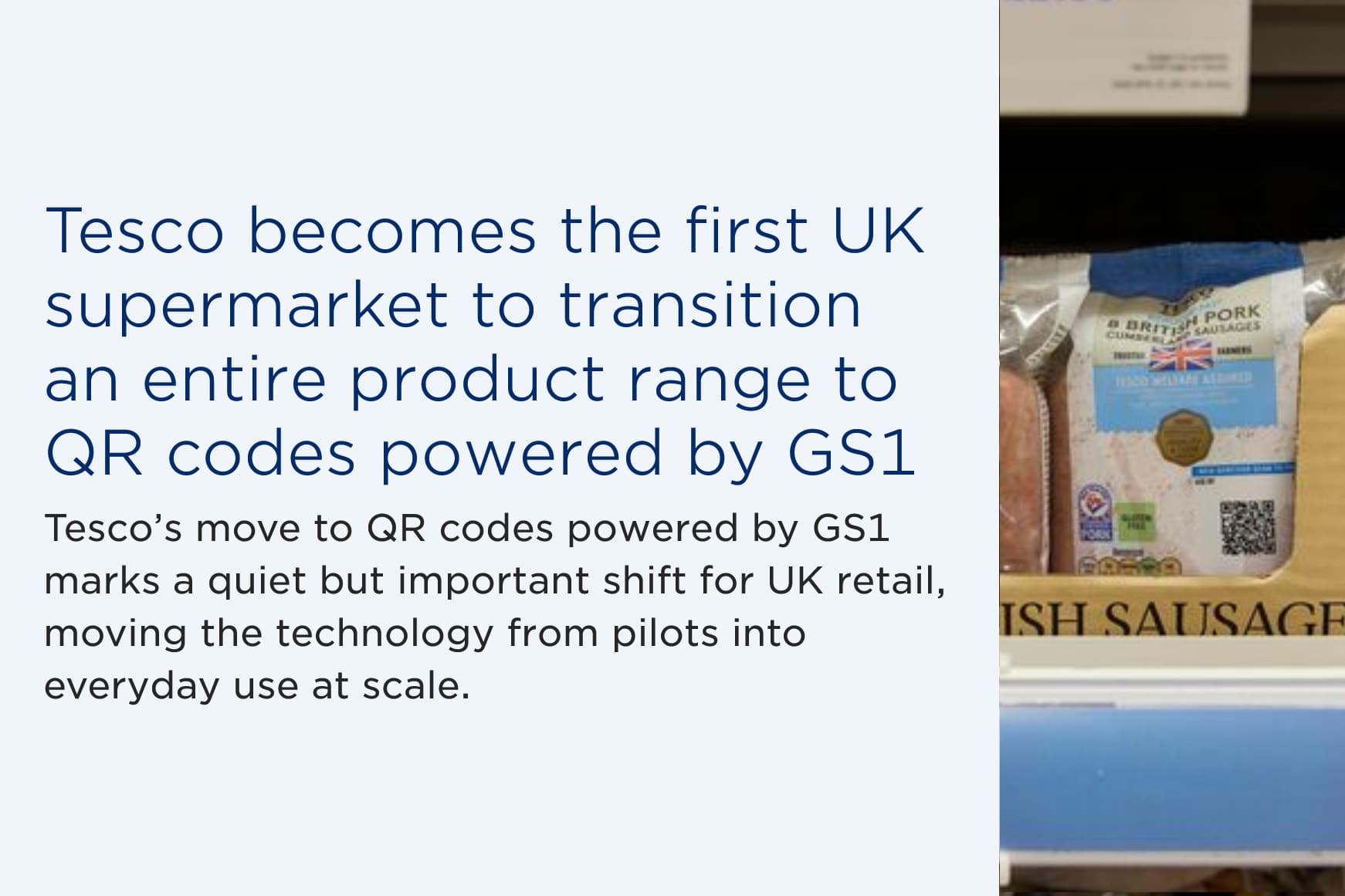
Tesco are doing what every marketplace seller, and indeed every retailer, will soon be undertaking. They’ve started the transition from traditional linear barcodes to QR codes, starting with their own‑label core sausage range. While the change will be largely invisible to shoppers at the checkout, it represents a significant step in how product data is […]
Source Lens
Industry Context
Useful background context, but lower-priority than direct platform, community, or operator intelligence.
Impact Level
medium
Use this briefing to decide whether your team needs an immediate workflow, policy, or reporting change.
Key Stat / Trigger
No single quantitative trigger surfaced in this report.
Focus on the operational implication, not just the headline.
Full Coverage
Tesco are doing what every marketplace seller, and indeed every retailer, will soon be undertaking. They’ve started the transition from traditional linear barcodes to QR codes, starting with their own‑label core sausage range.
While the change will be largely invisible to shoppers at the checkout, it represents a significant step in how product data is managed behind the scenes. By moving beyond pilots and adopting the next generation of barcodes across a live range, Tesco has shown how QR codes powered by GS1 can be embedded into day‑to‑day retail operations.
The move follows two years of industry pilots involving GS1 UK and a range of retail and brand partners. Those pilots focused on testing how QR codes powered by GS1 could work safely and reliably in real retail environments. Tesco’s decision now applies that learning in practice, marking a shift from exploration to implementation.
Linear barcodes are great for identifying a product when it’s scanned at the till, or for uploading to Amazon with certainty that it’s being assigned to the correct ASIN, but that’s where it stops.
Retailers are now expected to manage far richer product information, from expiry dates and batch data to sourcing, sustainability and regulatory requirements and that’s where the QR codes come in. QR codes powered by GS1 were identified by retailers, brands and regulators as a way to meet those demands without disrupting existing systems.
Linked to GS1 identifiers such as Global Trade Item Numbers (GTINs), they allow products to connect to trusted digital information that can be updated in real time, while still scanning at the checkout. Tesco’s transition is not about novelty or surface‑level change.
For retailers, the primary value of QR codes powered by GS1 sits in the operational foundations they enable. By capturing batch and date information more effectively, retailers can gain greater visibility of products within their stores. This supports more accurate inventory management, improved stock rotation and reduced food waste.
In the event of a product recall, QR codes powered by GS1 also enable far greater precision. Instead of withdrawing entire product lines, retailers can identify and manage specific affected batches, limiting disruption while improving availability and safety. Tesco’s decision matters not because it forces others to act, but because it sets a clear precedent.
And it’s going to impact you too – at the recent Interpack event Amazon were represented.
Discussions highlighted the growing momentum behind the transition to QR codes powered by GS1 at the point of sale and the EU Digital Product Passport, with panellists emphasising the value that more granular, standardised data can unlock for transparency and traceability across the whole supply chain.
Most organisations start with compliance, and that’s fine, but the real opportunity comes next. Richer, standardised product data enables better supply-chain intelligence and improved customer experiences. Compliance is just the first step – there’s additional value to be found in the journey.
– Monica Ravi, Director – Amazon Transparency, Amazon Monica Ravi’s comment is really interesting – most of us will slowly migrate to QR codes purely because the platforms we trade on require them, or because the EU Product Passport forces us to.
But the opportunity for better supply chain visibility and frankly the cost saving of including ever more information on product labels (or even printing physical product manuals) that can all be contained behind the QR code will add value and lower costs in the longer term.
Original Source
This briefing is based on reporting from Tamebay. Use the original post for full primary-source context.
Style
Audience