

The hidden operational challenges behind Europe’s 3P commerce opportunity
David Jennison, Managing Director, Europe at Pattern, discusses the operational challenges when operating on European marketplaces and the cross-border complexity that impacts commercial performance: For many brands, the shift from a first-party (1P) retail model to third-party (3P) marketplaces promises greater control over pricing, product content, customer experience and growth. Instead of selling wholesale, brands can […]
Source Lens
Industry Context
Useful background context, but lower-priority than direct platform, community, or operator intelligence.
Impact Level
medium
Use this briefing to decide whether your team needs an immediate workflow, policy, or reporting change.
Key Stat / Trigger
No single quantitative trigger surfaced in this report.
Focus on the operational implication, not just the headline.
Full Coverage
David Jennison, Managing Director, Europe at Pattern, discusses the operational challenges when operating on European marketplaces and the cross-border complexity that impacts commercial performance: For many brands, the shift from a first-party (1P) retail model to third-party (3P) marketplaces promises greater control over pricing, product content, customer experience and growth.
Instead of selling wholesale, brands can list directly, set pricing, access more data and influence how products appear online. It is easy to see why the model is attractive. The UK remains one of Europe’s most mature ecommerce markets, with online sales accounting for more than a quarter of total retail sales so far in 2026.
Marketplaces now play a central role in how consumers discover, research and purchase products, making 3P commerce a natural growth opportunity for brands looking to increase visibility and strengthen control over their performance. However, greater control also brings greater accountability. The move to 3P does not remove complexity. It transfers it.
Responsibilities that once sat with retailers increasingly fall to brands themselves, from inventory planning and pricing to compliance, fulfilment, returns and customer experience. Why greater marketplace control brings greater accountability Under a 1P model, brands sacrifice some visibility and control but benefit from a degree of operational protection.
Retailers typically absorb inventory risk, manage replenishment, handle fulfilment and own much of the customer relationship. In a 3P model, brands gain the freedom to control pricing, promotions, content and marketplace strategy. They also gain access to richer data and stronger performance insights.
In return, they take on greater operational responsibility and commercial risk. This is where many businesses underestimate the challenge. Marketplace success is often discussed in terms of visibility, advertising and conversion rates, but those outcomes are heavily influenced by operational performance behind the scenes.
Get inventory forecasting wrong and a stockout doesn’t just cost a week of sales. Marketplaces reward consistent availability with better search placement and punish the opposite, so two weeks out of stock can mean two months clawing back the ranking that was lost — the algorithm’s memory runs longer than the outage.
Overstocking causes a quieter version of the same problem: capital tied up, margin eroded through discounting, a business that looks like it’s growing while its unit economics get worse underneath. The same is true of pricing and fulfilment.
Inconsistent pricing across channels can create customer confusion and strain partner relationships, while poor delivery performance reflects on the brand regardless of whether the customer purchased through a marketplace. As brands gain control, they also inherit responsibility for maintaining a consistent and reliable customer experience.
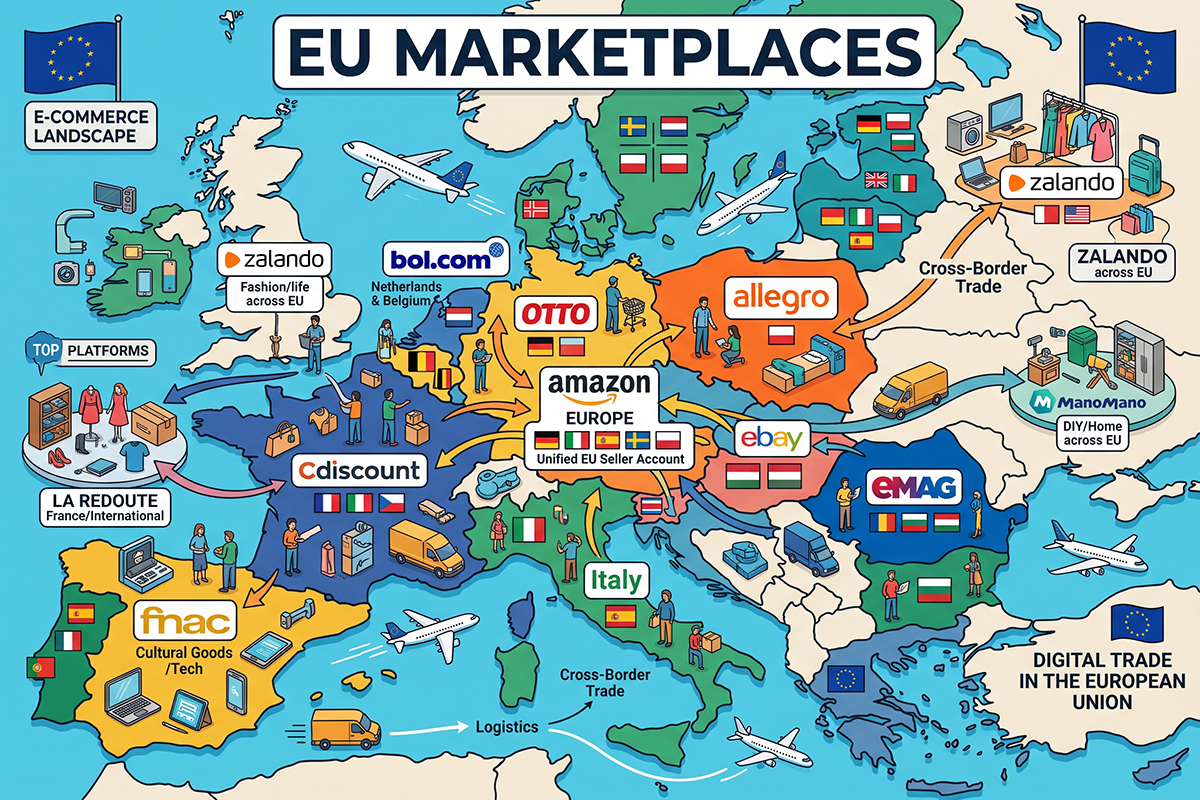
Europe’s fragmented ecommerce landscape raises the stakes Unlike the United States, Europe is not a single ecommerce market. Brands must navigate different languages, tax regimes, marketplace ecosystems, payment preferences and consumer expectations.
A strategy that succeeds in the UK will not necessarily translate directly into Germany, France, Italy or Spain. For UK brands expanding into Europe, cross-border complexity can quickly affect commercial performance.
VAT registration, customs requirements, local regulations, fulfilment decisions and returns processes all have a direct impact on margin and scalability. These factors often determine whether international expansion strengthens profitability or simply creates the appearance of growth while operational costs continue to rise.
Returns add another layer of complexity. In ecommerce, reverse logistics remains a significant expense, and brands operating under a 3P model must understand not only how to generate demand, but how every operational decision influences profitability, cash flow and customer loyalty.
Data is only valuable when it drives better decisions One of the biggest reasons brands transition to 3P is access to better data. Marketplace environments offer greater visibility into customer behaviour, search trends, conversion performance, reviews and pricing than traditional wholesale relationships. Yet data alone does not improve outcomes.
Its value lies in how effectively businesses use it to make better operational decisions. Many brands have ambitious marketplace growth plans, but operational readiness does not always keep pace with ambition. Greater visibility means little if forecasting, inventory management and fulfilment processes are unable to support that growth.
To make 3P profitable and sustainable, brands need to connect marketplace insights with forecasting, inventory planning, pricing, promotional activity and fulfilment capacity. That requires a more integrated approach across ecommerce, marketing, operations, finance and custo
Original Source
This briefing is based on reporting from Tamebay. Use the original post for full primary-source context.
Style
Audience