Tesla wins lead role in 2,500-truck electric Class 8 order
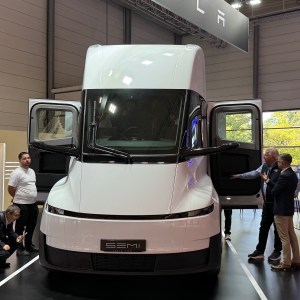
The order is the largest for electric trucks in the U.S. to date, organizers say. Deployments will concentrate in 10 freight hubs from Los Angeles to Newark. The post Tesla wins lead role in 2,500-truck electric Class 8 order appeared first on FreightWaves.
Source Lens
Industry Context
Useful background context, but lower-priority than direct platform, community, or operator intelligence.
Impact Level
medium
Use this briefing to decide whether your team needs an immediate workflow, policy, or reporting change.
Key Stat / Trigger
No single quantitative trigger surfaced in this report.
Focus on the operational implication, not just the headline.
Full Coverage
Tesla won the lead supplier role in a 2,500-truck battery-electric Class 8 order that its organizers say will nearly double the U. S. electric Class 8 fleet. Catalyst Mobility, the clean transportation nonprofit formerly known as CALSTART, and the Smart Freight Centre announced the order Tuesday and called it the largest electric truck order in the U. S.
to date. The trucks are being ordered through ZET SCALE, the Zero-Emission Truck Shipper-Carrier Alliance Leading Electrification, a program the two nonprofits run together. Its founding shippers include Microsoft and PepsiCo. The alliance’s stated goal is 10,000 trucks or more.
According to reporting by Electrive, only 875 zero-emission heavy trucks were sold in the U. S. in 2025, 0. 3% of the market, according to the International Council on Clean Transportation’s August 2026 global market monitor for zero-emission trucks and buses.
Pooled freight demand drove the bid ZET SCALE aggregated freight volume from its member shippers and put the trucks out through an independent request for proposals. window. googletag = window. googletag || {cmd: []}; googletag. cmd. push(function() {var gptSlot = googletag.
defineSlot('/21776187881/FW-Responsive-Main_Content-Slot1', [[300, 100], [320, 50], [728, 90], [468, 60]], 'div-gpt-ad-1709668545404-0'). defineSizeMapping(gptSizeMaps. banner1). addService(googletag. pubads()); googletag. pubads(). enableSingleRequest(); googletag. pubads(). collapseEmptyDivs(); googletag. enableServices(); setInterval(function() {if (!
document. hidden) {googletag. pubads(). refresh([gptSlot]); } }, 30000); }); googletag. cmd. push(function() {googletag. display('div-gpt-ad-1709668545404-0'); }); “You can have good technology and still not have a market,” said Michael Berube, president and CEO of Catalyst Mobility.
“What is different about ZET SCALE is that the demand was organized so manufacturers could price at scale. That is how costs move, and that is how clean trucks leave the pilot phase.” The alliance scored bids on price, range, charging capability and production capacity before selecting Tesla.
“The Tesla Semi is designed for lower cost per mile operations than diesel,” said Dan Priestley, director for the Tesla Semi program. “ZET SCALE’s goals are exciting because they take the operational cost advantage and predictability that electricity provides and amplifies it at scale.”
Kenworth, RIDE and Volvo were named secondary OEMs, available to carriers whose operations call for a different truck. Catalyst did not say how many of the 2,500 trucks will be Semis. Tesla plans to inaugurate its Semi factory in Sparks, Nev. , on Sept. 24. The plant is designed to build 50,000 trucks a year.
Lease keeps residual risk off carriers ZET Financial, a strategic partner to the alliance, is issuing the purchase order for the 2,500 trucks and will place them with carriers through its fair market value lease program. The structure, called ZET Lease, removes residual-value risk from the fleet operator.
Catalyst said that risk has kept many carriers and fleets on the sidelines. The company also builds a cost analysis around each fleet’s own duty cycle and operating data. Peter Flynn, CEO and founder of ZET Financial, said that assessment accounts for financing, electricity versus diesel fuel and maintenance. window. googletag = window.
googletag || {cmd: []}; googletag. cmd. push(function() {var gptSlot = googletag. defineSlot('/21776187881/fw-responsive-main_content-slot3', [[728, 90], [468, 60], [320, 50], [300, 100]], 'div-gpt-ad-1665767553440-0'). defineSizeMapping(gptSizeMaps. banner1). addService(googletag. pubads()); googletag. pubads(). enableSingleRequest(); googletag. pubads().
collapseEmptyDivs(); googletag. enableServices(); setInterval(function() {if (! document. hidden) {googletag. pubads(). refresh([gptSlot]); } }, 30000); }); googletag. cmd. push(function() {googletag.
display('div-gpt-ad-1665767553440-0'); }); The first round concentrates trucks in 10 freight hubs: Los Angeles, Stockton and Bakersfield in California; Seattle-Tacoma; Houston, Dallas and San Antonio; the Chicago area; Atlanta; and the Newark-New York City area. The alliance is recruiting more shippers and carriers to expand into new regions.
Advocacy groups press legacy truck makers Environmental groups including the Natural Resources Defense Council, Sierra Club and Transport & Environment used the order to press legacy manufacturers on electric truck pricing in a joint release the Sunrise Project emailed to FreightWaves. The median price of a U. S.
battery-electric Class 8 tractor rose 27% between model years 2020 and 2025, to $411,200, according to the ICCT’s September 2025 working paper, “Battery electric commercial vehicle pricing in the United States.” The median diesel equivalent in that dataset was $172,500. Both figures are in 2022 dollars. California Gov. Gavin Newsom signed SB 1213 on Sept.
20. His office said the law aims to improve transparency in state incentives for zero-emission trucks. The
Original Source
This briefing is based on reporting from Freightwaves. Use the original post for full primary-source context.
Style
Audience