

Mother’s Day Outspends Father’s Day by Billions—Here’s Why
Every year, consumers show up for Mother’s Day with bigger budgets, broader participation, and more emotional urgency than they do for Father’s Day. In 2026, shoppers were expected to spend a record $38 billion on Mother’s Day, according to the National Retail Federation’s latest Mother’s Day survey. For Father’s Day, spending was also projected to … The post Mother’s Day Outspends Father’s Day by Billions—Here’s Why first appeared on EcomCrew.
Source Lens
Operator Tactics
Tactical content that tends to be strongest when tied to workflow, process, or execution.
Impact Level
medium
Use this briefing to decide whether your team needs an immediate workflow, policy, or reporting change.
Key Stat / Trigger
No single quantitative trigger surfaced in this report.
Focus on the operational implication, not just the headline.
Full Coverage
Every year, consumers show up for Mother’s Day with bigger budgets, broader participation, and more emotional urgency than they do for Father’s Day. In 2026, shoppers were expected to spend a record $38 billion on Mother’s Day, according to the National Retail Federation’s latest Mother’s Day survey.
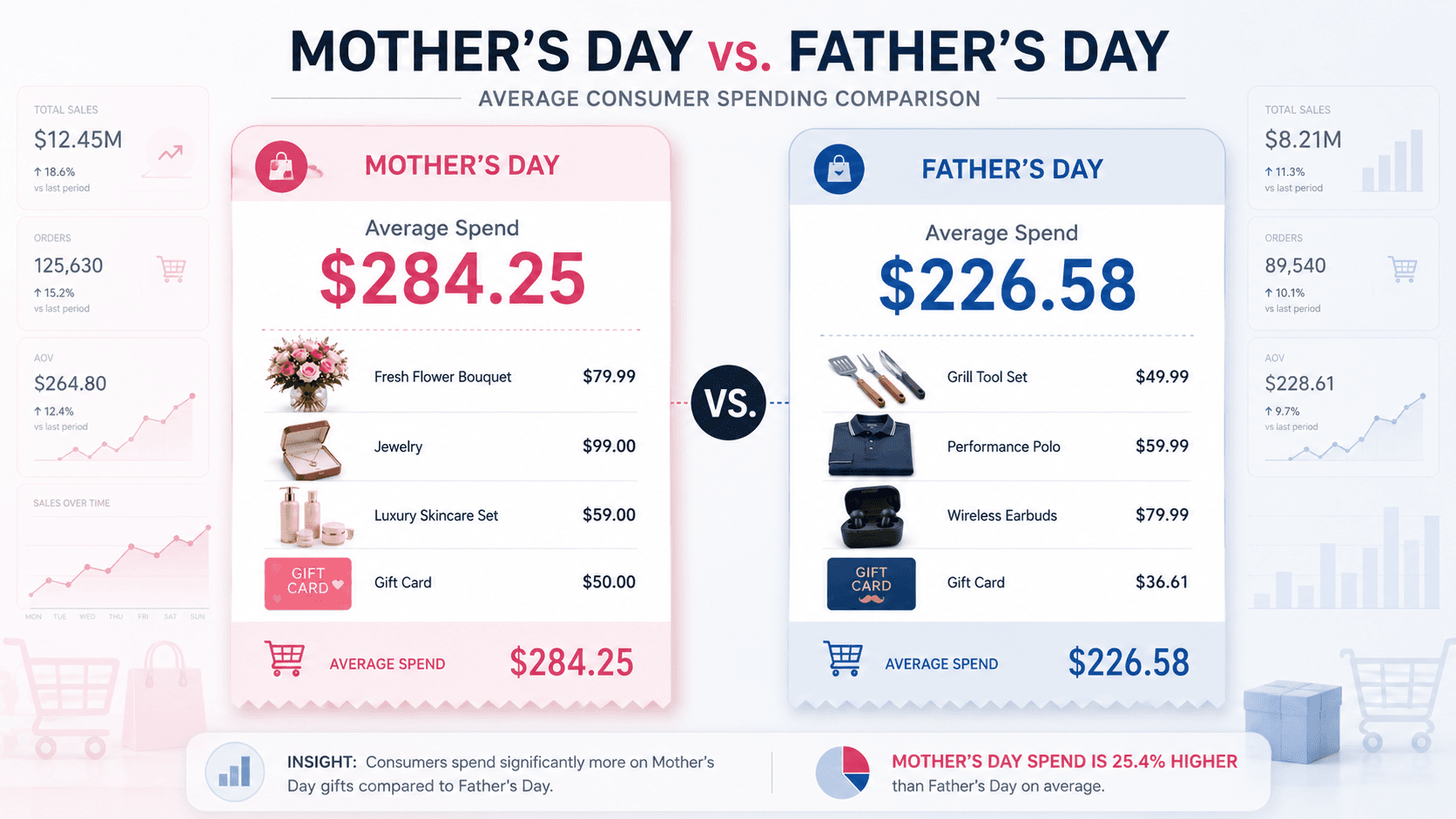
For Father’s Day, spending was also projected to hit a record high, but at a much lower total: $27. 9 billion, based on NRF’s Father’s Day spending data. That is still a massive holiday. But it also means Mother’s Day outspends Father’s Day by roughly $10. 1 billion. On a per-person basis, the gap is just as clear. Consumers planned to spend $284.
25 on Mother’s Day gifts in 2026, compared with $226. 58 on Father’s Day. Participation is higher too: 84% of U. S. adults planned to celebrate Mother’s Day, while 77% planned to celebrate Father’s Day. For ecommerce sellers, this is more than a fun retail trivia question.
It is a useful look at how emotional buying behavior, holiday timing, product category, and advertising strategy can shape demand. If you sell on Amazon, Shopify, Walmart, or any other marketplace, the lesson is obvious: not all gifting holidays behave the same. The Spending Gap Is Smaller Than Before, But Still Huge The Mother’s Day vs.
Father’s Day gap has narrowed in 2026 because Father’s Day spending jumped meaningfully from the previous record of $24 billion in 2025 to $27. 9 billion in 2026. Dad is not exactly getting ignored anymore. But Mother’s Day is still the larger retail event by a comfortable margin.
The simplest explanation is that Mother’s Day combines three things ecommerce brands love: more shoppers, higher spend per shopper, and stronger emotional purchasing intent. Mother’s Day shoppers are not just buying a card because the calendar told them to.
They are often buying flowers, jewelry, special outings, gift cards, clothing, beauty items, electronics, and “something unique.” NRF reported that 75% of Mother’s Day shoppers planned to buy flowers, while jewelry led total category spending at $7. 5 billion. Father’s Day shoppers are also spending more than ever, but the category mix looks different.
NRF’s 2026 data shows greeting cards, clothing, special outings, and gift cards leading the list. Those are valuable categories, but the emotional and premium-gifting ceiling still tends to be lower. That is where ecommerce brands should pay attention. The gap is not just about moms and dads. It is about how consumers assign emotional value to a purchase.
Mother’s Day Had a 58-Year Commercial Head Start One reason Mother’s Day has a deeper retail footprint is simple: it became official much earlier. Mother’s Day was made a national observance in the United States in 1914, when President Woodrow Wilson proclaimed the second Sunday in May as the holiday.
Father’s Day, despite being celebrated in some form earlier, did not become a national holiday until 1972. That gave Mother’s Day a 58-year head start in building traditions around flowers, cards, restaurants, jewelry, and gifting rituals. That kind of head start matters in retail. Commercial habits compound.
Once families get used to buying flowers, booking brunch, sending cards, and spending extra on mom every year, those behaviors do not vanish just because another holiday gets added to the calendar. Retailers also had decades longer to train shoppers around Mother’s Day promotions.
Florists, jewelers, restaurants, department stores, and eventually ecommerce brands all built campaigns around the idea that Mother’s Day is a major gift-giving moment. Father’s Day has grown, especially in categories like apparel, electronics, grilling, tools, personal care, subscription boxes, and experiences.
But it is still catching up to a holiday with more than a century of commercial muscle behind it. Mother’s Day Marketing Is More Emotional Look at the average Mother’s Day ad and the message is usually serious, sentimental, and appreciation-heavy. Mom sacrificed. Mom showed up. Mom deserves something special. Now look at a lot of Father’s Day marketing.
Dad likes grilling. Dad needs socks. Dad wants a gadget. Dad makes bad jokes. Dad will be fine. This is not exactly subtle. Mother’s Day campaigns often push shoppers toward emotionally loaded, higher-consideration gifts. Father’s Day campaigns often lean into humor, practicality, and last-minute convenience. That difference affects spending behavior.
If a customer feels that the purchase is tied to gratitude, sacrifice, and emotional recognition, they are often more willing to spend more. If the purchase feels like a practical token, the ceiling is lower. For sellers, this is where product positioning matters.
A garden statue, necklace, spa set, framed photo, or personalized keepsake can become a “meaningful gift for Mom” with the right creative. A grill basket, multitool, or polo shirt can absolutely work for Father’s Day, but the messaging usually has to fight harder to create the same emotional premium. T
Original Source
This briefing is based on reporting from EcomCrew. Use the original post for full primary-source context.
Style
Audience