

Did Amazon Cross a Red Line by Removing Credit Cards for Ad Payments?
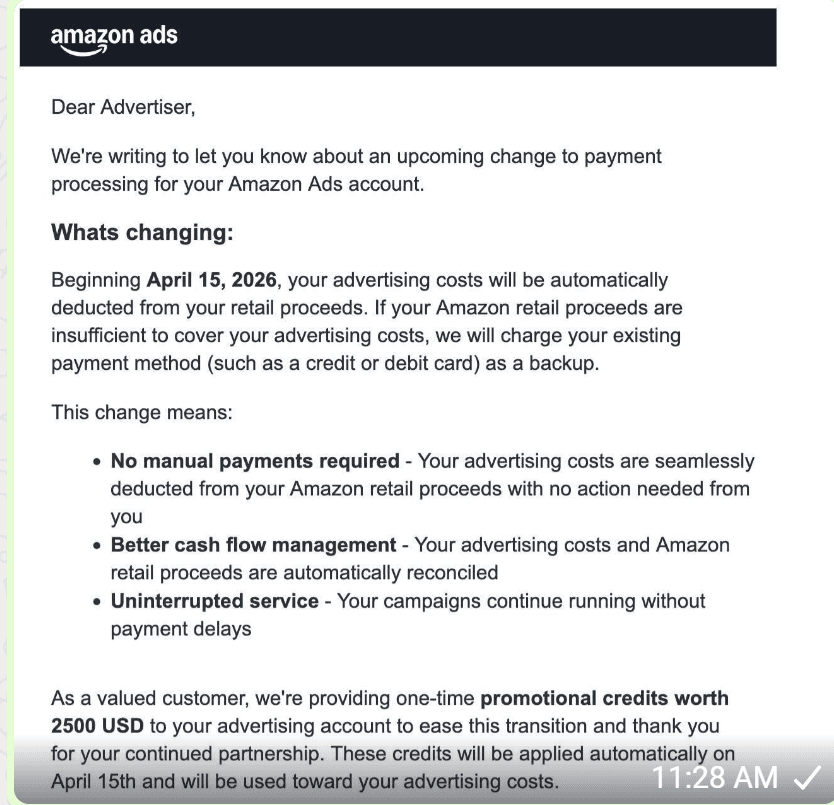
Amazon notified select sellers on April 2 that credit card payments for advertising fees will be disallowed starting April 15, 2024. No official Seller Central announcement has been made, so it's unclear if this applies to all sellers or just high-spend accounts.
Losing credit card rewards on ad spend could force sellers to scrutinize whether their 15-20% TACoS is actually profitable. This might accidentally improve seller profitability if they reduce wasteful ad spend rather than just switching payment methods.
Amazon's shift toward advertising revenue (20%+ growth vs 10% retail growth) shows they're prioritizing margins over seller convenience, signaling more monetization pressure ahead.
Check your advertising reports in Seller Central -- if TACoS is above 15-20%, audit campaigns before the April 15 deadline.
Set up ACH bank payments in your Amazon advertising account to avoid disruption if the policy expands to your account.
Bottom Line
Amazon blocks credit cards for ads means sellers lose points and might cut spend.
Source Lens
Operator Tactics
Tactical content that tends to be strongest when tied to workflow, process, or execution.
Impact Level
medium
Amazon blocks credit cards for ads means sellers lose points and might cut spend.
Key Stat / Trigger
20%+ advertising revenue growth vs 10% retail sales growth
Focus on the operational implication, not just the headline.
Full Coverage
Sellers are used to being screwed every way to Sunday by Amazon. We'll take penalties for having too much inventory. We'll take penalties for having too little inventory. We'll even take a 3. 5% fuel surcharge announced with almost no notice yesterday. But don't touch our credit card points.
Amazon may have crossed that red line on Thursday, though, when they sent emails to many sellers saying advertising fees would no longer be deducted from sellers' funds. But sellers aren't helpless. There's something we can do.
Some Sellers Get Notified Credit Card Payments Will Be Disallowed A select number of sellers received notification on April 2 that Amazon, as of April 15, will stop allowing credit card payments for advertising fees.
At this point, no official announcement has been made within Seller Central, so it is unclear whether this is a seller-wide policy or strictly aimed at higher-spending sellers. Amazon Is Not a Marketplace – They're an Ad Network Amazon is increasingly reliant on advertising revenue on its P&L.
By almost all measures, Amazon is now the third-largest advertising network in America, behind Meta and Alphabet. Amazon's ad network revenue compared to Meta and Google. Credit: Quartr. com Investors increasingly look to Amazon's advertising revenue as a key indicator of company performance in quarterly earnings.
Amazon's core retail sales (“Online Store Sales”) have been growing at 10% or less for the last three years. However, advertising revenue has grown by more than 20% during that same time. “Turn Off Ads” Day on April 15?
Given Amazon's reliance on advertising revenue for stock performance, a meaningful decline in advertising revenue could potentially lead Amazon to reverse course on allowing credit cards to be used for ad spend.
There have been efforts in many selling groups to coordinate a group action where sellers turn off all advertising on April 15 to draw attention from Amazon. There may also be an even crazier thought process: what if sellers heavily scrutinized their ad spend and determined whether a 15%-20% TACoS is actually healthy?
Don't stop selling on Amazon—that's not realistic in a world where they hold a virtual monopoly. But if sellers collectively re-evaluated their advertising spend, they might realize it's not FBA base fees or surcharges killing them—it's their advertising spend.
Even without a coordinated effort, taking away credit card points may force sellers to re-evaluate their advertising spend regardless. The post Did Amazon Cross a Red Line by Removing Credit Cards for Ad Payments? first appeared on EcomCrew.
Original Source
This briefing is based on reporting from EcomCrew. Use the original post for full primary-source context.
Style
Audience