U.S. emissions rollback on Boeing 777 freighter helps air logistics
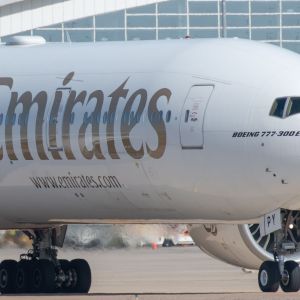
The Federal Aviation Administration’s rollback of emissions requirements for the legacy Boeing 777 will help mitigate tight capacity in the air cargo sector. The post U.S. emissions rollback on Boeing 777 freighter helps air logistics appeared first on FreightWaves.
Source Lens
Industry Context
Useful background context, but lower-priority than direct platform, community, or operator intelligence.
Impact Level
medium
Use this briefing to decide whether your team needs an immediate workflow, policy, or reporting change.
Key Stat / Trigger
No single quantitative trigger surfaced in this report.
Focus on the operational implication, not just the headline.
Full Coverage
The Federal Aviation Administration’s decision last week to waive an upcoming production ban for the Boeing 777 freighter is welcome news for airlines and freight forwarders because the air cargo industry is experiencing a shortage of widebody capacity. The FAA granted Boeing (NYSE: BA) an exemption to produce 35 777 freighter aircraft beyond the Jan.
1, 2028 international deadline mandating the use of cleaner engines, saying an extension is in the public interest so Boeing can continue to meet customer demand until its next-generation 777-8 cargo jet becomes commercially available.
The supply of air cargo capacity continues to be constrained due to retirements of aging freighter aircraft amid strong demand associated with the AI data center boom and ocean shipping disruptions created by the Iran war.
Compounding the space crunch is the fact that Airbus and Boeing are producing fewer widebody passenger planes, which normally carry about 50% of global air cargo shipments in their lower holds, than they did before Covid. In 2019, the two manufacturers delivered 345 large passenger aircraft.
Last year, they combined for 179 deliveries and are on pace for only a few more deliveries in 2026 because of ongoing engine quality and supply chain issues, said air freight consultant Tom Crabtree. The result is that freighters are currently handling about 60% of total volume. window. googletag = window. googletag || {cmd: []}; googletag. cmd.
push(function() {var gptSlot = googletag. defineSlot('/21776187881/FW-Responsive-Main_Content-Slot1', [[300, 100], [320, 50], [728, 90], [468, 60]], 'div-gpt-ad-1709668545404-0'). defineSizeMapping(gptSizeMaps. banner1). addService(googletag. pubads()); googletag. pubads(). enableSingleRequest(); googletag. pubads(). collapseEmptyDivs(); googletag.
enableServices(); setInterval(function() {if (! document. hidden) {googletag. pubads(). refresh([gptSlot]); } }, 30000); }); googletag. cmd. push(function() {googletag. display('div-gpt-ad-1709668545404-0'); }); Air cargo volume is up more than 4. 7% year over year through August, well above a slight increase in capacity.
The market dynamic has helped push spot rates up by more than 25% from the prior year, according to market researchers. Boeing estimates that without the exemption it would lose more than $15 billion in export sales.
International Civil Aviation Organization agreements ban commercial aircraft manufacturers from selling large aircraft that don’t meet 2028 fuel efficiency and carbon emissions standards. Without the exemption, Boeing would not be eligible to receive FAA airworthiness certificates for the 777F after 2027.
Under the Biden administration, the FAA in early 2024 issued a rule to reduce carbon pollution emitted by large aircraft flying in U. S. airspace, essentially adopting the ICAO standard in U. S. law. The rule only applied to new aircraft, not aircraft produced prior to Dec. 31, 2027 and already in service.
In December, Boeing petitioned the FAA for an exemption by April 2026 so it could maintain uninterrupted production while it finalizes development of a successor freighter that complies with new standards.
At the time, e-commerce was still considered a major driver of air cargo growth, but new restrictions on parcel-level imports in the United States and Europe have since slowed B2C shipments volumes moving by air.
It also argued that without the exemption, airlines might hold on longer to older, more polluting aircraft rather than investing in the legacy 777, which is more fuel efficient than previous types, such as the Boeing 747-400.
The 777 is a large widebody freighter primarily used by cargo airlines such as FedEx, DHL and Lufthansa Cargo on long-haul, intercontinental routes.
Why It Matters: Having more access to capacity for fleet expansion or modernization is good news for cargo airlines, especially since next-generation Boeing and Airbus freighters have faced development delays and production rates are likely to be slow at the outset, although no trade associations or airlines wanted to publicly comment on the FAA’s decision.
Some customers of the 777-9 passenger variant also want Boeing to delay freighter deliveries so it can focus on delivering more passenger models, according to Leeham News. window. googletag = window. googletag || {cmd: []}; googletag. cmd. push(function() {var gptSlot = googletag.
defineSlot('/21776187881/fw-responsive-main_content-slot3', [[728, 90], [468, 60], [320, 50], [300, 100]], 'div-gpt-ad-1665767553440-0'). defineSizeMapping(gptSizeMaps. banner1). addService(googletag. pubads()); googletag. pubads(). enableSingleRequest(); googletag. pubads(). collapseEmptyDivs(); googletag. enableServices(); setInterval(function() {if (!
document. hidden) {googletag. pubads(). refresh([gptSlot]); } }, 30000); }); googletag. cmd. push(function() {googletag. display('div-gpt-ad-1665767553440-0'); }); Korean Air last week finalized an order for eight 777-8 freighters after signing a tentative purchase agreement in Augu
Original Source
This briefing is based on reporting from Freightwaves. Use the original post for full primary-source context.
Style
Audience