

How Salesforce is positioning itself in the agentic AI landscape
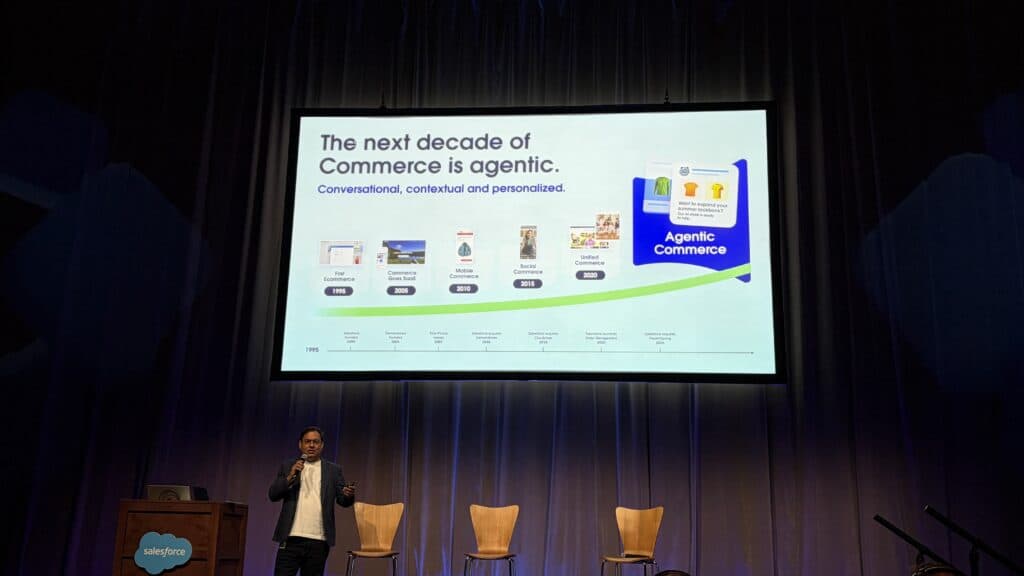
Salesforce has made updates to its ecommerce platform that center agentic artificial intelligence (AI) in what executive Nitin Mangtani considers its “biggest release in the past five years.” Mangtani specified three main aspects of Agentforce Commerce’s newest release, which is now generally available. Those are its official release of Cimulate technology for Salesforce users, shopper […] The post How Salesforce is positioning itself in the agentic AI landscape appeared first on Digital Commerc
Source Lens
Analyst Intelligence
Research or editorial analysis that adds market context beyond the official announcement.
Impact Level
medium
Use this briefing to decide whether your team needs an immediate workflow, policy, or reporting change.
Key Stat / Trigger
No single quantitative trigger surfaced in this report.
Focus on the operational implication, not just the headline.
Full Coverage
Salesforce has made updates to its ecommerce platform that center agentic artificial intelligence (AI) in what executive Nitin Mangtani considers its “biggest release in the past five years.” Mangtani specified three main aspects of Agentforce Commerce’s newest release, which is now generally available.
Those are its official release of Cimulate technology for Salesforce users, shopper agents for brands’ websites that include both discovery and checkout, and a new front-end experience it called Storefront Next. Cimulate is an AI-powered product discovery startup that Salesforce acquired earlier in the year.
Storefront Next is based on vibe coding and allows brands to design their own user interfaces, Mangtani told Digital Commerce 360. “If you don’t have agentic live as of yesterday morning, you’re already behind,” Mangtani told Digital Commerce 360. Mangtani is executive vice president of Agentforce Commerce & Retail Cloud at Salesforce.
He shared different use cases he has identified for agentic AI in ecommerce and gave insights into the role Salesforce is playing in the still-emerging space. Nitin Mangtani speaks at a commerce-focused keynote during Salesforce Connections 2026 in Chicago on June 3.
| Image credit: Abbas Haleem, Digital Commerce 360 78 of the Top 2000 online retailers in North America use Salesforce as their ecommerce platform, according to Digital Commerce 360 data. In 2025, those 78 online retailers combined for more than $192. 60 billion in web sales.
The Top 2000 is Digital Commerce 360’s database ranking North America’s largest online retailers by their annual ecommerce sales.
Charts & Data Salesforce credits agentic AI with driving revenue in Q1 2027 Abbas Haleem | May 29, 2026 Where Salesforce sees agentic AI adoption happening Mangtani bucketed agentic AI in the ecommerce sphere into two groups: the consumer experiences, and the product and engineering side.
On the consumer side, he made the case that agentic AI centers around conversations. That experience, he said, is ultimately inherently familiar for humans. He juxtaposed that with mouse clicks, which are only a product of the past few decades. “When we think about agentic, people are like, ‘Oh, how long will it take for people to get used to conversations?’
Wrong question,” Mangtani said. “We got used to a wrong form factor, which was the mouse. That was foreign to us. But conversation is not foreign to us. That’s how people start.” He said that in the first two years of agentic AI platforms, there are now about a billion monthly active users on OpenAI’s ChatGPT, Google’s Gemini and Anthropic’s Claude.
He cited that as evidence that consumers are already having full conversations with AI. “So we are definitely away from a two-keyword world that Google taught us, to now real conversations,” Mangtani said. “Once the consumer behavior shifts, it shifts for everything.”
News Salesforce releases AI agents among B2B ecommerce updates Abbas Haleem | Jun 24, 2026 Agentic shopping vs. agentic commerce “From my lens, every single ecommerce brand will have an agentic experience on their property, which is different than shopping while you are inside ChatGPT and Gemini,” Mangtani said. “Those are two different things.
In a lot of ways, I think a lot of articles in the press mix those two things. They just call it agentic shopping. But they are materially different — shopping happening inside Gemini versus shopping happening on SharkNinja. com. And we are powering both.”
He shared that part of how Salesforce is powering those experiences is by working with Google on the Universal Commerce Protocol (UCP). Salesforce is working on two main aspects of the agentic commerce experience, he said. One is product catalog syndication.
That’s where consumers can discover products on third-party large language models (LLMs) such as ChatGPT. The other is on implementing agentic AI-powered checkout experiences. Mangtani gave an example that he dealt with some dry skin during his trip to Chicago from California for Salesforce Connections 2026.
He went to Uber Eats to find a moisturizer but wasn’t sure which one to select. He used an agentic AI tool to ask about the best moisturizer for his situation. It gave recommendations it based, in part, on active ingredients. It then suggested specific products.
From there, he went back into Uber Eats to take screenshots of the products and their ingredients. The AI began ranking each brand, identifying its pros. Then, it gave a suggestion based on the ingredient lists. He went back into Uber Eats to make the purchase, which he said arrived from a CVS in about 20 minutes.
“I would’ve picked the wrong product if I didn’t go to Gemini and ask that question,” Mangtani said. “But the actual commerce happened on Uber. It didn’t happen on Gemini. That’s why it’s important that brands think about this 360 [view]. There’s no doubt in my mind: Discovery of products is going to — close to 100% — move from search to agentic.”
Original Source
This briefing is based on reporting from Digital Commerce 360. Use the original post for full primary-source context.
Style
Audience