

Agentic AI in Logistics: Why 55% Accuracy Fails
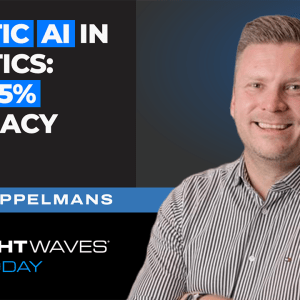
Agentic AI in logistics still breaks when spatial reasoning enters the picture. HERE Technologies’ Bart Coppelmans explains why general AI models can understand language but still fail on truck routing, low-clearance bridges, parking, congestion and real-world execution. In this FreightWaves Today segment, Bart lays out why location intelligence has to be built into logistics AI […] The post Agentic AI in Logistics: Why 55% Accuracy Fails appeared first on FreightWaves.
Source Lens
Industry Context
Useful background context, but lower-priority than direct platform, community, or operator intelligence.
Impact Level
medium
Use this briefing to decide whether your team needs an immediate workflow, policy, or reporting change.
Key Stat / Trigger
No single quantitative trigger surfaced in this report.
Focus on the operational implication, not just the headline.
Full Coverage
#fwtv_3lozOWxjIM. fwtv-panel{border:1px solid #d0d0d0;padding:18px;border-radius:6px;line-height:1. 6}#fwtv_3lozOWxjIM. fwtv-panel p{margin:0 0 12px}#fwtv_3lozOWxjIM. fwtv-note{font-style:italic;color:#666;margin-top:16px;padding-top:12px;border-top:1px solid #e0e0e0}Agentic AI in logistics still breaks when spatial reasoning enters the picture.
HERE Technologies’ Bart Coppelmans explains why general AI models can understand language but still fail on truck routing, low-clearance bridges, parking, congestion and real-world execution.
In this FreightWaves Today segment, Bart lays out why location intelligence has to be built into logistics AI from the start—not bolted on later—and how better spatial grounding can connect planning, execution and driver feedback in real time.
#LogisticsAI #SupplyChainTech #TruckingTechnologyGeneral-purpose large language models correctly answer only about 55% of basic direction questions, and that accuracy gap is directly blocking the adoption of agentic AI in logistics, according to Bart Coppelmans, head of enterprise product at HERE Technologies.
The company, which has powered transport management, fleet management, and last-mile delivery systems for multiple decades, argues that location intelligence must be embedded at the foundation of any AI-driven logistics workflow — not added later.
The core problem, Coppelmans explained, is that frontier AI models understand natural language but lack the spatial reasoning needed for real-world freight operations.
Tasks as routine as rerouting low-clearance trucks around bridge restrictions, identifying truck parking, and anticipating port or traffic congestion require a dense web of location-specific data that current large language models do not carry internally.
HERE’s own map and location datasets include more than 800,000 truck-specific data points covering tolls, road restrictions, and permitted routes.
“If you haven’t connected the model and the graph of the location and geospatial model underneath, then it starts really hallucinating dramatically across your responses and outcomes you are getting,” said Coppelmans. “We see it also not as an automation journey. We see it really as an assisted journey.”
— Bart Coppelmans, Head of Enterprise Product, HERE Technologies Coppelmans described a persistent disconnect between back-office planning and on-road execution that agentic AI, properly grounded in location data, could help close. Dispatchers may build what looks like an optimal route, but drivers encounter real-time conditions that invalidate the plan.
HERE’s approach creates a feedback loop that captures driver input from the field, routes it back to planners, and builds a learning pattern so the same failure mode is not repeated. The goal, he said, is moving from static planning to dynamic orchestration across dispatchers, operators, and drivers.
Beyond routing, Coppelmans framed the broader opportunity as “transportation intelligence” — a term he used to describe the trade-off engine HERE is building to optimize simultaneously across cost, compliance, risk, safety, and sustainability.
Rather than computing a single point-to-point route, the system is designed to let operators dial in whichever KPIs or service-level agreements matter most for a given operation and receive proactive suggestions calibrated to those priorities.
On the question of human oversight, Koppelmans was direct: human judgment should remain in control throughout the current phase of the technology.
He offered the example of constraint adjustments — if a planner relaxes a distance or cost constraint, the system can now show the downstream impact on total cost, but the decision to implement that change stays with the human operator. He added that he does not believe in fully automated logistics systems “at least for a little while.”
Looking ahead, Coppelmans identified multi-agent collaboration as the next frontier — connecting HERE’s agents directly to customer systems and to third-party agents so that information and decisions flow across organizational boundaries without requiring deep software integration on every side.
For the broader industry, he said the immediate priority is eliminating fragmentation by applying agentic capabilities seamlessly across workflows that today still operate in silos. Frontier AI models answer only 55% of basic spatial direction questions correctly, limiting their reliability in logistics routing and planning.
HERE Technologies embeds more than 800,000 truck-specific data points — covering tolls, road restrictions, and permitted routes — into its location datasets to ground AI outputs. HERE frames agentic AI as an ‘assisted journey’ with humans in control, and sees multi-agent collaboration across customer and third-party systems as the next major development.
This Summary is generated thanks to a transcription of the interview, for the full interview please enjoy the video above. The post Agentic AI in Logistics: Why 55% Accura
Original Source
This briefing is based on reporting from Freightwaves. Use the original post for full primary-source context.
Style
Audience