Tesla Marked the Start of High Volume Semi Production, and the Engineering Story Sits Underneath the Cab
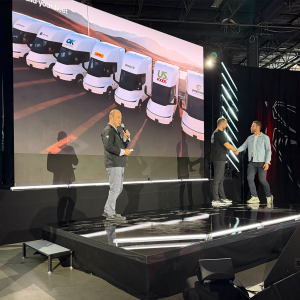
Tesla formally inaugurated its dedicated Semi factory in Sparks, Nevada on September 24, a 1.7 million square foot plant built adjacent to Gigafactory Nevada, and while the company framed the day as the start of high volume production, the first truck actually came off that line back in April, which makes this less a factory […] The post Tesla Marked the Start of High Volume Semi Production, and the Engineering Story Sits Underneath the Cab appeared first on FreightWaves.
Source Lens
Industry Context
Useful background context, but lower-priority than direct platform, community, or operator intelligence.
Impact Level
medium
Use this briefing to decide whether your team needs an immediate workflow, policy, or reporting change.
Key Stat / Trigger
No single quantitative trigger surfaced in this report.
Focus on the operational implication, not just the headline.
Full Coverage
Tesla formally inaugurated its dedicated Semi factory in Sparks, Nevada on September 24, a 1.
7 million square foot plant built adjacent to Gigafactory Nevada, and while the company framed the day as the start of high volume production, the first truck actually came off that line back in April, which makes this less a factory opening than a coming-out party for a program that has been promising this moment since 2017.
Deliveries went to DHL, PepsiCo and US Foods to name a few. The plant is designed for 50,000 trucks a year. Tesla has not said what it is currently producing, and that distinction matters. I drove one. Fully loaded, tractor and trailer, and I came away impressed by three things in particular: the power, the acceleration, and the ride quality.
The acceleration is the part that will get written about because it is the part that surprises people. The ride quality is the part that would matter to me if I were putting a driver in it every day. There is also a detail from behind the wheel worth naming. You barely touch the service brake.
Regenerative braking handles so much of the deceleration that the driving rhythm changes, and anyone who has run mountain grades understands immediately what that implies for brake wear and for the cost line that goes with it. window. googletag = window. googletag || {cmd: []}; googletag. cmd. push(function() {var gptSlot = googletag.
defineSlot('/21776187881/FW-Responsive-Main_Content-Slot1', [[300, 100], [320, 50], [728, 90], [468, 60]], 'div-gpt-ad-1709668545404-0'). defineSizeMapping(gptSizeMaps. banner1). addService(googletag. pubads()); googletag. pubads(). enableSingleRequest(); googletag. pubads(). collapseEmptyDivs(); googletag. enableServices(); setInterval(function() {if (!
document. hidden) {googletag. pubads(). refresh([gptSlot]); } }, 30000); }); googletag. cmd. push(function() {googletag. display('div-gpt-ad-1709668545404-0'); }); (Photo: Adam Wingfield/FreightWaves.) Nine Years, Told Honestly Dan Priestley, who leads the Semi program, walked me through a timeline that started earlier than most people realize.
The idea surfaced in 2014, and the origin was a contradiction inside Tesla’s own operation. The company was building a battery and powertrain plant in Nevada and shipping parts down to Fremont, California on diesel trucks. Electric car components moving on diesel power did not sit right with the mission.
Design work went from modeling to hardware in early 2016. Two alpha trucks appeared publicly in 2017, and Priestley said those vehicles drove more miles than any alpha program Tesla has run. The design language from those trucks survived, particularly the center seating position and the dual screen cockpit. The pilot fleet came in 2022.
Just under 200 trucks, and roughly 17. 5 million miles accumulated across them. Priestley described the architectural change between the alphas and that fleet as a massive leap, and then described the current production truck as the product of taking fleet data and direct customer feedback and feeding it back into the design.
What I appreciated was his framing of why. He said plainly that Tesla is not a heavy truck company yet, expressed respect for the people who run trucks every day, and said the truck has to work for the majority of fleets and drivers rather than for one customer. window. googletag = window. googletag || {cmd: []}; googletag. cmd.
push(function() {var gptSlot = googletag. defineSlot('/21776187881/fw-responsive-main_content-slot3', [[728, 90], [468, 60], [320, 50], [300, 100]], 'div-gpt-ad-1665767553440-0'). defineSizeMapping(gptSizeMaps. banner1). addService(googletag. pubads()); googletag. pubads(). enableSingleRequest(); googletag. pubads(). collapseEmptyDivs(); googletag.
enableServices(); setInterval(function() {if (! document. hidden) {googletag. pubads(). refresh([gptSlot]); } }, 30000); }); googletag. cmd. push(function() {googletag. display('div-gpt-ad-1665767553440-0'); }); The clearest evidence that the feedback loop is real is a window. The original truck had a small pop-out window.
Customers pushed back hard, and Tesla put in a roll-down window. The reason turned out to be mundane and completely obvious in hindsight: badge readers, toll booths and call boxes all sit at roughly that height. Priestley and the team owned it as a design call they got wrong.
The Best Part Is No Part The factory tour is where the engineering argument actually lives, and the phrase the team repeated is that the best part is no part. The battery moved from purchased 2170 cells to in-house 4680s built in the complex next door.
That change let Tesla cut battery mass and total kilowatt hours while holding range, because efficiency improvements elsewhere absorbed the difference. The efficiency number is the one I would put in front of a skeptical fleet manager. The original internal target was roughly 2,000 watt-hours per mile, and the team said outside voices called it impossible.
They are now running around 1. 6 to 1. 7, which is about 25 percen
Original Source
This briefing is based on reporting from Freightwaves. Use the original post for full primary-source context.
Style
Audience