

Borderlands Mexico: Exports of Mexican-made heavy-duty trucks to US roar back
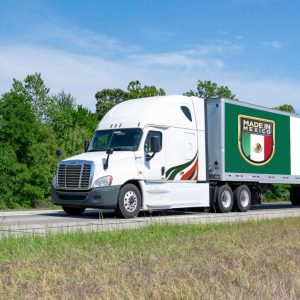
This week in Borderlands Mexico: Exports of Mexican-made heavy-duty trucks to US roar back and Nexio secures 77-acre Texas campus for commercial truck production. The post Borderlands Mexico: Exports of Mexican-made heavy-duty trucks to US roar back appeared first on FreightWaves.
Source Lens
Industry Context
Useful background context, but lower-priority than direct platform, community, or operator intelligence.
Impact Level
medium
Use this briefing to decide whether your team needs an immediate workflow, policy, or reporting change.
Key Stat / Trigger
No single quantitative trigger surfaced in this report.
Focus on the operational implication, not just the headline.
Full Coverage
Borderlands Mexico is a weekly rundown of developments in the world of United States-Mexico cross-border trucking and trade. This week in Borderlands Mexico: Exports of Mexican-made heavy-duty trucks to US roar back and Nexio secures 77-acre Texas campus for commercial truck production.
Exports of Mexican-made heavy-duty trucks to US roar back Mexico’s heavy-duty vehicle industry posted a sharp rebound in August, with production doubling and exports more than doubling from a year earlier, while domestic wholesale sales continued to recover. Heavy-duty manufacturers in Mexico produced 16,389 trucks and buses in August, a 100.
2% increase from 8,187 units in August 2025, according to data released Wednesday by Mexico’s National Institute of Statistics and Geography (INEGI). Exports jumped even faster, rising 116. 7% year over year to 14,310 units, compared with 6,605 vehicles during the same month last year.
The August gains represent a significant turnaround from weakness earlier in the year, although year-to-date growth remains much more modest. From January through August, manufacturers produced 101,940 heavy-duty vehicles, up 2. 6% compared with 99,311 during the same period in 2025. Exports totaled 85,687 units, a 3. 7% increase from 82,620 a year earlier.
Cargo vehicles accounted for 97. 6% of Mexican heavy-duty vehicle production through August, totaling 99,526 units, while passenger buses represented the remaining 2,414 vehicles. The U. S. remains overwhelmingly the industry’s largest export market. Through August, Mexico shipped 79,261 heavy-duty vehicles to the U. S. , representing 92. 5% of all exports.
Canada ranked second with 3,809 units, or 4. 4%, followed by Colombia with 1,697 units, or 2%. Freightliner, International drive production surge Freightliner led heavy-duty vehicle production in Mexico during August with 10,240 units, a 133. 1% increase from 4,393 a year earlier. International produced 4,525 units, up 100.
8%, while Kenworth produced 1,087, an 8. 5% increase. Freightliner also dominated exports, shipping 10,073 Mexico-built vehicles abroad during August, up 151. 4% year over year. International exported 3,877 units, an 89. 6% increase, while Kenworth exports fell 35. 3% to 358 units. ManufacturerAugust productionYoYAugust exportsYoYFreightliner10,240+133.
1%10,073+151. 4%International4,525+100. 8%3,877+89. 6%Kenworth1,087+8. 5%358-35. 3%Isuzu132+4. 8%——Mercedes-Benz Autobuses106+6. 0%——Hino105+72. 1%——Foton70+311. 8%——Volkswagen Camiones y Autobuses51-32. 9%——Volvo Buses49-47. 3%2N/ADina24+41. 2%—— Source: INEGI. August 2026 figures are preliminary. Mexico’s truck fleet has an average age of 19.
3 years, according to ANPACT. The organization called for expanded financing, tax incentives, scrappage programs and measures addressing imports of used heavy-duty vehicles from the United States. About 26,000 used heavy-duty vehicles entered Mexico from the U. S. in 2025, compared with roughly 29,000 in 2024. Although those imports fell 29.
2% year over year during the first seven months of 2026, ANPACT said roughly 53 used imported vehicles enter Mexico for every 100 new vehicles sold in the country. USMCA review, tariffs loom over Mexico truck industry ANPACT also highlighted trade policy as a growing concern for manufacturers ahead of the USMCA review and amid U. S. Section 232 tariffs.
The association called for preserving the trade agreement’s existing rules of origin while reducing tariff burdens on companies that have invested to comply with regional-content requirements. “The industry needs certainty,” Arzate said, according to a translation of his remarks.
“Automotive investments are planned for the long term and require clear rules to make decisions about new plants, suppliers and production capacity.”
ANPACT said it supports increasing regional content as agreed under USMCA to 70% in 2027, rather than loosening rules of origin, while seeking lower tariffs affecting the integrated North American heavy-duty vehicle supply chain.
Nexio secures 77-acre Texas campus for commercial truck production Nexio Power has secured a 77-acre industrial campus in Anderson, Texas, that the company plans to use for commercial truck production, finishing, testing and warehousing, according to a news release.
The Texas-based manufacturer of propane-powered commercial vehicles said the property includes about 180,000 square feet of existing production capacity and is already equipped for heavy-duty vehicle manufacturing.
The previous operator used the site for large-scale fabrication and assembly, leaving infrastructure that includes paint and blast facilities, 13 overhead cranes, a dedicated testing complex and racked warehousing.
Nexio said the Anderson operation will allow it to begin truck production while serving as a bridge to a larger campus the company plans to develop in Lufkin, Texas. The Anderson property will eventually provide excess production capacity once the Lufkin operation comes online, according to the company. N
Original Source
This briefing is based on reporting from Freightwaves. Use the original post for full primary-source context.
Style
Audience