

“It Ain’t That Bad That I Got to Pay Somebody to Come Here.” Why a Man Who Runs 65 Owner-Operators Says Sign-On Bonuses Repel the Drivers You Actually Want.
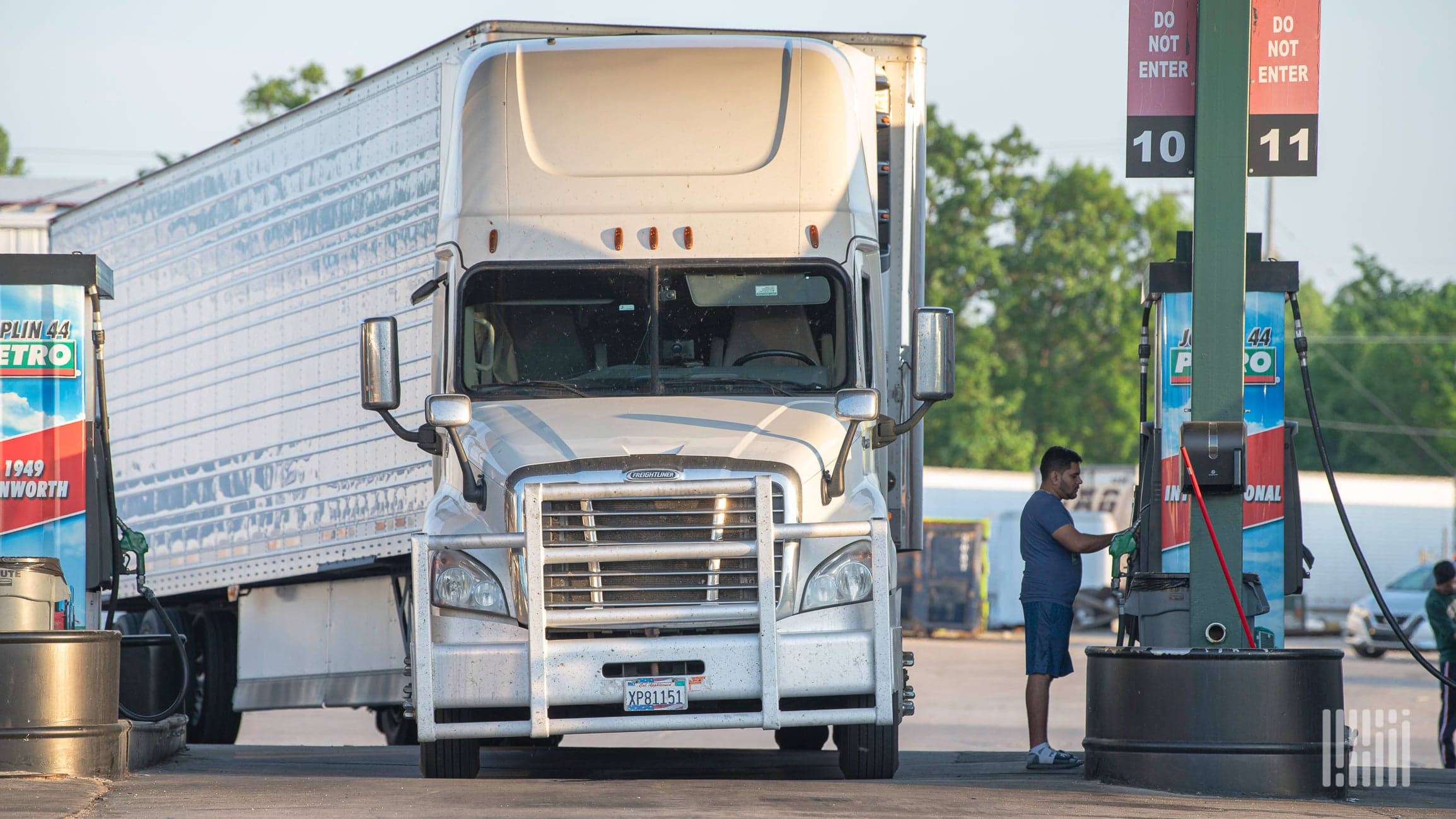
Sixty-five owner-operators is not the same thing as sixty-five trucks. That distinction sits underneath everything Christian Martinez does. As director of operations at Voyager Nation in Mulberry, Florida, he manages a fleet that is 100% owner-operator, which means he manages 65 independent business owners who have no obligation to stay and every other option available […] The post “It Ain’t That Bad That I Got to Pay Somebody to Come Here.” Why a Man Who Runs 65 Owner-Operators Says Sign-On Bonuses Repel the Drivers You Actually Want. appeared first on FreightWaves.
Source Lens
Industry Context
Useful background context, but lower-priority than direct platform, community, or operator intelligence.
Impact Level
medium
Use this briefing to decide whether your team needs an immediate workflow, policy, or reporting change.
Key Stat / Trigger
No single quantitative trigger surfaced in this report.
Focus on the operational implication, not just the headline.
Full Coverage
Sixty-five owner-operators is not the same thing as sixty-five trucks. Watch the full episode: 65 owner-operators, one standard, and a lot of hard lessons about what keeps independent contractors running your freight when they have every other option to leave. That distinction sits underneath everything Christian Martinez does.
As director of operations at Voyager Nation in Mulberry, Florida, he manages a fleet that is 100% owner-operator, which means he manages 65 independent business owners who have no obligation to stay and every other option available to them. “That’s 65 worlds, 65 minds,” Martinez said. “They all want to run their businesses a little bit different.
Whether certain guys are willing to go to certain regions, home time, all of that looks different. However, the outcome has to be the same. They have to be making enough money or have enough cash flow to their business to be successful.”
Martinez came up through loading docks, warehouses, ports, last-mile recruiting, and fleet acquisitions before he landed in operations, and he appeared on a recent episode of The Long Haul to talk about the thing most small carriers handle badly: recruiting and keeping owner-operators. His conclusions run against most of what the industry does by reflex.
The Bonus That Drives Away the People You Want Asked to name the dumbest thing carriers do to attract owner-operators, Martinez did not hesitate. “I’m going to say a sign-on bonus,” he said. “It ain’t that bad that I got to pay somebody to come here.” His objection is not primarily about the cost. It is about who the money attracts and what it signals.
Across years of recruiting, he said he has seen sign-on bonuses “do more damage than good,” because they select for operators who move carrier to carrier chasing the payout rather than operators building a business. The math, in his telling, does not even work for the driver.
A disciplined owner-operator who has built consistency into his week is not moved by $6,000, because capturing it means disrupting the pattern that produces his revenue. “Just to get a $6,000 sign-on bonus, because he’s consistent, now he has to go do customer freight or whatever,” Martinez said. “He’s going to be losing money for chasing $6,000.”
We noted the practice traces largely to the pandemic, when demand surged past available capacity and carriers reached for anything that would put people in seats. What followed was predictable: operators who stayed exactly long enough to collect and then left. “Ninety Percent of What?”
The percentage a carrier advertises is the other recruiting lever most small fleets pull, and Martinez argues it is nearly meaningless on its own. Voyager runs two packages: 85% for an operator pulling his own trailer, and 75% as what Martinez calls the bread and butter, which includes the trailer, cargo and liability coverage, and access to fuel programs.
He is aware competitors advertise higher. “You’re going to have competitors that will pay 90%,” he said. “But 90% of what? Are they giving you the original rate con? Do you know how many guys actually didn’t even know they can get that original rate con?” That is the whole point.
A percentage of a number the operator cannot see is not a rate, it is a promise. Martinez is careful to say a 90% offer is not automatically a bad deal. It is an unverified one, and he thinks operators have an obligation to verify it. His recommended test is specific and it costs nothing to run. Ask for settlements.
“May I see a sample settlement of this week, last week, the last three weeks?” he said. “Not what some guy did six months ago one time. If you can get your hands on that settlement, that thing right there is going to tell you a world of information of how they run their business. Are you paying rental fee? Are you paying usage?
Regardless of what that recruiter is telling you, you got facts on the table.” Voyager’s counter-move is to invite the prospect in. Operators considering the fleet are asked to come to the office, meet the operations team, meet the mechanic, and look at the equipment before they sign anything. “Transparency is king,” Martinez said.
The Fuel Card Story That Explains the Philosophy One anecdote captures how Martinez thinks about the operators running under his authority. Around the pandemic, Voyager’s fuel card provider had a security incident and cards froze for a day or two. “I was like, I could never be in this position again for my owner-operators,” he said.
He brought in a second provider, and when that provider later asked him to drop the original, he declined and kept both. “Let the best man win,” Martinez said. “If you offer better savings, my guys are going to naturally gravitate to your fuel card and not use the other one.”
He was also guarding against a specific failure: if he consolidated to one provider and that provider later cut the discount, his operators would reasonably suspect the carrier was skimming the difference. Two cards remove both the single point of failure and the suspicion. Voyager passes 100% of the fuel savings through.
Recruiting Is Not a Marketing Problem Small carriers commonly treat recruiting as a spending problem: more ads, bigger bonus, adjusted pay. Martinez says that framing guarantees a loss, because the budgets are not comparable. “You’re competing with these big boys that have very, very deep pockets, a lot deeper than mine,” he said.
“When they’re using Indeed or Craigslist, that goes a long way for them.” His alternative is to compete on information rather than spend. Voyager produces content aimed at people who want to become owner-operators, and Martinez is deliberate that it covers the failures rather than the highlight reel.
“We’re talking about places that we have failed, because in that failure is where we probably did the most learning,” he said. “The learning actually comes through that friction or suffering.”
The fleet also polls its own 65 operators about where they bought their trucks and what the experience was like, then gives that information to people who call in, including people who never sign on. “Even if they don’t onboard with me, it’s just really putting it out there,” Martinez said.
“Because if you put good people in front of good people, good things are going to happen.” Much of the education is elementary, which is the point. Many of Voyager’s onboards are first-time owner-operators who need to understand how to open an LLC, how to get a plate, and the difference between running under a carrier’s authority and holding their own.
“There’s so much misguided information out there that a lot of people get confused and forget what they actually came for, which is to make money and put it on their truck,” he said.
The Retention Mistake That Cost Him a Driver Wingfield asked Martinez for a retention failure rather than a win, and the answer reframes what most carriers think retention means. Early in his career, Martinez believed the way to keep an owner-operator was to give him what he asked for. It cost him one.
“I used to think that just listening to the individual and doing what he says, or what he needs for his business, was the right thing to do,” he said. “In the end, it cost me a driver because I couldn’t increase his gross revenue, which means I couldn’t increase the net on that truck.
I was very busy just conforming to what he wanted as opposed to what his business needed.” He calls the underlying behavior pandering, and he thinks it is endemic. “There’s a lot of organizations, we get caught up in pandering. We just want to be yes sir, just because as long as he doesn’t quit, it’s going to be okay,” Martinez said.
“But at the end of the day, if it’s not good for business and it’s not going to work, I’m prolonging the damage to his company. Ultimately he’s getting to the same destination. Grand opening, grand closing type thing.” The alternative is a harder conversation held early and held professionally.
That includes telling an operator that the regional lane he prefers will not produce the revenue number he says he wants, and that home time carries a real cost. “There’s a value out of you getting home on time, doing the same thing over and over again,” Martinez said. “But that will come at a price to your business.”
It also includes a piece of advice he delivers flatly: “You should not buy a truck to work less. That’s a bad idea.” The Question That Should Open Every Recruiting Call Martinez does not open with lane preference. He opens with money. “Once we start recruiting, it’s not so much what do you like to do. I like to ask what is your financial goal,” he said.
“Because that sets the tone for our conversation.” The follow-up is the real diagnostic. Somebody should know exactly what their fixed costs are, and if they do not, Martinez treats that as the beginning of the conversation rather than a disqualification.
“I think that’s a great opening liner to spark a little business discussion about why you’re getting into this, what is your perception of what’s supposed to happen next.” From there the week becomes arithmetic. An operator targeting $10,000 needs to be booking roughly $1,000 to $1,500 a day.
An operator targeting $8,500 has to leave on Monday, because leaving Tuesday for a better rate costs a day and a half of transit that has to be made up on the back end. “It’s just math,” Martinez said. “Two plus two is four.” He applies the same arithmetic to his own market without flinching. “Rates out of Florida haven’t changed in 24 years.
They’re not going to change in 24 hours.” When operators press him for better outbound Florida rates, his answer is that no customer overpays for outbound Florida freight, and that the operator is “looking for money where it doesn’t exist. You have to look for money where it does exist.”
He extends the same logic to operators with six years in the business still hunting for a lane that pays above market in a soft origin. “Don’t you think you would have found it by now? And if you did, there’d be a line from there to Miami.”
The Texas Trap The most useful illustration Martinez offered describes an operator everybody in dispatch loves and nobody is watching. An operator likes Texas. Dispatch gives him Texas. He runs it back and forth, calls home happy, and takes every load offered. “My dispatcher is like, hey, I love this guy, give me ten more of these guys,” Martinez said.
“He takes every load I give him.” “But the problem is nobody’s counting money. And when that settlement check comes in, it’s this big. Who’s the bad guy?” The failure is not the driver’s preference or the dispatcher’s enthusiasm.
It is that nobody connected the operator’s stated financial goal to the pattern he was actually running, and by the time the settlements make it obvious, the relationship is already damaged. “Three weeks of this, not meeting your goals, it’s over,” Martinez said. “You have fixed costs. At the end of the day, that’s what it is.”
The Spot Market Is a Tool, Not a Threat Martinez pushes back on the instinct to treat dedicated freight as inherently safer than the spot market. “A lot of guys get stuck in I want to do dedicated customer freight,” he said, “just because it’s comfortable. It doesn’t mean it’s money. I didn’t buy a truck to limit my ROI.”
He does not pretend the tradeoff is free. Dedicated freight means the shipper is the customer, and service levels have to be met regardless of what the market is doing elsewhere. “Let’s say it’s Coca-Cola. Coca-Cola is now my customer because I have to provide a service level for them,” he said.
“But if the market is on the up and up and I can make more money going the other way, my dispatchers are now forcing this guy to a less desirable area just to satisfy a service level.”
He also notes that contract rates were set by the lowest bidder, and when a contract carrier runs out of capacity, that freight lands on the spot market at a premium, because the carrier would rather lose margin on a load than take a service failure. What the spot market requires is a different caliber of dispatcher and discipline about which loads to chase.
“I could dispatch 50 trucks on customer freight,” Martinez said. “He’s not doing 50 trucks on the spot market.” And: “Not everything that shines is gold. You don’t chase the rate. You keep your head down chasing $4 a mile and end up in Colorado on a Friday night, good luck getting out.”
The exception is when the number justifies the position: “who cares about a 200 mile deadhead if the rate is strong enough to offset that?” His summary of the discipline is worth repeating. “You may want a certain rate, but if the market is not yielding that, you still want to be at the top of whatever the market is. And that’s the secret to it.”
The same thinking applies to the winter migration south. Operators avoid the Northeast because of weather, and Martinez tells them everyone else has the same idea, which floods southern capacity and drops the rate. His counter is to treat the region as a strike rather than a residence. “They do really good up in Jersey and plow the roads.
Once it’s gone, then we get up there real quick, get it and come back down. You don’t have to live there.” Where the Real Danger Sits Asked to name the most dangerous gap in a small carrier’s business, Martinez did not name rates, equipment, or freight. “The most dangerous gap is not being connected with your owner-operators and even your staff,” he said.
Growth is what breaks it. “If somebody went from 60 trucks to 300 trucks overnight, does that person even really know what’s going on in that dispatch room?” He still personally hand-picks and trains every dispatcher for that reason, on the theory that the talent inside the building is what determines whether the operators outside it succeed.
“Keeping that pure is the toughest part, because does it get diluted as you start to grow?” It also shapes how he handles compliance conversations, which he refuses to outsource to the regulation. When an operator does something he should not have, Martinez said the useful response is not to cite the rule but to explain the shared exposure.
“This is my exposure, not just because DOT said I shouldn’t. We got kids too. We got bills. As an owner-operator, you can go get a job in about an hour. What about my people that have been with me for over 15 years?” “We want good people,” he said, “but not at any cost.” We closed the episode by naming the conclusion the conversation kept circling.
The owner-operator retention problem is not a market problem. It is a management problem, and management problems are the only ones a carrier actually controls. Nobody controls what brokers pay, what fuel costs, or what a competitor is offering.
Every carrier controls how it communicates with the people running its freight, how quickly it settles, and whether an owner-operator feels like a number or a partner. The post “It Ain’t That Bad That I Got to Pay Somebody to Come Here.” Why a Man Who Runs 65 Owner-Operators Says Sign-On Bonuses Repel the Drivers You Actually Want.
appeared first on FreightWaves.
Original Source
This briefing is based on reporting from Freightwaves. Use the original post for full primary-source context.
Style
Audience