Daimler to build largest US truck manufacturing plant
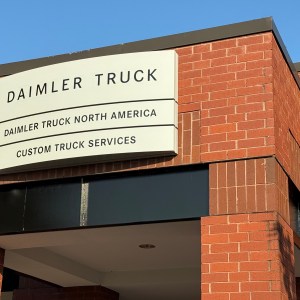
Daimler Truck's supervisory board approved plans for its largest truck plant in the U.S. Construction starts late 2026, with operations targeted for 2029. The post Daimler to build largest US truck manufacturing plant appeared first on FreightWaves.
Source Lens
Industry Context
Useful background context, but lower-priority than direct platform, community, or operator intelligence.
Impact Level
medium
Use this briefing to decide whether your team needs an immediate workflow, policy, or reporting change.
Key Stat / Trigger
No single quantitative trigger surfaced in this report.
Focus on the operational implication, not just the headline.
Full Coverage
One of the largest truck manufacturing plants in the U. S. does not have an address yet. It instead has a supervisory board signature, with construction to start in late 2026. The headcount is projected in the thousands. Daimler Truck North America said Thursday that Daimler Truck’s supervisory board approved plans for a new greenfield facility in the U. S.
It’s purpose-built for vocational and on-highway vehicle production. Construction is expected to begin late this year, with operations targeted for 2029. The company is still evaluating locations and will not name one.
“We had our quarter-end supervisory board meeting and I’m proud to announce that we got the approval for the plans to build a new truck manufacturing plant in the U. S. ,” John O’Leary, president and CEO of DTNA, told reporters in a press conference. “It will be our largest manufacturing plant in the U. S. for trucks.”
The project sits inside the parent company’s growth plan for the region. “This new manufacturing facility supports our long-term growth plans for North America,” said Karin Rådström, CEO of Daimler Truck. For fleets, a key number is not square footage but rather the delivery date, and O’Leary put that at the center of the business case.
“Customers, if they order a truck, they need it at a certain date, and if you deliver it two weeks later, for them that’s not a good thing because they had a driver waiting to be seated in that truck, probably just completed their training, and now they have to wait,” he said. “So even things like delivery are super important.”
The internal pitch predates the board approval by years.
“Several years now I’ve been making the pitch to John that we need to do something for a while, and just with everything going on, the environment, technology being a big part of it, now was the time to really start preparing for the future,” said Jeff Allen, senior vice president of operations at DTNA.
The Mexico Build Math A majority of DTNA’s assembly runs through Mexico today. The new plant aims to change that ratio. “When it is completed, it would definitely give us the ability to flex back and forth and improve that percentage in the U. S. ,” O’Leary said.
“It’s no mystery to anybody that at this point in time the majority of our build is in Mexico, although it’s not a giant majority, but still some majority, and that’s fine. However, as you know, it’s also nice to be able to have U. S. -built products as well, especially these days.”
Asked whether tariffs drove the decision, O’Leary pointed at the calendar instead. “But again, it’s 2029, so who knows what the situation is going to be,” he said. “Again, it’s not really about the tariff thing at all.
It’s far more about we want to have the best, most modern plants out there because we know that will ultimately give us the best cost position, which ultimately is a huge part of the TCO equation, which is something that every customer that we sell to takes very seriously.”
Not So Many Plants Up in New Hampshire DTNA’s existing plants sit in Cleveland, Gastonia, Mount Holly, and High Point, N. C. , plus Gaffney, S. C. Southeast-based reporters tried to pry a region loose. O’Leary declined, then left a trail. “I give you full points for creativity and asking a question that I am not going to answer,” he said.
“However, I would say that you are all smart people and you know the way that the supply chains are typically configured these days and where people tend to locate their plants. You don’t see so many up in New Hampshire, for example.”
Allen said the shortlist will be driven by logistics to customers and suppliers, available land at scale, proximity to technical talent and large labor pools, and a business-friendly environment. The decision window is short. “We’re still in that process of narrowing the scope down,” Allen said.
“Hopefully that’ll be nailed down in the next couple of months.” Portland, Ore. , keeps what it has. “The wind tunnel will stay there and the corporate headquarters and the engineering centers and the warranty center and everything else that we have there,” O’Leary said. A Truck Manufacturing Plant Built to Flex The company notes this will be a truck plant.
It will not be a bus plant, and not a powertrain plant. Past that, the design brief is deliberately open. “We are absolutely designing the plant for the utmost flexibility for what the future might bring,” Allen said. “And that’s a big thing that John’s challenged me with.
We don’t know what will happen in the future, and in the past there’s been much more rigid conveyance systems and paint systems.” The flexibility extends to powertrains DTNA is not moving in volume today. “The new plant will certainly have the capability, as well as zero-emission vehicles, if that starts coming back,” O’Leary said.
“So yeah, we will have full flexibility.” Ready Fast When the Market Peaks Automation will raise output per worker without emptying the floor. Even with new technology and efficiency gains, the plant
Original Source
This briefing is based on reporting from Freightwaves. Use the original post for full primary-source context.
Style
Audience