

Georgia Is Building 41 Miles of Toll-Free, Truck-Only Lanes on I-75. GDOT Thinks Nearly Every Truck Will Use Them.
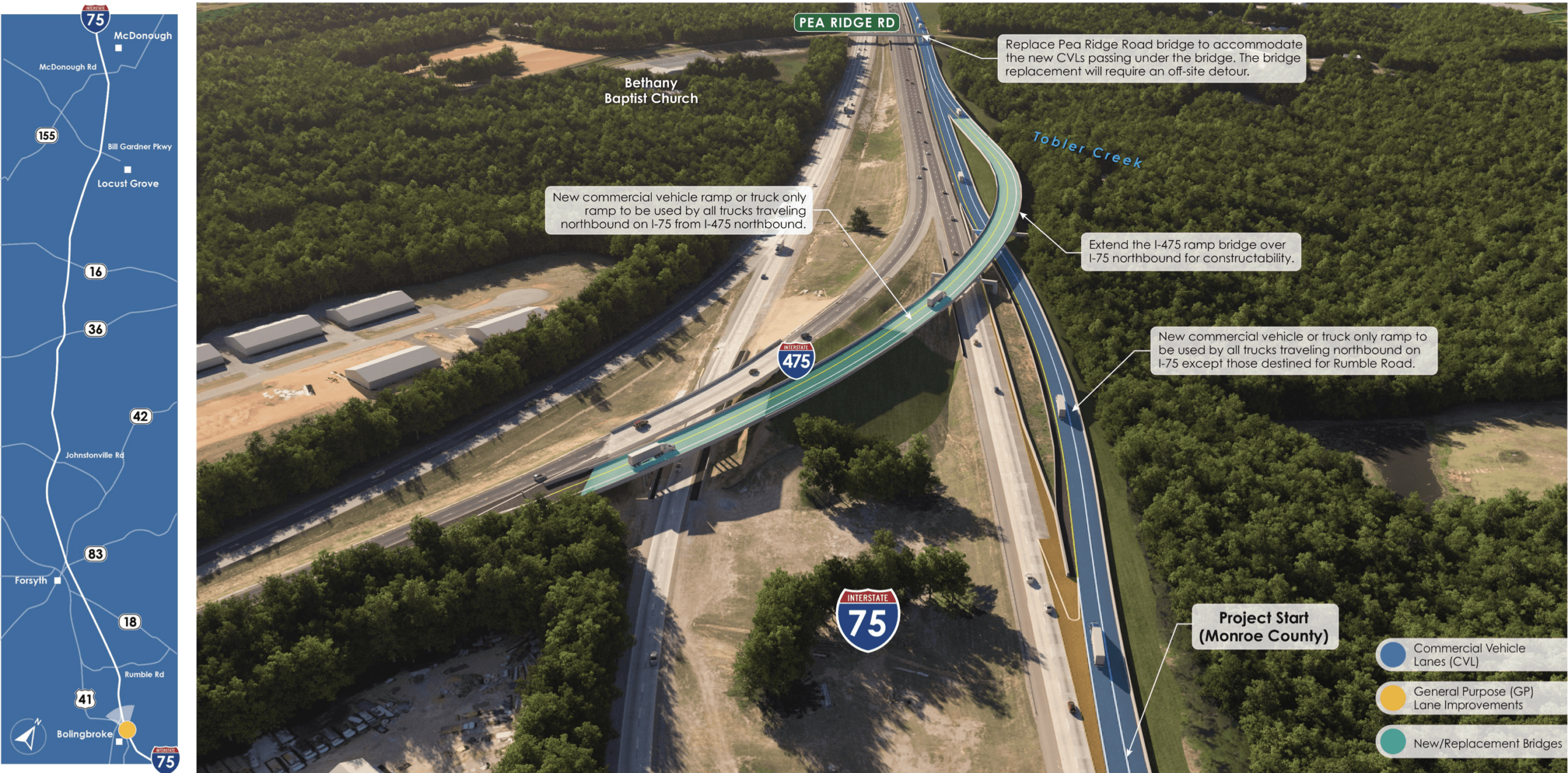
Georgia is moving ahead with an idea that most of the country has only talked about: a stretch of interstate where the trucks get their own road. The Georgia Department of Transportation has released a construction timeline for its I-75 Commercial Vehicle Lanes project, and the plan is concrete. Design work will be finalized and […] The post Georgia Is Building 41 Miles of Toll-Free, Truck-Only Lanes on I-75. GDOT Thinks Nearly Every Truck Will Use Them. appeared first on FreightWaves.
Source Lens
Industry Context
Useful background context, but lower-priority than direct platform, community, or operator intelligence.
Impact Level
medium
Use this briefing to decide whether your team needs an immediate workflow, policy, or reporting change.
Key Stat / Trigger
No single quantitative trigger surfaced in this report.
Focus on the operational implication, not just the headline.
Full Coverage
Georgia is moving ahead with an idea that most of the country has only talked about: a stretch of interstate where the trucks get their own road. The Georgia Department of Transportation has released a construction timeline for its I-75 Commercial Vehicle Lanes project, and the plan is concrete.
Design work will be finalized and construction will begin in 2027, with completion expected by the end of 2032.
When it is done, northbound I-75 will carry two barrier-separated lanes reserved exclusively for commercial vehicles, running 41 miles from the I-75/I-475 interchange in Monroe County to near the State Route 20 interchange in Henry County, passing through Monroe, Lamar, Butts, Spalding, and Henry counties. There is no toll.
The commercial vehicle lanes, which GDOT refers to as the CVL, will be free for trucks to use. For a project of this scale, the details matter, and so does the context, because this is not a minor widening. It is a roughly $3.
5 billion bet on a specific idea about how to move freight through one of the most congested corridors in the country, and if it works, Georgia will not be the last state to try it. What Is Actually Being Built The core of the project is straightforward to describe and enormous to execute.
GDOT is adding two new lanes along the northbound side of I-75, physically separated from the general purpose lanes by a barrier, and restricting them to commercial vehicles. Under the current proposal, all trucks with more than six wheels must use the CVL unless they are destined for a local exit within the project limits.
The 41-mile corridor runs south to north, beginning where I-75 splits from I-475 in Monroe County near Macon and ending near the SR 20 interchange in Henry County, in the McDonough area south of Atlanta. It threads through five counties and the towns along that stretch, including Forsyth, Locust Grove, and McDonough.
The project carries GDOT project number 0014203 and an estimated cost in the range of $3. 5 billion, with the state’s eminent domain filings estimating around 173 affected parcels of property and tens of millions of dollars in right-of-way acquisition.
This is a reconstruction and widening of the northbound right-of-way at a very large scale, which is part of why the timeline runs out to 2032. It is also worth noting for anyone who has followed this project that the timeline has moved before.
Earlier versions of the plan once targeted substantial completion around 2027, and the schedule has been revised more than once as GDOT restructured how the work would be bid and built. The dates announced now, construction beginning in 2027 and wrapping by the end of 2032, are the current official projection.
Credit: Georgia Department of Transportation Rendering Why This Corridor, and Why It Matters GDOT did not pick this stretch at random. It picked one of the worst freight chokepoints in the United States.
In the American Transportation Research Institute’s 2026 Top Truck Bottleneck List, I-75 at McDonough ranks as the tenth-worst truck bottleneck in the entire country. That is the northern end of exactly the corridor these lanes are meant to relieve.
Georgia as a whole placed nine locations on ATRI’s 2026 top 100 list, second only to Texas, and three Georgia bottlenecks landed in the national top ten. The McDonough chokepoint on I-75 is the one this project is built to fix. The freight volume through the corridor explains why.
GDOT officials have said truck traffic through this stretch of I-75 is approaching 30% of average daily traffic, an unusually high share, and the department expects it to keep climbing as economic development and port activity in Georgia grow.
When close to a third of the vehicles on a road are heavy trucks and the road is already failing at peak hours, separating the trucks from everything else becomes a serious proposal rather than a novelty. The national backdrop makes the stakes clear. ATRI found that average rush-hour truck speeds at the country’s bottlenecks fell to 33.
2 miles per hour in its 2026 analysis, and among the ten worst locations, average peak truck speed dropped to 29. 6 miles per hour. ATRI states the total congestion cost in stark terms, saying the delays inflicted on truckers are the equivalent of 436,000 drivers sitting idle for an entire year.
For an owner-operator paid by the mile, time lost crawling through McDonough is money that never gets earned back. The Projection That Is Turning Heads The number drawing the most attention is GDOT’s estimate of how many trucks will actually use the new lanes.
The department projects that between 73% and 100% of trucks traveling within the project limits will shift out of the general purpose lanes and into the commercial vehicle lanes, depending on their destination. That is a remarkable range, and the upper end of it, essentially every truck, is what makes this project notable.
It reflects the design intent: with a mandate that trucks over six wheels use the CVL unless e
Original Source
This briefing is based on reporting from Freightwaves. Use the original post for full primary-source context.
Style
Audience