

Transpacific ocean rates fueled by early peak, frontloading
Spot rates from Asia to the U.S. West Coast are up 120% since mid-May, while the East Coast lane is 85% higher compared to the last six weeks, according to Freightos.
Source Lens
Industry Context
Useful background context, but lower-priority than direct platform, community, or operator intelligence.
Impact Level
medium
Use this briefing to decide whether your team needs an immediate workflow, policy, or reporting change.
Key Stat / Trigger
No single quantitative trigger surfaced in this report.
Focus on the operational implication, not just the headline.
Full Coverage
An article from Dive Brief Transpacific ocean rates fueled by early peak, frontloading Spot rates from Asia to the U. S. West Coast are up 120% since mid-May, while the East Coast lane is 85% higher compared to the last six weeks, according to Freightos.
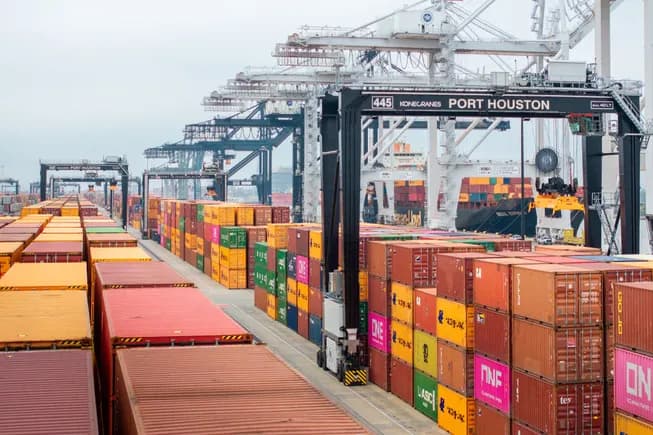
Published July 7, 2026 Alejandra Carranza Reporter Share Copy link Email / Print License Add us on Google Shipping containers organized at Port Houston. Shippers are continuing their frontloading efforts leading to a rise in ocean spot rates for the Transpacific trade lane.
Brandon Bell via Getty Images Listen to the article 3 min This audio is auto-generated. Please let us know if you have feedback. Dive Brief: Transpacific ocean rates are rising with an early peak season demand from shippers being a main driver, according to a June 30 Freightos weekly update.
The rush to pull forward cargo is leading to an early peak season as shippers aim to get ahead of expected July Bunker Adjustment Factor surcharge hikes, manufacturer price increases and an approaching tariff deadline for U. S. shippers, per Freightos. An early peak can also mean there could be an early unwind of peak season sometime in July.
Spot rates from Asia to the U. S. West Coast are at $6,200 per forty-foot equivalent unit, a 120% climb since mid-May, according to Freightos. Meanwhile, rates on the Asia-East Coast lane are at $8,000 per FEU, reflecting an 85% increase over the last six weeks. By the numbers $6,200 Spot rate per FEU from Asia to the U. S.
West Coast, as of July 4 $8,000 Spot rate per FEU from Asia to the U. S. East Coast, as of July 4 Source: Freightos Dive Insight: Shippers’ behavior is showing caution as frontloading efforts continue. While fuel prices were driving up ocean rates, it seems that surging peak season demand is the driver now, per Freightos. Late last month, a U. S.
-Iran ceasefire pact was announced to reopen the Strait of Hormuz. Even with a pact in place, recovery for ocean supply chain networks was not expected until mid-September, according to a June 19 Xeneta update. Last week, the U. S.
and Iran held separate meetings with Qatari and Pakistani mediators as they have agreed to continue discussions seeking a permanent end to the war, the AP reported. Frontloading efforts are driving demand on the Transpacific trade lane. Offered capacity from Asia to the U. S.
West Coast, for instance, is hitting an all-time high, Xeneta Chief Analyst Peter Sand said in a July 3 shipping update. “The combination of record capacity deployment and further rate increases on the Transpacific tells us demand is strong and that carriers are scrambling to satisfy it,” Sand said in a weekly update.
The four-week rolling average of containers moving from the Transpacific to the U. S. West Coast beginning June 29 stands at about 350,000 TEUs, Sand said. This figure matches the previous record of 349,000 TEUs set during the 90-day U. S. tariff pause last year.
In response, carriers such as MSC are making changes to accommodate shippers’ frontloading efforts. The ocean carrier reinstated the Pearl-service on June 13, Sand said. The MSC LYSE V was the first vessel on that service to call at Long Beach on June 30, while Yang Ming and ONE are also running extra-loaders.
“Carriers are set to introduce more rate increases to start July, so the degree of success carriers have with these price hikes should reflect where the market is in terms of this year’s peak season peak,” Freightos said.
Still, the market is not ready to turn a corner, Sand said, as spot rates continue to climb into mid-July, or at least for other major fronthauls to Europe and the U. S. “More capacity is welcome and will help shippers to move goods more reliably, but it is not enough to reverse the upwards trend,” Sand said.
Recommended Reading Ocean shippers frontload cargo ahead of tariffs, fuel concerns By Alejandra Carranza • June 12, 2026 Ocean shipping recovery still a ways off despite US-Iran ceasefire pact By Kelly Stroh • June 24, 2026 Add us on Google Share Copy link Email / Print License Filed Under: Logistics, Freight, Maritime
Original Source
This briefing is based on reporting from Supply Chain Dive. Use the original post for full primary-source context.
Style
Audience