

Trucking Legislator Rankings. 79 Bills, 3 Laws.
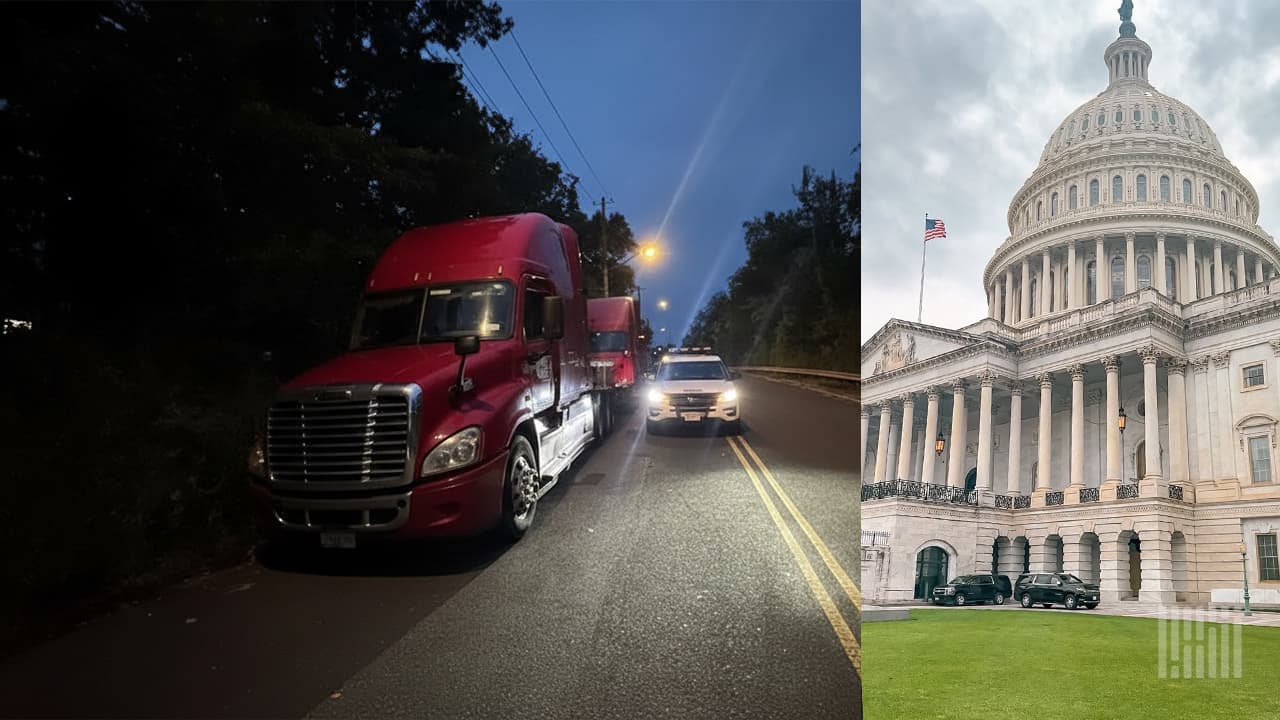
We’re auditing the people who write the laws MCSAP dollars enforce. We pulled every trucking bill in Congress, every name, and laid it against the crash data in their own states. The post Trucking Legislator Rankings. 79 Bills, 3 Laws. appeared first on FreightWaves.
Source Lens
Industry Context
Useful background context, but lower-priority than direct platform, community, or operator intelligence.
Impact Level
medium
Use this briefing to decide whether your team needs an immediate workflow, policy, or reporting change.
Key Stat / Trigger
No single quantitative trigger surfaced in this report.
Focus on the operational implication, not just the headline.
Full Coverage
Before he was the Transportation Secretary withholding hundreds of millions of dollars from states for not enforcing hard enough, Sean Duffy spent nine years in the United States Congress. From 2011 to 2019, he put his name on roughly 820 pieces of legislation. Four involved trucking.
A clarification of the agricultural exemption from hours-of-service rules, so certain farm haulers could drive longer. The Drug-Free Commercial Driver Act, backed twice, the hair-testing recognition bill, and the Safe, Flexible, and Efficient Trucking Act of 2015, the bill to put heavier trucks on the interstate.
All four died in the same place: referred to the Subcommittee on Highways and Transit, never heard from again. The point is that Secretary Duffy has tried even before becoming Secretary. The guardrails of bureaucratic government don’t always lead to a destination.
In fairness, Duffy sat on Financial Services, not Transportation, and a Secretary’s job is to execute law, not write it. Yesterday I pulled enforcement across states, and today I pulled the policymaker portion of that data. Every bill introduced in the 118th and 119th Congress, all 36,608 of them, was screened for trucking, which produced 79 bills.
Every sponsor and cosponsor on all 79, cross-referenced against committee assignments, and then against the numbers from yesterday’s enforcement piece: the crash deaths, the inspections, and the enforcement dollars in each member’s own state.
Following yesterday’s State partner MCSAP bang-for-buck rankings, today we bring you the trucking legislation bang-for-buck ledger. It is not flattering to anybody. Pass term limits because there’s a whole lot of partisan politics and sound bites that don’t track to real action or outcomes. 79 bills. Three laws. Start with the output of the whole machine.
Over two Congresses, nearly four years, the United States Congress introduced 79 bills touching trucking. Three became law.
Two of the three are worthy but modest CDL housekeeping measures: the Veteran Improvement Commercial Driver License Act, easing the path for veterans to get their CDLs, and the Strengthening the Commercial Driver’s License Information System Act, a data-plumbing upgrade to the system that states use to share driver records. Good bills.
None puts an inspector on a ramp or a dangerous carrier out of business. The third is the one that tells you where the energy actually went: a Congressional Review Act resolution striking down California’s Advanced Clean Trucks rules.
Whatever you think of California’s emissions mandates, and plenty of drivers cheered that repeal, including me, notice what it means. The single most consequential piece of trucking legislation enacted by this Congress was a deregulation.
In four years, Congress did not pass one bill that added enforcement capacity, funded inspections, or tightened carrier oversight. Not a single one. The 76 that didn’t pass? Sixty-nine died the same week they were born, were referred to a committee, and never touched again.
Five fought their way through committee, got reported to the House calendar, and died sitting on it. Two of those are bills this industry has spent years asking for.
The Motor Carrier Safety Selection Standard Act would have created a national standard for vetting carriers before hiring them; the question the Supreme Court just made urgent for every broker in America in Montgomery v. Caribe. Reported out of committee. Placed on the calendar. Died.
The Truck Parking Safety Improvement Act, the top quality-of-life ask of nearly every driver survey ever taken. Reported out. Placed on the calendar. Died. The system worked exactly up to the point of mattering, then stopped. So we should ask why. The workhorses Not many go-getter workhorses among the legislators. Why?
Well, because they’re consumer politicians that you and I continuously feed regardless of what they do or fail to do. 79 bills didn’t sponsor themselves, and the people doing the work aren’t mostly the ones you’d guess. In the House, the heaviest lifters over two Congresses are Rep. Tracey Mann of Kansas with 12 trucking bills carrying his name, Rep.
Troy Nehls of Texas, himself a former sheriff whose district sits on the Houston freight corridor, with 11, Rep. Rudy Yakym of Indiana with 10, and Rep. Chris Pappas of New Hampshire, the leading Democrat, with 9. On the Senate side, Sen.
Deb Fischer of Nebraska stands out as the chamber’s most prolific author of trucking legislation, with Wyoming’s Cynthia Lummis and Michigan’s Gary Peters among the most active. Note the geography: Kansas, Nebraska, Wyoming, Indiana, New Hampshire.
Freight-corridor and agricultural states, mostly, whose members live with trucking whether they chose the issue or not. Give the workhorses their due but what did all that work produce? Mann’s 12 bills, Nehls’ 11, Fischer’s portfolio, nearly all of it is sitting in the same subcommittee graveyard as Duffy’s four bills from a decade ago. Effort is not outp
Original Source
This briefing is based on reporting from Freightwaves. Use the original post for full primary-source context.
Style
Audience