

Autonomous Freight Needs to Solve the Predictability Problem
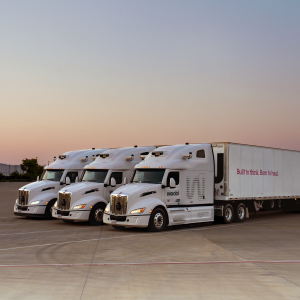
FreightWaves and Waabi are hosting a free Sept. 29 webinar on how autonomous trucking is moving from pilot programs to predictable, scalable freight capacity. Register now to learn what the early mover advantage means for shippers, carriers and brokers. The post Autonomous Freight Needs to Solve the Predictability Problem appeared first on FreightWaves.
Source Lens
Industry Context
Useful background context, but lower-priority than direct platform, community, or operator intelligence.
Impact Level
medium
Use this briefing to decide whether your team needs an immediate workflow, policy, or reporting change.
Key Stat / Trigger
No single quantitative trigger surfaced in this report.
Focus on the operational implication, not just the headline.
Full Coverage
For years, the promise of autonomous trucking has been sold in the future tense. Someday, driverless trucks will free up capacity, someday they’ll smooth out the peaks and valleys of freight demand, someday shippers won’t have to plan around driver shortages and hours-of-service limits. On Sept.
29, FreightWaves and Waabi are asking what happens when “someday” starts showing up on the schedule. That’s the premise behind The Autonomous Freight Blueprint: Unlocking Predictable Capacity and the Early Mover Advantage, a free webinar airing at 2 p. m.
EDT that will dig into how AI-driven trucks are moving from pilot programs to the kind of dependable, scalable capacity that shippers and carriers can actually plan a network around.
Waabi, the Toronto-based Physical AI company founded by longtime autonomous vehicle researcher Raquel Urtasun, has spent 2026 turning heads with an approach that looks different from the rest of the autonomous trucking field.
Rather than layering machine learning on top of a traditional rules-based driving stack, Waabi built a verifiable end-to-end AI model capable of reasoning and generalization.
This is paired with an industry-leading neural simulator used to train, test and validate the system, allowing the company to test rare and dangerous edge cases without putting a truck on the road to find them.
“The beauty of this technology is it is end-to-end trainable, meaning it can learn to deal with the complexity of the real world,” Urtasun has said of the approach. She has argued it will change the world once proven at scale.
Investors are betting Waabi’s physical AI platform will drive both freight-hauling trucks and passenger robotaxis on the same underlying technology. For the freight industry, that generalization speaks directly to the capacity question at the heart of the webinar.
Waabi COO Lior Ron, who founded Uber Freight before joining Waabi last year, has been blunt about why the company isn’t chasing the highway-only, hub-to-hub model that much of the autonomous trucking industry defaulted to early on.
Bolting expensive first- and last-mile human-driven legs onto either end of an autonomous highway run, he’s argued, just recreates the cost structure carriers are trying to escape, with hundreds of dollars in transfer costs that shippers won’t ultimately subsidize. Instead, Waabi enables door-to-door, facility-to-facility autonomy.
The vast majority of freight will be moved door-to-door, Ron has said. The company is also partnered with Volvo Autonomous Solutions and together, they have integrated the Waabi Driver into the Volvo VNL Autonomous to deliver a safe, redundant autonomous solution designed for broad commercial deployment.
That’s non-negotiable for anyone serious about pulling the driver out of the cab. None of that is a hard sell to an industry that has spent the past several years absorbing capacity swings, driver shortages and rate volatility.
It is, however, a case that has to be made in specifics, including how autonomous capacity actually gets planned into a network, what “early mover” gets a shipper or carrier who is willing to commit now versus waiting for the technology to fully mature, and where the realistic timeline sits between today’s pilots and tomorrow’s driverless freight lanes.
The webinar is free to attend and includes audience Q&A. Anyone responsible for capacity planning, network design, or long-term freight strategy (whether shipper, carrier, or broker) will want the details before the seats fill up. Register for “The Autonomous Freight Blueprint” here to save your spot for the Sept. 29 session at 2 p. m. EDT.
The post Autonomous Freight Needs to Solve the Predictability Problem appeared first on FreightWaves.
Original Source
This briefing is based on reporting from Freightwaves. Use the original post for full primary-source context.
Style
Audience