

Why the Same Amazon DSP Budget Produces Two Very Different Outcomes
We turn down business on purpose. Every strategist we hire could carry thirty or forty accounts, the way most agencies staff them. We cap them at a fraction of that, which means we say no to brands we’d like to work with and leave money on the table doing it. That sounds like a bad… The post Why the Same Amazon DSP Budget Produces Two Very Different Outcomes appeared first on SellerApp Blog. Related posts: How to Plan Amazon Sales Post Holidays Amazon Review Trader Websites: What Sellers Must Kn
Source Lens
Industry Context
Useful background context, but lower-priority than direct platform, community, or operator intelligence.
Impact Level
medium
Use this briefing to decide whether your team needs an immediate workflow, policy, or reporting change.
Key Stat / Trigger
No single quantitative trigger surfaced in this report.
Focus on the operational implication, not just the headline.
Full Coverage
--> Why the Same Amazon DSP Budget Produces Two Very Different Outcomes Ishita Banerjee July 17, 2026 9 mins to read [shared_counts] We turn down business on purpose. Every strategist we hire could carry thirty or forty accounts, the way most agencies staff them.
We cap them at a fraction of that, which means we say no to brands we’d like to work with and leave money on the table doing it. That sounds like a bad way to run an agency. It might be. But it’s the only way we’ve found to run DSP that actually works, and the 9. 38% click-through our retargeting segments hit against a 0.
47% platform average is the entire argument for it. Here’s what nobody tells you about Amazon DSP. Two brands can run the identical budget, in the same category, on the same platform, and one triples its business while the other loses money the whole way. The difference usually isn’t strategy. It’s who is actually watching the account.
This is a question about DSP account management, and about whether managed DSP earns its keep, so let’s get concrete.
Quick Gudie: Same budget, two outcomes Forty accounts per strategist works out to thirty minutes a week for yours Thin attention shows up directly in your click-through rate The half most agencies skip is proving the spend was incremental TubShroom is the Brand B, in full Category math is where a thin-attention agency breaks completely Four questions that tell you which brand you are What we’d tell you either way Frequently asked questions Same budget, two outcomes Picture two versions of the same brand.
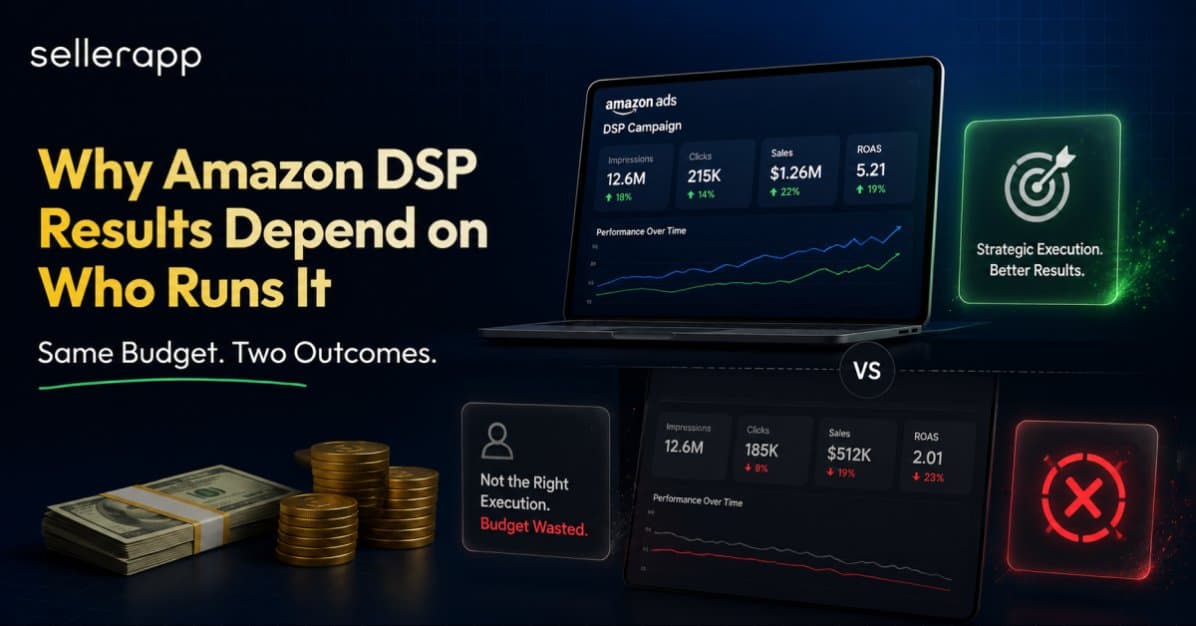
Call them Brand A and Brand B. Same catalog, same $100k monthly DSP budget, same starting point, TACoS stuck at 33% with search tapped out.
Brand A (thin attention) Brand B (daily senior attention) Who runs it One strategist across 40 accounts Dedicated senior strategist Time on the account ~30 minutes a week Every day Audiences Off-the-shelf demographic segments Built from real purchase behavior Pacing Checked at month-end Watched and corrected daily Attribution Blended monthly report AMC-split, incrementality proven Six-month outcome Spend flat, TACoS climbs DSP scales to 35% of revenue, TACoS holds Brand B is TubShroom.
We’ll come back to them. Brand A is most DSP campaigns running right now, and the brands inside them usually have no idea that’s what they are. The budget didn’t decide the outcome. The attention did. Forty accounts per strategist works out to thirty minutes a week for yours Most Amazon DSP agencies run 30 to 50 accounts through a single strategist.
Do the arithmetic and that’s about half an hour of senior attention per account, per week. Half an hour is enough to pull a report. It is nowhere near enough to run the channel. DSP isn’t a set-and-forget line item where you pick an audience and let it ride.
It needs daily calls, which audiences to scale, which to cut, where pacing is slipping, when a placement stops earning its keep. A weekly report can’t make those calls, and a strategist with 39 other accounts won’t. This is the part that surprised even us at scale.
Across our first hundred enterprise accounts, the single biggest predictor of whether DSP worked wasn’t the brand’s budget, the category, or the creative. It was whether someone senior was in the account every day. Strategy is where agencies compete on the pitch. Staffing is where the results are actually won or lost.
Thin attention shows up directly in your click-through rate Attention isn’t a soft quality you can’t measure. It turns into performance, and you can follow the line from one to the other.
A strategist who actually has time builds custom audiences from purchase behavior across hundreds of millions of shoppers, instead of grabbing the off-the-shelf demographic segments a rushed one reaches for. Better audiences get clicked. Our retargeting segments run at 9. 38% click-through against a 0. 47% platform norm, and that gap isn’t a trick.
It’s what happens when someone builds the audience properly. Then it compounds. Higher click-through lowers your effective CPM, which buys more impressions on the same budget, which feeds the algorithm more signal to optimize against. Thin attention runs that same flywheel in reverse.
Weaker audiences, lower click-through, higher CPMs, less reach for every dollar. Same budget, worse math, and nobody watching closely enough to catch it. As Nithin Mentreddy, who runs our customer success, puts it, the next customer isn’t searching yet, so reaching them before a competitor does and then showing the brand it happened is the entire job.
Most agencies stop at the first half, because the second half is hard to staff for. The half most agencies skip is proving the spend was incremental Reaching new buyers is the visible half. Proving the spend was incremental is the half that separates a real DSP operation from an expensive one, and it’s the half thin attention never reaches.
Through direct Amazon Marketing Cloud access, we separate DSP-assisted, DSP-only, and DSP-to-searc
Original Source
This briefing is based on reporting from SellerApp Blog. Use the original post for full primary-source context.
Style
Audience