
Rejigged NLRB likely to target Cemex rule, used by Teamsters to organize
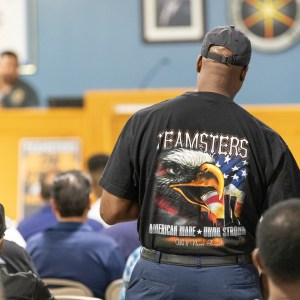
The Cemex rule, favored by unions to make it easier to organize work forces, is under more pressure to be eliminated. The post Rejigged NLRB likely to target Cemex rule, used by Teamsters to organize appeared first on FreightWaves.
Source Lens
Industry Context
Useful background context, but lower-priority than direct platform, community, or operator intelligence.
Impact Level
medium
Use this briefing to decide whether your team needs an immediate workflow, policy, or reporting change.
Key Stat / Trigger
No single quantitative trigger surfaced in this report.
Focus on the operational implication, not just the headline.
Full Coverage
A tool the Teamsters and other unions have been attempting to use in their organizing efforts is likely to be under renewed pressure from the Trump administration, now that the National Labor Relations Board has a clear Republican majority and a quorum. The tool is the Cemex precedent from the Biden administration.
As the Benesch law firm wrote in a commentary about a recent memorandum written by Crystal Stowe Carey, the NLRB’s new General Counsel, the Cemex precedent came from an NLRB decision that “when a union requests recognition on the basis that a majority of employees in a bargaining unit have designated the union as their representative, an employer must recognize and bargain with the union or promptly file a petition for an election.”
That petition is known as an RM petition. Card check has been a preferred strategy Getting a work force organized through that process is known as card check.
And the Teamsters recently said they had organized workers at the DRI1 facility of Amazon (NASDAQ: AMZN) in Providence, Rhode Island through card check, though the union did not use that term in its prepared statement. There is no recent record of a traditional unionization vote at DRI1 in the NLRB’s data base of actions.
There can be a lag in the NLRB’s publication of election results, but there is nothing in the Teamsters statement to suggest there was a traditional election. But regardless of what happens in Rhode Island, or at other work sites that unions have sought to organize through card check, the Cemex precedent has been the key to those efforts.
And it is clearly threatened. In the August 26 memo to regional directors and other NLRB officials, Carey spelled out the “further guidance (on) General Counsel priorities.” Weakening the Cemex precedent was on the list.
“To ensure transparency in relation to my priorities, I am issuing this memorandum to identify cases where I have requested or intend to request the Board to revisit certain Precedents,” Carey wrote. She added the memo doesn’t require that cases in the regions be submitted to the NLRB’s Division of Advice.
But “regions have been, and continue to be, provided with guidance on best practices to use in the settlement, and prosecution, of the cases and issues discussed in the memo.” Cleaning up the NLRB backlog Carey, who took over her role in January, said overturning precedents is not her top priority.
Rather, it is clearing a lengthy backlog that grew as empty seats on the NLRB went unfilled. The NLRB went months with just two members, short of a quorum. The board now has four members, with three of them Republicans. With that, precedents can be overturned if a relevant case comes before it. The list of precedents on Carey’s focus list is a long one.
Cemex is just one of many. Several of the precedents, including Cemex, have not been in front of the NLRB yet, and Carey said she has therefore not had an opportunity to make her case before the commissioners. But on the top of that list in the memo is Cemex. That decision, Carey said, “is contrary to Supreme Court precedent and sound labor policy.”
Back to the Gissel precedent She added the precedent that Cemex overturned, NLRB vs. Gissel Packing from 1969, as well as other cases from 1971 and 1973, should be “reaffirmed.”
“Carey intends to seek reinstatement of Gissel Packing, under which the Board held that issuance of a bargaining order is appropriate where an employer who has rejected a card majority has committed unfair labor practices which have made the holding of a fair election unlikely, or which have undermined a union’s majority, caused an election to be set aside, and made the holding of a fair rerun election unlikely,” Benesch wrote in its commentary on Carey’s memo.
The key there is the unfair labor practice charge, which Cemex no longer established as a prerequisite to ordering a successful card check effort be recognized. One of the older cases cited by Carey in her memo is Linden Lumber.
Benesch describes the core of that decision as “an employer does not commit an unfair labor practice for refusing to accept evidence of the union’s majority status other than the results of a Board election, such as authorization cards.” The Teamsters are not just approaching unionization through card check.
The union recently scoured a victory at a warehouse in the Oakland, California area, winning a traditional vote. Success at a casino It also has organized workers through card check where the company recognized those efforts.
For example, according to the Teamsters, 110 casino workers at the Black Hawk Casino in the town of that same name in Colorado organized through card check, according to a prepared statement by the union. That card check drive came with Bally’s, the casino owner, knowing what was going on, the union said.
“In November 2025, (the union) and Bally’s reached a landmark neutrality agreement,” the union said. “Under the card check process, Bally’s workers were able to choose u
Original Source
This briefing is based on reporting from Freightwaves. Use the original post for full primary-source context.
Style
Audience