25 states sue Trump over Section 301 forced-labor tariffs
The suit claims the tariffs are a workaround for a Supreme Court decision that revoked sweeping duties imposed by President Donald Trump.
Source Lens
Industry Context
Useful background context, but lower-priority than direct platform, community, or operator intelligence.
Impact Level
medium
Use this briefing to decide whether your team needs an immediate workflow, policy, or reporting change.
Key Stat / Trigger
No single quantitative trigger surfaced in this report.
Focus on the operational implication, not just the headline.
Full Coverage
An article from 25 states sue Trump over Section 301 forced-labor tariffs The suit claims the tariffs are a workaround for a Supreme Court decision that revoked sweeping duties imposed by President Donald Trump. Published Aug. 4, 2026 Antone Gonsalves Reporter Share Copy link Email / Print License Add us on Google U. S.
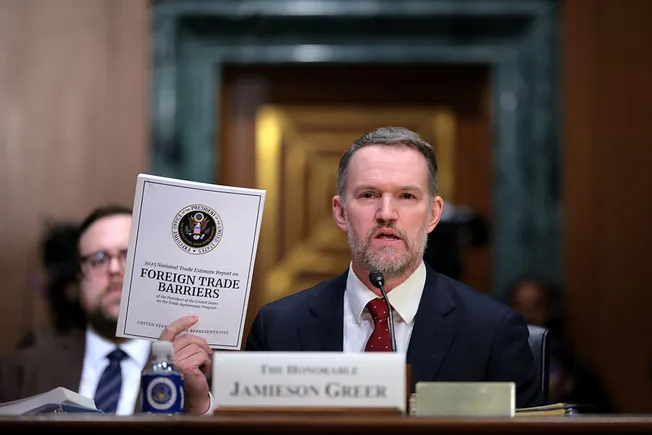
Trade Representative Jamieson Greer testifies before the Senate Finance Committee on April 8, 2025. The USTR is accused of imposing Section 301 tariffs without linking the levies to trading partners' goods allegedly connected to forced labor. Kayla Bartkowski via Getty Images Listen to the article 3 min This audio is auto-generated.
Please let us know if you have feedback. A 25-state coalition has sued the Trump administration over its Section 301 tariffs on 60 trading partners the administration accused of failing to prevent goods made with forced labor from entering the U. S. The lawsuit, filed Monday in the U. S.
Court of International Trade, challenges the administration’s decision to impose tariffs of 10% or 12. 5% on dozens of trading partners, including the European Union, China, Canada and Mexico. The plaintiffs say the levies were imposed under the “guise of combating forced labor in global trade” and should be ruled unlawful, with refunds made to the states.
“The Tariff Action is arbitrary, capricious, and contrary to law,” the suit says, adding that “the Administration cannot use forced labor as a pretext to continue its illegal tariff scheme.” The suit claims the U. S.
Trade Representative imposed the tariffs as a workaround for a February Supreme Court decision that revoked sweeping tariffs President Donald Trump had instituted under the International Emergency Economic Powers Act the year before.
According to the suit, the USTR instituted the Section 301 tariffs without linking the rates to the alleged prevalence of forced-labor-tainted goods in each economy and did not respond to comments and testimony that undercut its rationale.
“In short, there is no rational fit between the purported problem of forced labor in international supply chains and the blanket global tariffs the USTR imposed,” the suit says.
The legal action said the USTR offered no mechanism for an accused economy to escape the levies through remedial action, and it kept an effective 10% tariff floor even for countries it said were taking steps to combat forced labor. The suit names Trump, U. S.
Trade Representative Jamieson Greer, Customs and Border Protection Commissioner Rodney Scott and their offices as defendants. The states filed the suit more than a week after two U. S. businesses launched the first legal challenge to the forced-labor tariffs in the Court of International Trade.
Spice importer Burlap and Barrel and watch retailer Collective Horology asked for the new levies to be removed and for refunds. Like the states’ lawsuit, the businesses argued that the administration imposed the levies without fully meeting Section 301 requirements. They said the tariffs are a backdoor attempt to replace duties previously removed.
The businesses filed the lawsuit on July 24, the same day the Section 301 tariffs took effect and Trump’s temporary Section 122 tariffs reached their 150-day expiration date. Trump imposed the Section 122 levies after the Supreme Court revoked the IEEPA tariffs.
Recommended Reading US imposes tariffs over forced labor before global duty ends By Phil Neuffer • July 23, 2026 Add us on Google Share Copy link Email / Print License Filed Under: Procurement, Regulation, Manufacturing
Original Source
This briefing is based on reporting from Supply Chain Dive. Use the original post for full primary-source context.
Style
Audience