

Bank exits squeeze truck financing for mid-size fleets
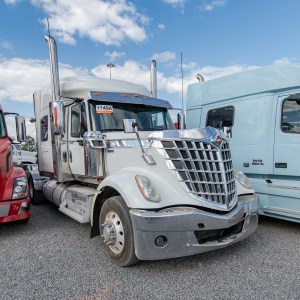
Truck financing has thinned out for carriers rebuilding after the freight recession. Mitsubishi HC Capital’s Kirk Mann on what now separates an approval from a decline. The post Bank exits squeeze truck financing for mid-size fleets appeared first on FreightWaves.
Source Lens
Industry Context
Useful background context, but lower-priority than direct platform, community, or operator intelligence.
Impact Level
medium
Use this briefing to decide whether your team needs an immediate workflow, policy, or reporting change.
Key Stat / Trigger
No single quantitative trigger surfaced in this report.
Focus on the operational implication, not just the headline.
Full Coverage
Three and a half years of freight recession did two things to the truck financing market at once. It shredded the credit profiles of the carriers who most needed to borrow. It also pushed a large share of the lenders who would have lent to them out of the sector.
Both are now rationing the equipment replacement cycle the industry has spent two years waiting on. Kirk Mann stayed in. As executive vice president and general manager of the transportation vendor solutions business at Mitsubishi HC Capital America, he financed trucks through the entire downturn and watched a great many of them come back.
“There are a lot of lenders, banks that left, and so we’ve had the benefit of being one of the lenders actually lending money in this space,” Mann said in an interview with FreightWaves. What competition remains is mostly OEM captive finance arms, a couple of large independents and a few bank-led groups, he said.
The carriers that did not survive were overwhelmingly the newest. On average, 85% of motor carriers with fewer than two years of operating experience and their own operating authority failed over a three-year stretch of the downturn, Mann said.
The asset bubble behind the failure rate Back in January 2023, Mann sat in Mitsubishi HC Capital’s Chicago offices with Wayne Pass, the company’s chief credit officer for vendor solutions, since retired. He asked what a Freightliner Cascadia 13-speed with a tall sleeper and fewer than 500,000 miles was worth. Both men wrote down $45,000.
Mann then asked what the company was financing those trucks at. About $110,000. “I remember we were in a bubble. It was an asset bubble of enormous proportions,” Mann said. A typical 4-year-old sleeper tractor sold at auction in a range of roughly $30,000 to $50,000 across the 11 years between the Great Recession and the COVID-19 pandemic, according to J. D.
Power’s Commercial Truck Guidelines. That same truck peaked near $118,000 in early 2022, a 136% jump over the highest pre-COVID peak in the same dataset. Class 8 average retail prices have since settled at $60,986 as of September, according to ACT Research’s State of the Industry: U. S. Classes 3-8 Used Trucks report.
Mitsubishi HC Capital lent into that bubble knowing what it was. “We made the decision to stay in that market even though we knew there was a tremendous asset bubble, because we wanted people to know we were there,” Mann said. “And if I could do it over again, I’m not sure I’d do it exactly like that.
But we’d probably mitigate our risk exposure a little bit differently.” The unwind arrived as repossessions. “The problem was when things kind of unwound those trucks were coming back because there were payments that people couldn’t sustain, and so those trucks came back like in droves,” Mann said.
The lender has since improved recoveries on transportation assets by 15% by building out a dedicated asset management function, Equipment Finance News reported. Fewer lenders in truck financing, weaker credit profiles Carriers reading the market as a credit squeeze are half right. Mann said his underwriting did not change. It was the borrowers who did.
“We don’t really change our underwriting philosophy or process, but the credit profile of the customer definitely changes during these down cycles,” he said. “So it feels like lenders are squeezing up and we’re not.
We’re just trying to do business with customers that have the right credit profile, and of course those deteriorate over a three-and-a-half-year cycle.” Freight cycles normally run 12 to 18 months. This one ran nearly three times that, with the damage compounding along the way.
The price of capital is now segregating carriers by how much of that damage they absorbed. Financing runs from roughly 5. 25% for investment-grade private fleets up to 12% or higher for lower-credit small operators, who are typically asked for a deposit as well, Mann noted in a FreightWaves Today interview.
Fleets of 50 to 200 units are increasingly approaching Mitsubishi HC Capital through dealer relationships, according to the same interview. Where the replacement demand is coming from For two years the industry pinned the coming equipment wave on EPA 2027 pre-buying. Mann does not. “I don’t think it’s a lot of EPA pre-buy.
I think it’s just simply replacement demand and people have released themselves to go ahead and replace their trucks,” he said. Manufacturers have split on how to handle the 2027 rules, some building the compliant truck and others planning to run legacy models on banked credits or pay the penalty, which leaves 2027 pricing unsettled.
His team polls dealers on it constantly and gets different answers depending on the make they carry. He is not expecting a spike large enough to drive purchasing behavior. Volume through the dealer channel is up regardless.
Over-the-road volume at Mitsubishi HC Capital has improved by roughly 30%, Mann said, driven mostly by medium and large fleets replacing equipment they held far past the
Original Source
This briefing is based on reporting from Freightwaves. Use the original post for full primary-source context.
Style
Audience