

AI & Logistics: Will a ‘Job Apocalypse’ Hit the Supply Chain?
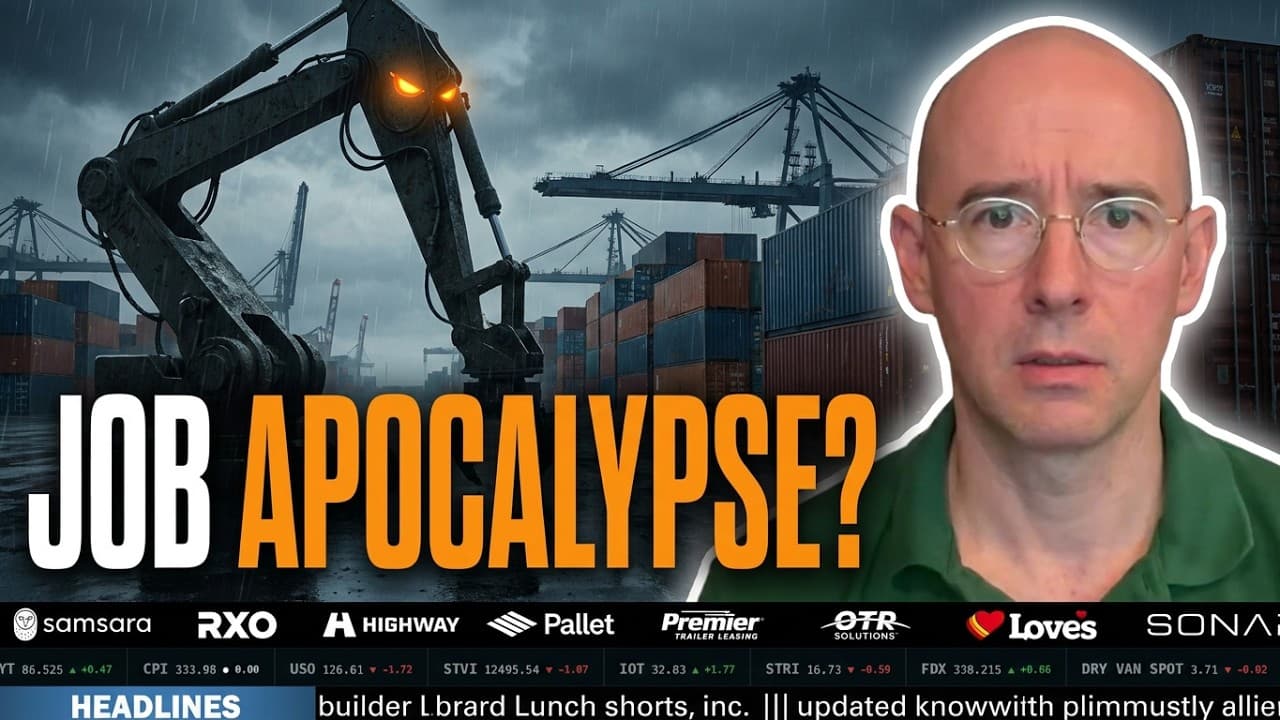
Trimble's Chief Platform Officer, Jonah McIntire, unpacks the real impact of AI on logistics, addressing the buzz around a potential "job apocalypse" in the supply chain. He explains how AI is changing software development and M&A integration, and why it's not just about flashy new tech, but about unlocking deeper value in legacy systems and data. Discover how this shift will redefine roles and empower new business models. The post AI & Logistics: Will a ‘Job Apocalypse’ Hit the Supply Chain? ap
Source Lens
Industry Context
Useful background context, but lower-priority than direct platform, community, or operator intelligence.
Impact Level
medium
Use this briefing to decide whether your team needs an immediate workflow, policy, or reporting change.
Key Stat / Trigger
No single quantitative trigger surfaced in this report.
Focus on the operational implication, not just the headline.
Full Coverage
Summary View Transcript Trimble's Chief Platform Officer, Jonah McIntire, unpacks the real impact of AI on logistics, addressing the buzz around a potential "job apocalypse" in the supply chain.
He explains how AI is changing software development and M&A integration, and why it's not just about flashy new tech, but about unlocking deeper value in legacy systems and data. Discover how this shift will redefine roles and empower new business models.
Jonah McIntyre, chief platform officer at Trimble, is doubling down on his prediction that artificial intelligence will trigger a "job apocalypse" in logistics back offices.
McIntyre, who oversees all product and engineering for Trimble's transportation segment — roughly half the division's headcount — first made the comment around October or November before it resurfaced as AI deployment in freight accelerated.
"I don't really see a lot of reasons why those can't be displaced or eliminated by AI," he said of roles where all data input and output flows through a screen. The forecast carries weight given Trimble's footprint: the company's products touch an estimated 65% of all over-the-road capacity in the U. S.
, spanning transportation management systems, mapping, and telematics hardware now integrated through the Platform Science merger. McIntyre argues that ownership of embedded data, deployed networks, and distributed hardware gives legacy platforms a structural advantage over AI-native startups that can be built quickly but disrupted just as fast."
You do the math and it's not like there's some law of physics that says that the amount of money distributed to the staff has to remain constant or something. It will just be cheaper to have a back office because you'll need less people."
McIntyre tempered the outlook by noting that displaced workers have historically moved to other sectors through what he called "the creative destruction of capitalism," pointing to typists and other roles eliminated by earlier technology waves.
He said the remaining human role centers on originating ideas and setting direction — work AI cannot yet perform reliably or that carries moral weight. "AI hasn't been able to, so far, satisfactorily have the initial idea to begin with," he said.
On the product side, Trimble recently released a new TMS called Trimble TMS aimed squarely at small and mid-sized U. S. carriers, many of whom are buying a TMS for the first time. The offering is built on a build-to-order model made economically viable by AI-driven development costs.
McIntyre said the unit economics have flipped: it is now cheaper and more effective to build custom workflows for individual customers than to persuade them to conform to pre-written code.
He cited a hypothetical chocolate carrier that needs automatic refrigeration checks at every stop — under the new model, Trimble would simply build that feature at a price point below what a conventional TMS cost just a few years ago. The downmarket push also reflects how AI is reshaping Trimble's integration strategy across its many acquisitions.
Rather than enforcing a uniform look and feel across platforms — some dating to the 1960s, including Innovative, which McIntyre called arguably the first commercially available TMS in the world — the company is pursuing what he described as "maximum interoperability with minimum interdependence."
Common elements such as master data and external connections will be standardized; everything else, including user interface, can vary by product. AI is also allowing Trimble to layer modern experiences on top of mainframe-based legacy systems without requiring customers to migrate their data.
McIntyre acknowledged that Wall Street's concern about AI eroding the value of traditional software businesses has some merit, particularly for vendors whose only competitive moat was the time it took to build their code.
But he argued that data assets, installed-base stickiness, and brand durability have held or increased in value in the AI era, even as pure-software differentiation has weakened. He described AI-native startups enjoying rapid hypergrowth as a potential "sugar high," vulnerable to the same low barriers that enabled their rise.
Trimble CPO Jonah McIntyre reaffirmed his 'job apocalypse' prediction, saying screen-mediated back-office logistics roles face elimination or devaluation as AI matures. Trimble launched a new build-to-order TMS called Trimble TMS targeting small and mid-sized U. S. carriers, many buying a TMS for the first time, at price points below legacy TMS costs.
McIntyre says Trimble's advantage in the AI era rests on its data assets and embedded networks u2014 covering roughly 65% of U. S. OTR capacity u2014 rather than software complexity alone. Speaker 1 [0:00] Definitely. Speaker 2 [0:00] We have Jonah McIntyre. He's the chief platform officer at Trimble. Jonah, how are you today, sir? Speaker 3 [0:06] I'm good.
This is fun to listen to you guys' conversation. Speaker 2 [0:08] Yeah. Well, I
Original Source
This briefing is based on reporting from Freightwaves. Use the original post for full primary-source context.
Style
Audience