

NEW AI Listing Builder: The Next Generation of Amazon Product Page Optimization
Helium 10 launched AI Listing Builder, a tool that simultaneously optimizes Amazon listings for A9 keyword indexing, Rufus semantic search, and conversion — treating all three as one system rather than separate problems.
Most sellers are still writing listings for A9 alone, leaving Rufus-driven discovery (which powers AI-generated search results and recommendations) completely unaddressed — a growing blind spot as Rufus handles more top-of-funnel queries. Audit your top 5 ASINs against Rufus query responses directly in Amazon chat to identify answer gaps before competitors do.
Amazon's shift from pure keyword matching to AI-interpreted intent (via Rufus) mirrors broader platform consolidation around LLM-driven discovery — sellers who don't adapt listing strategy now face compounding visibility loss as Rufus handles a larger share of search.
Test your existing listings in Rufus by asking product-category questions — if your ASIN isn't surfaced or the answer pulls competitor content, your bullets lack use-case and intent language that Rufus prioritizes.
Within 30 days, rebuild at least one high-traffic listing using a structured 'product truth card' approach: lock in verified features, audience, and brand voice before any AI generation to prevent hallucinated claims.
Bottom Line
Rufus-blind listings will lose organic visibility as AI search expands on Amazon.
Source Lens
Industry Context
Useful background context, but lower-priority than direct platform, community, or operator intelligence.
Impact Level
medium
Rufus-blind listings will lose organic visibility as AI search expands on Amazon.
Key Stat / Trigger
No single quantitative trigger surfaced in this report.
Focus on the operational implication, not just the headline.
Full Coverage
TL:DR; Amazon search operates in synergistic layers now: lexical matching through A9, semantic interpretation through Rufus, and intent-driven discovery across the entire shopping experience. Most listing tools optimize for one of these and ignore the others.
Helium 10 and I built AI Listing Builder to treat them as one integrated problem, because that is how Amazon’s systems actually work. Listings that perform tend to do three things well. They index well, read well, and answer well.
Here is what that looks like in practice: • Grounded in Helium 10 keyword intelligence • Generates sections in a deliberate sequence so the listing holds together as a unified page • Supports 5 to 10 bullet point workflows without sacrificing keyword coverage or clarity • Optimizes for Rufus answerability alongside traditional A9 keyword ranking • Enforces marketplace constraints during generation • Modular rewrites that improve one section without regenerating everything • Content is anchored in your product truth Reclaim Your Time Elevate Your Brand Performance Helium 10’s Diamond Plan automates the tasks eating your day so you can focus on decisions that actually move the needle across Amazon, Walmart, and TikTok Shop.
Sign Up Today How to build Amazon product listings the RIGHT way Creating a listing from scratch takes TIME. Deep keyword research is HARD WORK. Balancing the narrative of a product page with the integration of high-value keywords to show up in search and convert customers is an ART. Human experts will always have the edge.
With that being said, what if the time, hard work, and art you poured into your listing could be accelerated. Less time, less hard work, even more art. GEO, AEO, SEO, or as the song goes, E-I-E-I-O.
LinkedIn, newsletters, emails are bombarding us with another acronym every day, stemming from the desperation for new language, since we are in a new world of discovery. Everyone feels this shift, so naturally we ask, who is right? Who do we believe? Who do we TRUST to provide the new paradigm of search optimization?
I keep coming back to the same answer: don’t choose between SEO, GEO, or AEO. Use them together. That was the thesis behind my earlier work on Amazon AI strategy. AI Listing Builder is the execution of it. If you optimize for only one of these, you overpay somewhere else.
Keyword stuffing can raise short-term relevance signals while harming conversion and trust. Beautiful prose can convert well while failing to show up where it matters. A modern listing needs a truly balanced design. Helium 10 knows keyword intelligence better than anyone in this space.
I have spent the last few years studying how Rufus actually processes and ranks content. We built AI Listing Builder together because the problem demanded both: deep search term data and narrative-driven, use-case-based writing working inside the same system.
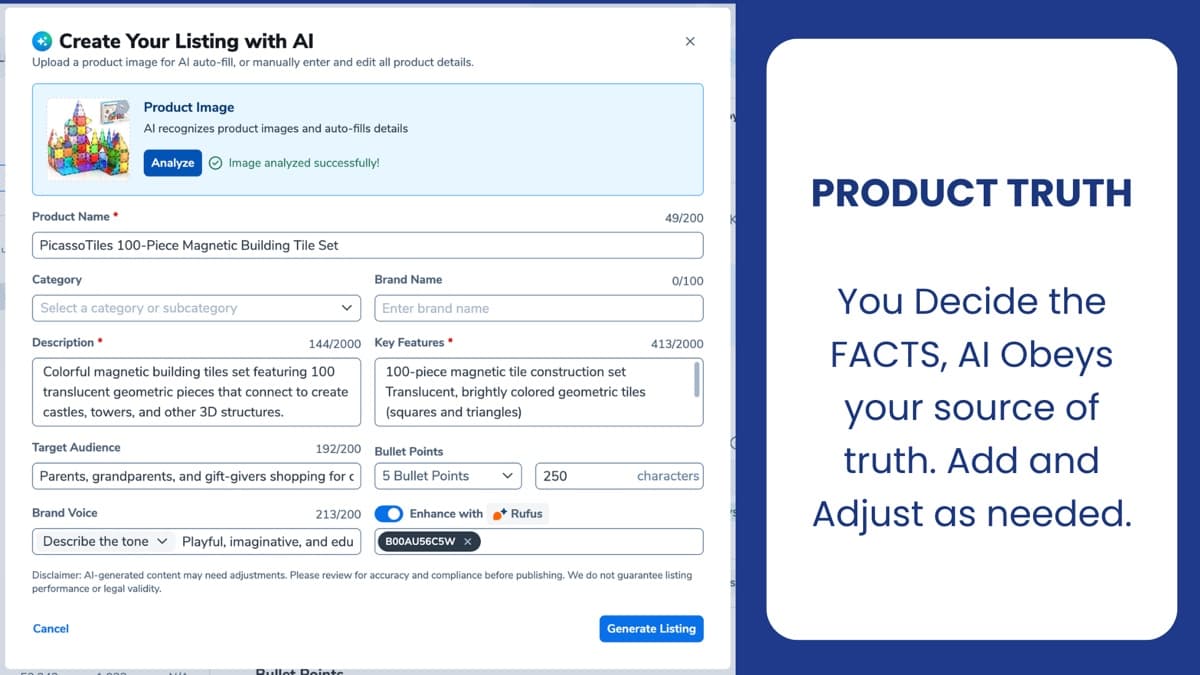
Listing Builder begins with the most important part of AI-powered listing generation: a product truth card, providing the proper truths to AI for authentic generation. You decide the facts. Product Truth lets you define your product name, description, key features, target audience, brand voice, and bullet point count. AI obeys your source of truth.
If you do not have ideas of where to start, whether you’re not great with words, great with words, or have little to no product details from your manufacturer, our Visual Product Intelligence gives you the power to do exactly that: fill in details you would otherwise not have the knowledge to fill.
Upload a product image and let AI analyze it to auto-fill details like product name, description, and key features, then adjust and add accordingly. This is especially useful when source material is incomplete or when a seller wants a faster starting point. It surfaces likely features, use cases, and descriptive language that the seller can then refine.
I encourage you to use it carefully, as your output can only be as factual as your input. Include all of your product truths and attributes. Visual Product Intelligence gives you a start. Most importantly, ADJUST and ADD as needed before clicking Start AI Workflow.
Once you click “Start AI Workflow,” the agent will go through its decision-making, grounded in the best keyword research and optimal prompting and architectural workflows. Keyword Foundation, Narrative Completion, Compliance Audit.
Listing Builder works through a structured pipeline: analyzing inputs, applying high-ranking keywords, generating the title, writing bullets with feature-benefit links, integrating Rufus answers, and running a compliance check. Listing Builder will account for the importance of Amazon keyword placement as well as AI search.
In other words, your best keywords are prioritized in the places with the highest real estate value. Sequence matters here. Strong listings are rarely the result of random generation. They come from intentional planning, where keyword priorities are assigned with care and section r
Original Source
This briefing is based on reporting from Helium 10 Blog. Use the original post for full primary-source context.
Style
Audience