Why the future of retail is bigger than AI
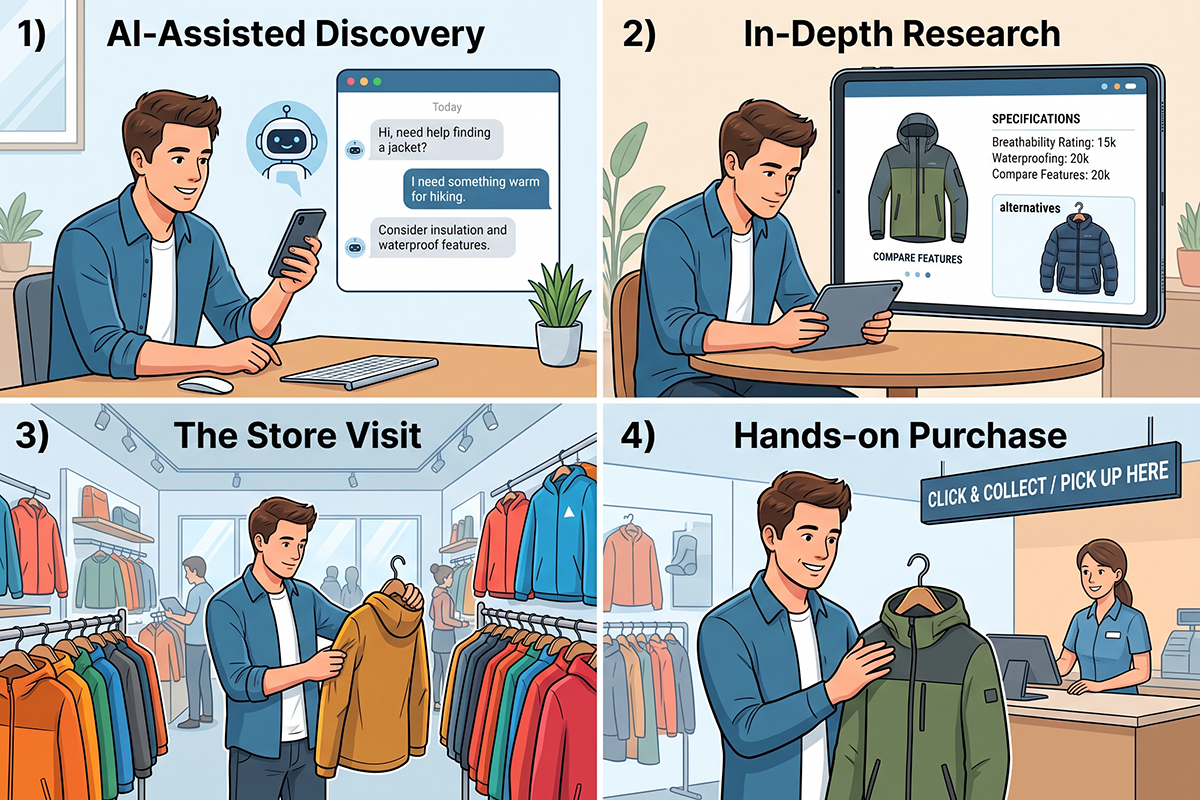
We’re all talking about AI, but retail isn’t limited to chatbots – Ben Heath, Director of Implementation, Virtualstock powered by Logicbroker, shares how AI, website and retail stores combine to fit the need so customers at different stages of their retail journey: Agentic search is growing fast. The use of AI assistants as the first […]
Source Lens
Industry Context
Useful background context, but lower-priority than direct platform, community, or operator intelligence.
Impact Level
medium
Use this briefing to decide whether your team needs an immediate workflow, policy, or reporting change.
Key Stat / Trigger
No single quantitative trigger surfaced in this report.
Focus on the operational implication, not just the headline.
Full Coverage
We’re all talking about AI, but retail isn’t limited to chatbots – Ben Heath, Director of Implementation, Virtualstock powered by Logicbroker, shares how AI, website and retail stores combine to fit the need so customers at different stages of their retail journey: Agentic search is growing fast.
The use of AI assistants as the first step in a shopping journey is up 200% year on year. That said, only 28% of commerce organisations are using agentic AI today. Retailers need to be ready for where that number is heading, but the bigger opportunity is in front of them already.
Too many retailers still treat the store, the website and AI as three separate channels to manage, when the reality is that they’re part of the same shopping journey. A customer might use a chatbot to narrow down their options, check a retailer’s website for fuller product details or alternatives, then visit a store to see the item in person or collect it.
From their perspective, this is one continuous decision – and retailers need to recognise that. Stores still do something AI can’t A physical shop still offers experiences that algorithms can’t replace. Customers can benefit from the expertise of salespeople and the ability to try something before they commit to it.
It will always be limited by shelf space, but that’s not a problem if a brand stocks the items customers want to see or take home immediately and makes the extended assortment easy to order when it is needed. I recently bought a jacket that didn’t have my size in stock.
The assistant checked the system, found it was arriving Friday and had it ready for collection. The same logic applies to higher-consideration purchases: a customer sitting down with a salesperson who genuinely knows the product range makes a more confident decision than one scrolling alone.
Stores that lean into that role, treating the shop floor as a showroom, keep customers coming back even when the transaction happens somewhere else. For that to work, the online and in-store experience must be joined up properly.
If a product isn’t on the shelf, a customer should know within seconds whether it’s available for click and collect or home delivery instead. If it’s on the shelf but not in the size or colour a customer wants, staff need the same visibility, so it becomes “we can have it here Friday,” rather than a lost sale.
Expand range without the paradox of choice Extending range doesn’t mean adding thousands of products and hoping for the best. Faced with 10,000 options, a customer who might have bought one of six can end up buying nothing. Curation still matters. It just doesn’t need to be limited by warehouse space.
Dropship allows retailers to extend their range through supplier networks without committing to inventory it may never sell – all while keeping control over what gets listed.
Curated marketplaces can serve a similar purpose, bringing third-party sellers into a retailer’s offer while giving the retailer the tools to set standards around product selection, presentation and customer experience. The important point is that range should be expanded deliberately, rather than simply made bigger.
Stocked inventory carries a higher headline margin, often in the 50-60% range, against 20-25% for dropship. But once warehousing, delivery and the other overheads of holding stock are factored in, the real profitability gap narrows to single digits. Robert Dyas is a case in point, with 70% of its total Gross Merchandise Value (GMV) coming from dropship.
Retailers do not need to choose between a strong in-store experience, a carefully extended range and AI-led discovery. The jacket sale worked because those elements were connected: I could try it on in person, find a size beyond the store’s immediate stock and collect it when it arrived.
That is what customers will increasingly expect, whichever route they take to a purchase.
Original Source
This briefing is based on reporting from Tamebay. Use the original post for full primary-source context.
Style
Audience