

‘Utter devastation’ from Amazon cargo jet crash, NTSB chief says
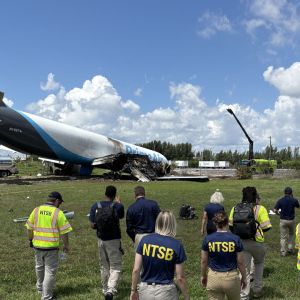
Freight and passenger delays could mount this week at Miami International Airport where two runways remain shut as the recovery operations and an investigation into Sunday’s deadly crash landing of an Amazon cargo jet continue. The post ‘Utter devastation’ from Amazon cargo jet crash, NTSB chief says appeared first on FreightWaves.
Source Lens
Industry Context
Useful background context, but lower-priority than direct platform, community, or operator intelligence.
Impact Level
medium
Use this briefing to decide whether your team needs an immediate workflow, policy, or reporting change.
Key Stat / Trigger
No single quantitative trigger surfaced in this report.
Focus on the operational implication, not just the headline.
Full Coverage
The Amazon freighter aircraft that overshot the runway at Miami International Airport left a path of “utter devastation” as it plowed through vehicles and infrastructure, leaving the airport operating at reduced capacity until recovery operations are completed and investigators can safely access the aircraft, said National Transportation Safety Board Chairwoman Jennifer Homandy.
The safety chief provided more details about the fateful accident that resulted in five deaths and at least five injured persons, three of them in critical condition, during a news conference streamed live from the airport Monday afternoon.
Flight 7598, a Boeing 767-300 converted freighter operated on Amazon’s (NASDAQ: AMZN) behalf by 21 Air, was on its third run of the day when it arrived from San Juan, Puerto Rico on Sunday afternoon around 2 p. m. The aircraft flew from Amazon’s superhub at Cincinnati-Northern Kentucky International Airport to Miami and then to San Juan before returning.
The cargo jet overran Runway 30 during landing, struck navigational aids and equipment, and then slammed into a 2012 Ford Econoline van owned by Professional Ocean Services Corp. , a contract cleaning company for airlines. Seven persons were on board the van.
The aircraft continued traveling through a perimeter fence and impacted a Toyota Corolla Cross on a main street, continued into the grass and impacted another fence line protecting a lot full of Tesla robo taxis. The plane traveled about 1,300 feet past the paved runway, said Homenday. “There’s debris everywhere. The Econoline van is torn apart.
It is devastating [to see]. And then the SUV, you can see the surrounding airbags. You can see components from vehicles, both passenger vehicles and the aircraft itself. And certainly components of navigational aids. Debris from the airport and then certainly fencing everywhere. It’s pretty extensive,” she said.
National Transportation Safety Board Chairwoman Jennifer Homandy on Monday described the destruction caused by an Amazon Boeing 767 cargo jet that overshot the runway at Miami International Airport the day before. (Photo: FreightWaves/NTSB video) Two of four runways at Miami airport remain closed.
When they will reopen is unclear because NTSB investigators need to first document the scene and gain access to the aircraft itself, which is still not safe to do, the chairwoman explained. “It’s going to take time. We hope that we can move through it swiftly because we know it is impacting flight operations here,” she said.
“There’s fuel everywhere that will have to be remediated, but then they are also removing fuel from the aircraft. So we have to allow that to occur.” Miami International Airport is a major passenger and cargo hub between Europe, North America and South America.
Investigators have already been collecting information, including tire marks, along the plane’s path. The flight data recorder and cockpit voice recorder were recovered and are on their way to NTSB headquarters in Washington, D. C. , for analysis.
Teams of experts will analyze every aspect of the accident, including operations, pilot performance, flight history, flight crew experience, training, 21 Air policies and procedures, the contractual relationship with Amazon, FAA oversight of all operators, air traffic control, radar data, pilot transmissions, airframe wreckage, aircraft systems and engines, and weather conditions.
MIA does not have an engineered materials arresting system, a specialized safety bed made of crushable material placed at the end of a runway to safely stop airplanes that overshoot during a takeoff or landing. About 72 airports in the United States have an EMAS system. Homandy said the board will also look into whether EMAS could have minimized the damage.
“We have investigated many runway excursions … since 2008. If we are repeatedly investigating an accident or tragedy and our recommendations are not implemented, then we’re here again and again and again,” she said The NTSB is expected to publish a preliminary report about the accident in 30 days. A full report and recommendations could take a year or more.
Click here for more FreightWaves/American Shipper stories by Eric Kulisch. Write to Eric Kulisch at ekulisch@freightwaves. com.
RELATED STORIES: 2 Miami runways still closed after deadly Amazon cargo jet accident 21 Air eyes larger Boeing 777 cargo jets to access long-haul market 21 Air makes debut cargo flight for Amazon The post ‘Utter devastation’ from Amazon cargo jet crash, NTSB chief says appeared first on FreightWaves.
Original Source
This briefing is based on reporting from Freightwaves. Use the original post for full primary-source context.
Style
Audience