Amazon announces new tools and services to help sellers go global from day one
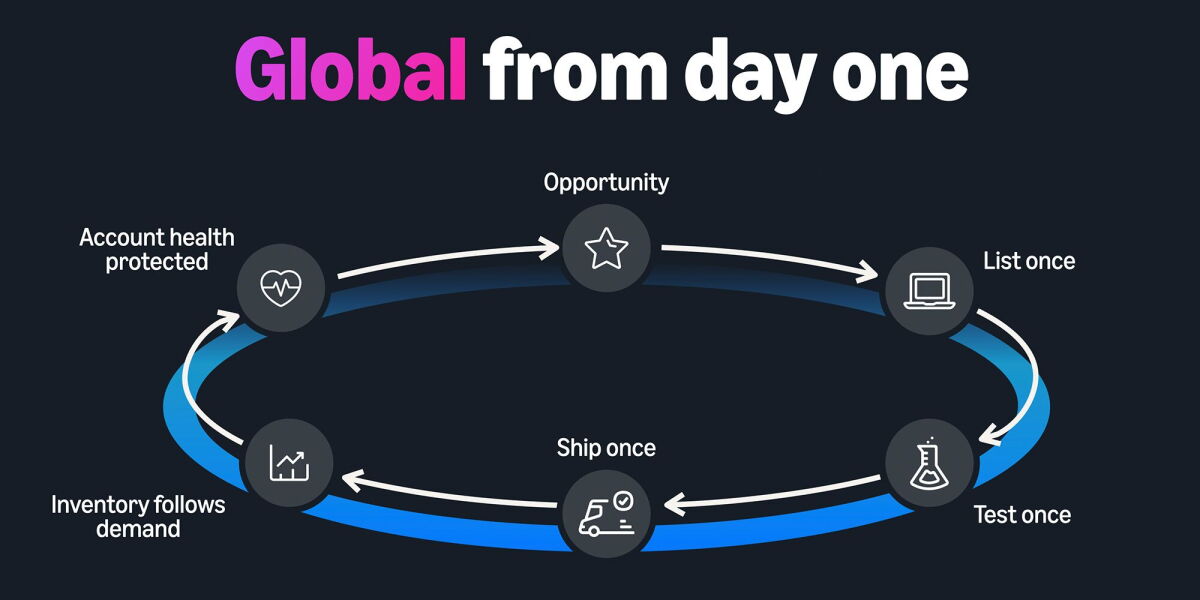
Only 30% of Amazon sellers list in more than one country. New capabilities spanning compliance, logistics, and the selling experience are designed to change that.
Source Lens
Official Platform Update
Direct platform communication. Highest-value for policy, product, and operational changes.
Impact Level
medium
Use this briefing to decide whether your team needs an immediate workflow, policy, or reporting change.
Key Stat / Trigger
No single quantitative trigger surfaced in this report.
Focus on the operational implication, not just the headline.
Full Coverage
Key takeaways Sellers active in more than one country earn 70% more revenue on average—and Amazon is making it easier to get there. New compliance tools let sellers test once and certify across multiple countries, with early pilot sellers reporting up to 60% savings. Global Warehousing and Distribution is expanding from the U. S.
to eight countries by year-end, with storage costs up to 45% lower than Amazon Warehousing and Distribution (AWD) in the U. S. At Amazon, we're working to put more of the world within reach of our selling partners. In the United States, we now deliver to more rural communities than ever before, reaching customers who were once hard to serve.
Now, we're bringing that same ambition to the global stage, making it possible for sellers to reach customers in countries they've never sold in before. Today, only 30% of our selling partners list in more than one country, largely because going global has meant managing separate inventory, compliance, listings, and logistics for each country.
We want to change that—and today, we're announcing new capabilities spanning compliance, logistics, and the seller experience to make it happen.
Amazon gives sellers an even smarter Seller Assistant and a new plugin for Amazon Quick and Anthropic’s Claude Sellers can now automate routine tasks 24/7 with Seller Assistant and bring their Amazon data and Seller Central insights into the AI tools they already use.
Sellers active in more than one country earn 70% more revenue on average than those selling in just one. But until now, going global meant essentially starting a new business in each country.
Now, we're making it possible for a seller to list a product in the Amazon store once and reach customers around the world, with compliance guidance and testing built in at every step, listings that adapt automatically to each destination, real-time visibility across the entire supply chain, and infrastructure that moves inventory where demand shows up.
Our vision is simple: any seller should be able to go global from day one, and today we’re making big strides toward that reality. This isn't one feature or one tool. It's a set of connected capabilities across how sellers list, ship, and comply that work together to remove the guesswork and overhead from international expansion.
Some of these capabilities are live today. Others are rolling out over the coming weeks and months, with more planned for 2027. Tools that make expansion simple This fall, we introduced the first version of an expanded, unified view for sellers to see expansion opportunities across the U. S. , Europe, and Japan, with more countries coming by year-end.
They can see where there is demand for their products, what the economics look like in each country, and exactly what steps remain before they can start selling. No more piecing it together across disconnected dashboards.
Future features will enable sellers to manage all their listings, inventory, and orders in one place, making a change once globally, instead of repeating it country by country. Listing a product, the step that used to multiply with every country a seller added, is becoming a one-time task.
We're building toward an experience where, at the moment a seller creates a listing, our systems will evaluate that product against every destination at once—translating content, adjusting for local currency and units, and flagging compliance requirements specific to each country.
As these capabilities roll out, products that meet those requirements will be able to go live internationally, with listings already localized for the store they're entering. Our vision is for one listing to do the work that used to take a separate listing for every country, built and translated by hand.
Going global simply becomes part of the standard workflow, not a separate project.
Introducing Amazon Supply Chain Services: Amazon’s logistics network, now open to every business Any business can now move, store, and deliver everything from raw materials to finished products using the same supply chain that supports Amazon and its independent selling partners.
Sellers will get end-to-end supply chain visibility for the first time, as this rolls out over the coming weeks. From the moment a seller creates a shipment, one interface tracks its journey across Amazon-managed fulfillment, with a single reconciled unit count they can trust.
No more checking separate systems to figure out where inventory is or how much product actually arrived. Alongside that view, Seller Assistant is adding new supply chain capabilities, starting with agents for aged inventory and inbound planning. Over time, it will expand into a more personalized advisor across every part of a seller's global operations.
It doesn't just show sellers where things are; it proactively alerts sellers of actions needing their attention, explains why, and shows the data behind each recommendation. Compli
Original Source
This briefing is based on reporting from About Amazon. Use the original post for full primary-source context.
Style
Audience