

Amazon opening of shipping services could shake up intermodal status quo
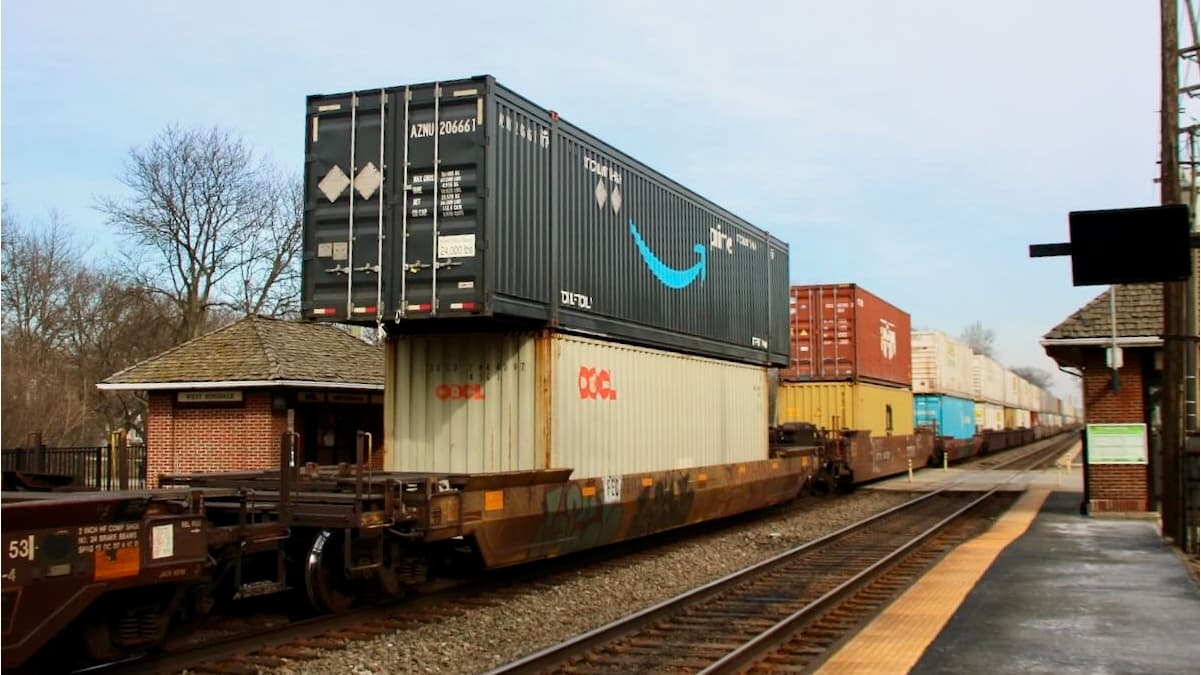
Amazon launched Supply Chain Services (ASCS) on May 5, 2026, opening its logistics network to outside businesses including P&G, 3M, and American Eagle. The service offers freight, fulfillment, and parcel shipping previously exclusive to Amazon operations.
This creates a new FBA alternative that could offer better rates and faster delivery for multi-channel sellers. Monitor your current 3PL costs against Amazon's pricing when ASCS becomes widely available to smaller sellers.
Amazon is monetizing its infrastructure advantage beyond retail, potentially becoming the dominant logistics provider across all ecommerce channels while creating new revenue streams from competitors.
Compare your current 3PL and shipping costs to prepare for ASCS pricing when it opens to smaller sellers
Evaluate multi-channel fulfillment strategy - ASCS could replace separate Shopify/Walmart fulfillment providers
Bottom Line
Amazon's logistics network opens to competitors, creating new 3PL option for sellers.
Source Lens
Industry Context
Useful background context, but lower-priority than direct platform, community, or operator intelligence.
Impact Level
medium
Amazon's logistics network opens to competitors, creating new 3PL option for sellers.
Key Stat / Trigger
24,000 intermodal containers already moved by Amazon logistics network
Focus on the operational implication, not just the headline.
Full Coverage
Amazon has opened its freight, distribution, fulfillment, and parcel shipping service to other businesses in a move that analysts say could help boost domestic intermodal volume while shaking up the major intermodal players.
Amazon (NASDAQ: AMZN) on Monday announced the launch of Amazon Supply Chain Services (ASCS), which offers services that were originally developed to power the retail giant’s own operations and to support its independent selling partners worldwide.
Over the past three years, hundreds of thousands of Amazon sellers have used the company’s logistics network to move, store, and deliver hundreds of millions of packages across third-party facilities, warehouses, and sales channels beyond the Amazon store.
The launch of ASCS now supports third-party logistics for businesses in industries such as healthcare, automotive, manufacturing, and retail.
“Amazon is bringing the infrastructure, intelligence, and scale of its supply chain services — proven over decades — to businesses everywhere, much like Amazon Web Services did for cloud computing,” said Peter Larsen, vice president of Amazon Supply Chain Services.
“Supply chain wasn’t just a function at Amazon — it was core to providing an exceptional shopping experience. Our differentiator. The reason we could offer fast, dependable delivery that nobody else could.
And with the launch of ASCS, we’re confident we can give any other business access to the same cost efficiency, reliability, and speed that we’ve built for Amazon customers.” Several customers are already using the service, Amazon said.
Procter & Gamble (NYSE: PG) is using Amazon’s freight services to transport raw materials to production facilities and move finished goods across its distribution network. 3M (NYSE: MMM) uses the service to move products from its manufacturing sites to distribution centers worldwide.
Lands’ End (NASDAQ: LE) is using a unified inventory pool within Amazon’s network to fulfill orders across multiple sales channels. And American Eagle Outfitters, Inc. (NYSE: AEO), is using Amazon’s parcel shipping network to deliver online orders from its American Eagle and Aerie website directly to customers nationwide. Logistics expert Paul D.
Tonsager, CEO and founder of Integrated Multi-Modal Solutions, LLC, says Amazon’s announcement is neutral to slightly positive for Class I railroads in the near term. “Amazon needs rail capacity. ASCS doesn’t change that.
They already move more than 24,000 intermodal containers using Class I line-haul, and Monday’s announcement formalizes a dependency rather than threatening it,” he says.
“BNSF (NYSE: BRK-B) benefits most because Amazon’s intermodal flow is BNSF-heavy on the Transcon, and BNSF’s recent investment in … premium intermodal aligns directly with where Amazon needs the network to perform.
Norfolk Southern (NYSE: NSC) and CSX (NASDAQ: CSX) get a longer-term tailwind to the extent that more Amazon volume migrates east as the fulfillment footprint shifts.” Independent analyst Anthony B. Hatch says Amazon could expand the intermodal universe. “This could bring new shippers and industries into the rail/intermodal world,” he says.
Down the road, though, Amazon could wield enough market power that it could put a dent in railroad financials if Amazon decided to shift its business elsewhere as it has done with the U. S. Postal Service, Tonsager warns.
“The smart play for the Class I’s is to keep Amazon as a major customer without becoming dependent on a single anchor in a single corridor,” he says. Amazon will pose a bigger threat to the intermodal marketing companies that bring loads to the Class I railroads. “For the intermodal IMCs, this is decidedly bad,” Tonsager says. “J. B.
Hunt (NASDAQ: JBHT), Hub Group (NASDAQ: HUBG), Schneider Intermodal (NYSE: SNDR), STG, and Knight-Swift (NYSE: KNX) now have a credible new competitor with structural advantages no IMC has: captive demand from Amazon’s own retail volume, container and drayage density, an integrated fulfillment bundle the IMCs cannot replicate, and a data architecture customers actively want.”
Intermodal analyst Larry Gross agrees. “I see them becoming a full-fledged channel competing with the existing big dogs,” he says. “It’s a pretty big deal,” Gross says. “They bring scale, just like they did with Amazon Web Services and their parcel network.” Amazon already operates the fourth-largest domestic container fleet, after J. B.
Hunt, Hub Group, and Schneider. “They won’t hesitate to buy more equipment if it works,” Gross says. “And I think it will work. I wouldn’t bet against them.” Amazon’s fleet, which had 5,000 containers as recently as 2022, now stands at 24,000 boxes.
Amazon’s service could erode the coast-to-coast single-line service argument that’s one of the foundations for Union Pacific’s proposed acquisition of Norfolk Southern, Tonsager says. A merger, the railroads have said, will allow a transcontinental UP to provide seamless service, improve shipment visibility,
Original Source
This briefing is based on reporting from Freightwaves. Use the original post for full primary-source context.
Style
Audience