

Nobody Is Asking the Hard Questions About What Happens When an Autonomous Truck Breaks Down on the Highway at 2 AM. Let Us Start.
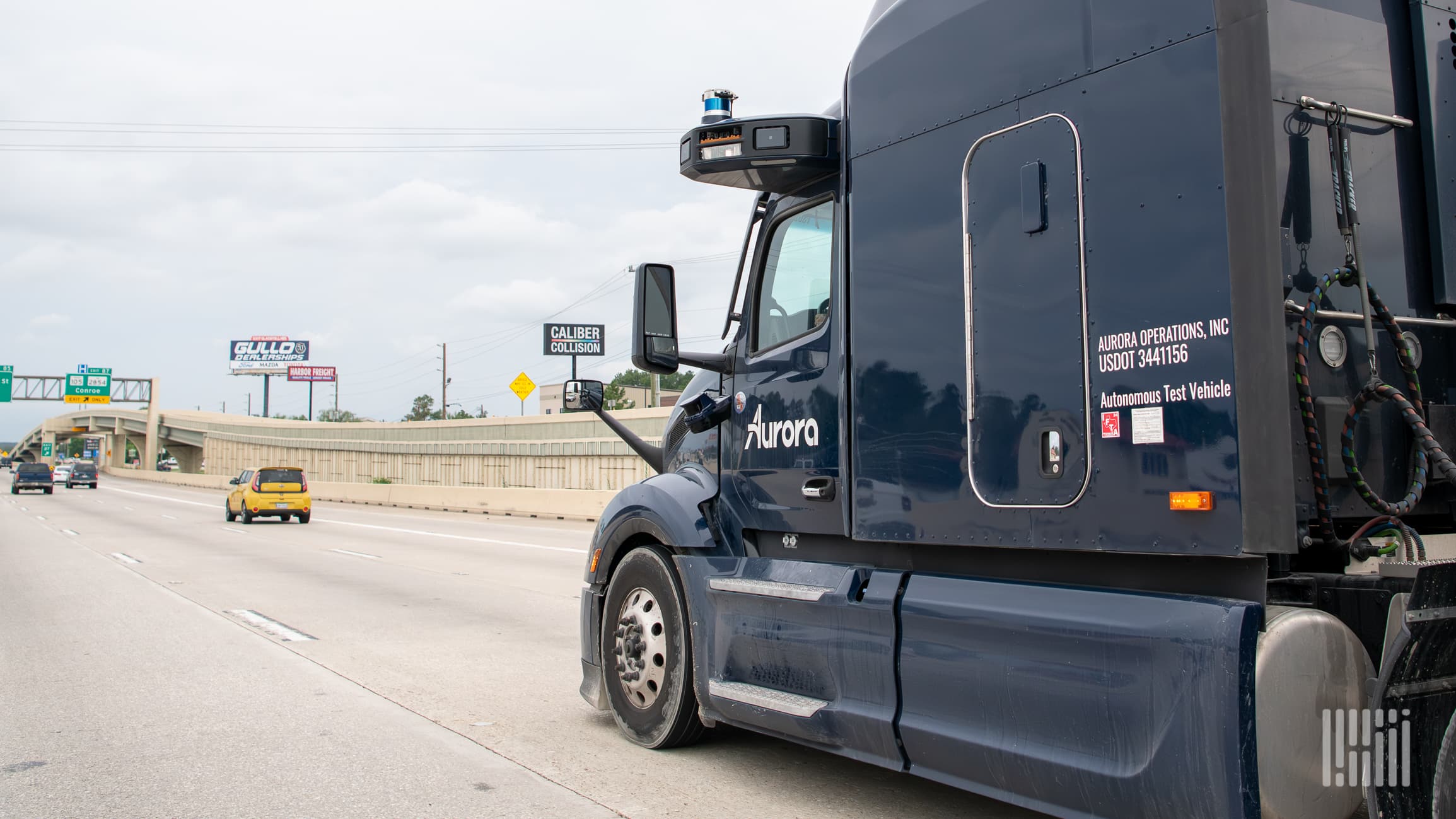
This article is not an argument for or against autonomous trucks. It is not a prediction about what the freight market looks like in 2035, and it is not an endorsement of any technology company’s safety record or business model. It is a set of questions that the industry — carriers, drivers, regulators, first responders, […] The post Nobody Is Asking the Hard Questions About What Happens When an Autonomous Truck Breaks Down on the Highway at 2 AM. Let Us Start. appeared first on FreightWaves.
Source Lens
Industry Context
Useful background context, but lower-priority than direct platform, community, or operator intelligence.
Impact Level
medium
Use this briefing to decide whether your team needs an immediate workflow, policy, or reporting change.
Key Stat / Trigger
No single quantitative trigger surfaced in this report.
Focus on the operational implication, not just the headline.
Full Coverage
This article is not an argument for or against autonomous trucks. It is not a prediction about what the freight market looks like in 2035, and it is not an endorsement of any technology company’s safety record or business model.
It is a set of questions that the industry — carriers, drivers, regulators, first responders, and the public that shares the road with 80,000-pound vehicles — deserves honest answers to before the scale of this deployment outpaces the infrastructure designed to manage it. Those questions exist because something real is happening.
Aurora Innovation is running driverless Class 8 trucks commercially between Dallas and Houston. Kodiak Robotics is operating driverless trucks in the Permian Basin. Both companies have logged real commercial miles, reported real safety data, and announced scaling plans that extend to hundreds of trucks by the end of 2026 and thousands beyond that.
This is not a press release. It is operational. And the people who have spent careers behind the wheel of a truck, who understand what it actually takes to move freight safely across this country, deserve to have this conversation on their terms — not on the terms of a venture-backed company’s investor presentation.
What a Professional Driver Does That Nobody Is Talking About Start with the thing that gets left out of every autonomous trucking announcement: what a professional driver actually does for highway safety that has nothing to do with steering and braking. An experienced driver hears the tire that is losing pressure before the monitoring system registers it.
They feel the brake pulling to one side before the alignment is measurably off on any sensor. They smell an electrical component beginning to fail before it generates a fault code. They notice the shimmy at 65 miles per hour that the ECM has not translated into a diagnostic event.
They see the passenger car drifting in the next lane and recognize — before any algorithm has processed the trajectory — that the driver is asleep. That is not just intuition.
It is years of accumulated pattern recognition built through thousands of hours in a moving vehicle, learning what that specific truck sounds like on that specific road at that specific load weight. No autonomous system in commercial deployment today replicates that.
Not because the technology does not exist in theory — but because that kind of contextual, experiential awareness is what a professional brings to the job, and it is exactly what disappears when the cab is empty. This is not an argument that autonomous trucks cannot be safe.
It is an argument that replacing that layer of awareness requires deliberately engineering something to fill the gap — and the question of whether the industry has done that adequately at scale has not been answered. The data set is too small and too controlled to know yet.
The Maintenance Problem Nobody Has Solved at Scale When an autonomous truck breaks down, who figured out it was breaking down?
In a conventional truck, the answer is usually the driver — who noticed something was wrong before a sensor said so, pulled to a safe location with professional judgment about where and how, and then managed the situation with their presence, their training, and their physical ability to act. They placed the reflective triangles.
They flagged approaching traffic. They called for help and communicated the specific nature of the problem to whoever responded. The autonomous truck’s maintenance architecture works differently and requires things that the current infrastructure was not built to provide.
Sensor calibration becomes a scheduled safety event — a lidar unit operating at even minor degradation from road grime, insect accumulation, or moisture is making decisions about a world it cannot fully see, with no one in the cab to notice the picture is degrading.
Software updates — Aurora has pushed four major releases since April 2025 — change the operational behavior of the truck in ways that require validation before deployment, and at scale that validation process introduces risk that has no parallel in conventional trucking.
Redundant systems — the backup braking, the backup steering, the backup power — must be tested regularly because their failure mode is invisible until they are needed. The problem is that in a conventional truck, a driver who discovers the backup is failing has discovered it because the primary just failed.
The entire premise of the redundant architecture is that you find out in a shop, not on the highway. But testing redundant systems requires specialized technicians with specialized tools, working in hub facilities that do not yet exist along most of the routes these trucks will eventually need to run. The CDL workforce availability is documented and ongoing.
The shortage of technicians qualified to service autonomous sensor arrays, software-defined safety systems, and redundant electronic architectures does not yet exist — because the scale of demand for those technicians does not yet exist. When it does, the training pipeline to produce them is years behind where it needs to be.
That gap is not a technology company’s problem. It is the industry’s problem, and it will land on the carriers, the drivers, and the roadside assistance networks that have to deal with the consequences.
The Breakdown at 2 AM That Nobody Has a Complete Answer For Here is the scenario that deserves a direct answer from every autonomous trucking company operating on public roads. A driverless truck is running a Sun Belt corridor at 2 AM. A tire fails.
The vehicle executes a controlled stop and pulls to the shoulder — functions the autonomous system is designed to perform correctly. The truck is now stationary on the shoulder of a major interstate, in the dark, with 80,000 pounds of freight and no human being in the cab. The system alerts Aurora’s operations center. Hazard lights activate.
A remote operator assesses the situation via onboard cameras. A support vehicle is dispatched from the nearest hub terminal. Now the questions start. Who places the reflective triangles 100 feet, 200 feet, and 300 feet behind the disabled vehicle as FMCSA regulations require? Not the truck — it cannot.
Not the remote operator in a different state — they cannot. The support vehicle, if it arrives in time, can. But what happens in the 45 minutes before it gets there, on a dark interstate, with an 80,000-pound disabled vehicle and approaching traffic that may or may not see it in time? What does a state trooper do when they arrive at that scene?
In San Francisco in December 2025, a power outage simultaneously disrupted more than 1,500 Waymo robotaxis. The city’s 911 dispatcher sat on hold with Waymo’s first responder hotline for 53 minutes while the system was overwhelmed with remote assistance requests.
San Francisco’s fire department publicly stated that stalled autonomous vehicles were forcing first responders to become “default roadside assistance.” Those are passenger cars in an urban environment. The stakes of the same scenario on a rural interstate with a driverless semi are not comparable.
The Governors Highway Safety Association and Waymo launched a first responder training course in late 2025 specifically to address this gap — teaching law enforcement, firefighters, and EMS how to approach a vehicle with no driver, how to execute an emergency shutdown, and how to communicate with an operations center rather than a human being in the cab.
The fact that this course had to be created at all tells you everything about how far ahead of the supporting infrastructure the technology has moved. A 2023 U. S. patent covering autonomous vehicle breakdown protocols describes the vehicle’s ability to detect a breakdown, stop safely, and use its perception system to alert nearby traffic.
It describes detection and communication. It does not describe the physical safety actions that follow — because those require a human, and the patent cannot patent something that does not exist in the system. The Question the Industry Is Not Asking Publicly The autonomous trucking companies running today will point to their safety records.
Aurora: 250,000 driverless miles, zero system-attributed collisions, 100% on-time performance. Gatik: 60,000 driverless orders completed without incident.
Those numbers are real and they are meaningful within the context that generated them — controlled Sun Belt corridors, favorable weather conditions, limited route complexity, and an operational scale that allows the support infrastructure to keep pace.
The question that those numbers do not answer is what the safety record looks like at 20,000 trucks across 500 routes including lower-density corridors, winter weather states, and the full range of highway conditions that professional drivers navigate every day as a matter of professional practice.
Waymo’s robotaxi fleet — which has accumulated dramatically more miles than any autonomous trucking program — offers the closest available data point on what AV safety looks like at scale. Between July 2021 and November 2025, Waymo reported 1,429 incidents to NHTSA, resulting in 117 injuries and two fatalities.
Waymo vehicles in Austin and Atlanta were documented passing stopped school buses with flashing red lights on multiple occasions in late 2025 and early 2026. These are not arguments that autonomous vehicles cannot improve.
They are arguments that the safety picture at scale is more complicated than the safety record at launch, and that professional drivers who spent careers developing judgment in complex, ambiguous, and high-stakes situations were providing something that the early data is not yet capturing.
The industry deserves to know — before the deployment scales past the point where the questions become urgent — what the plan is when a driverless truck encounters a scenario its system was not designed for and there is no professional driver present to exercise judgment about what to do next.
What Drivers and Carriers Should Be Demanding This is not a conversation about whether autonomous trucks will exist. They exist now. It is a conversation about the terms on which they exist on public roads alongside the professional drivers, small carriers, first responders, and everyone else who shares that infrastructure.
There are specific things that drivers and carriers have the standing and the leverage to demand right now, while the regulatory framework is still being written and the operational protocols are still being established.
Transparent, independently verified safety data that covers the full operational domain — not just the best-case routes and conditions but the edge cases, the weather events, the infrastructure failures, and the out-of-domain scenarios that professional drivers handle with judgment every day. The data that Aurora and Kodiak publish is self-reported.
Independent verification at scale has not happened. Clear regulatory standards for roadside safety when a driverless vehicle becomes disabled on a public highway. FMCSA’s current regulatory updates are exempting autonomous trucks from human-specific requirements like hours-of-service rules.
What the updated regulations do not yet specify with clarity is the full set of obligations that apply when a driverless truck is disabled on a shoulder — who is responsible, what must be done, and on what timeline. Those answers matter to every driver who passes a disabled autonomous truck at 70 miles per hour in the middle of the night.
First responder training and infrastructure investment in the corridors where autonomous trucks will operate — not just in the urban markets where Waymo has built relationships with city fire departments, but in the rural highway patrol posts and rural fire stations in the Texas, Arizona, and New Mexico corridors where Aurora and Kodiak are running their routes.
That training costs money and takes time, and the companies whose trucks are on those roads have an obligation to fund and facilitate it before their trucks are there in numbers that matter.
And from the maintenance and infrastructure side: honest acknowledgment that the technician workforce needed to service autonomous trucks at scale does not exist yet, and a commitment to building the training pipeline before the deployment outpaces the people who can keep the equipment safe.
What This Means for Professional Drivers Right Now The near-term freight market reality is this: autonomous trucks in 2026 are operating on a small number of Sun Belt highway corridors doing hub-to-hub long-haul runs. They are not backing into docks. They are not navigating shipper facilities.
They are not managing customer relationships, responding to last-minute load changes, or exercising the kind of professional judgment that experienced drivers apply hundreds of times on every run.
The human driver is still essential to every load these trucks move — on the first mile, the last mile, and every moment of complexity that the highway does not provide.
The professional skills that autonomous systems cannot replicate — dock interaction, situational judgment in ambiguous conditions, direct shipper relationships, physical presence, and the kind of contextual awareness that comes from years of operating heavy equipment on real roads — are also the skills that define the most defensible freight for small carriers and experienced drivers over the next decade.
That is not a reason to be comfortable with unanswered questions about highway safety and emergency response.
It is a reason to insist those questions get answered while there is still time to shape the answers, and while the professional driver community still has the leverage to demand accountability from an industry that is scaling technology onto roads that belong to everyone.
The drivers who have spent careers keeping this supply chain moving — safely, professionally, and without the backup of a $1. 2 billion cash reserve and a PR team — have earned the right to ask hard questions about what shares the road with them. Ask them.
The post Nobody Is Asking the Hard Questions About What Happens When an Autonomous Truck Breaks Down on the Highway at 2 AM. Let Us Start. appeared first on FreightWaves.
Original Source
This briefing is based on reporting from Freightwaves. Use the original post for full primary-source context.
Style
Audience